Türkiye’s Baykar K2 Kamikaze drone outclasses Iranian Shahed with AI swarm and 13-hour endurance
{loadposition bannertop}
{loadposition sidebarpub}
Türkiye’s Baykar has presented the K2 kamikaze drone, a long-range strike UAV designed to operate in coordinated swarms with other unmanned systems, during SAHA 2026 after flight demonstrations in April 2026. The K2 signals a shift from single-use loitering munitions, like the Iranian Shahed, toward networked, multi-layer strike operations, offering greater survivability, resistance to electronic warfare, and the ability to overwhelm air defenses through coordinated attacks.
The K2 combines a payload exceeding 200 kg with more than 13 hours of endurance and a range over 2,000 km, while demonstrating AI-enabled swarm coordination and navigation without GNSS, allowing operations in heavily contested environments. Integrated into a three-tier strike model alongside lighter expendable drones and ISR platforms, it enables phased attacks that first saturate defenses and then deliver precision strikes on high-value targets, reflecting an evolution toward autonomous, distributed warfare systems.
Related topic: Türkiye Reveals Baykar K2 Loitering Munition for Long-Range Swarm Strike Missions
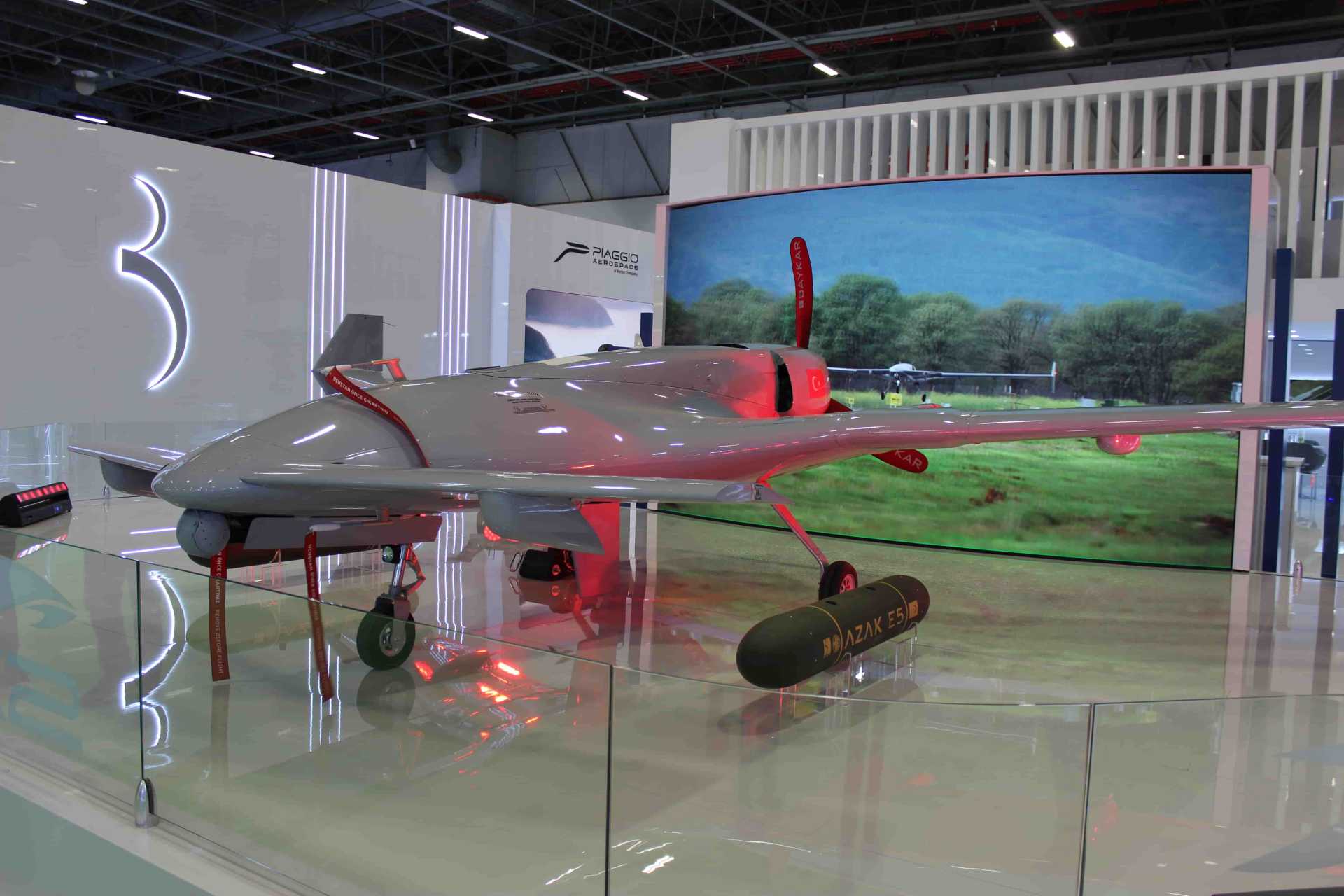
The Baykar K2 combines four key capabilities (long-range strike, heavy payload capacity, autonomous swarm coordination, and the ability to operate without GPS), allowing it to hit targets at long distances even in heavily jammed environments. (Picture source: Army Recognition)
On May 5, 2026, Baykar introduced the K2 Kamikaze UAV at SAHA 2026, held from May 5 to May 9, following a series of controlled demonstrations conducted at the Keşan Flight Training and Test Center in April 2026. The K2 is positioned by Baykar within a coordinated three-tier strike network composed of the heavy K2, the lighter Sivrisinek, and the medium Mizrak. This structure reflects lessons drawn from the operational use of Iranian Shahed drones between 2023 and 2025, where long-range one-way attack systems were employed at scale against fixed infrastructure targets.
The K2 differs from earlier expendable designs by combining characteristics of a loitering munition with extended endurance and a planned capability for post-strike recovery in certain mission profiles. Demonstration activities included combined swarm flights involving five K2 units, ten Sivrisinek munitions, and ISR and coordination support from Bayraktar TB2, TB3, and AKINCI aircraft. Therefore, the Baykar K2 emphasizes extended range, autonomous coordination, and the ability to maintain navigation and targeting under GNSS-denied conditions within a shared data network.
The K2 was first announced on March 14, 2026, followed by a full-scale swarm test on April 17, 2026. During this test at Keşan, five K2 UAVs conducted sequential takeoffs within approximately five minutes, and this formation later incorporated ten Sivrisinek loitering munitions operating at a lower altitude layer, while one TB2, one TB3, and one AKINCI provided ISR coverage and acted as communication relays. These drones then executed multiple formation geometries, including line, V, echelon, referred to as right ladder, and Turan configurations, each requiring different spacing and synchronization parameters.
The test sequence validated several operational functions, including navigation without GNSS input, autonomous maintenance of formation geometry, and coordinated engagement sequencing between different UAV classes. In the final phase, all participating drones formed an 18-unit composite formation, synchronizing multi-layer operations between heavy strike UAVs, expendable munitions, and ISR systems. The Baykar K2 kamikaze drone quadruples the capabilities of the Shahed-136, with an 800 kg maximum takeoff weight and a payload capacity of over 200 kg.
The Turkish drone also possesses a range exceeding 2,000 km and an endurance greater than 13 hours, allowing it to operate at extended distances without forward basing. Cruise speed is reported at 70 KTAS, equivalent to about 130 km/h, while maximum speed reaches 110 KTAS, or about 200 km/h, indicating a design trade-off favoring endurance over high-speed penetration. The UAV has a wingspan of 10 m and a fuselage length of 5.1 m. Powered by an internal combustion engine producing about 100 hp, the K2 reaches an operational altitude of 8,000 ft and a service ceiling of 10,000 ft, which places it below most high-altitude air defense engagement zones but within range of short- and medium-range systems.
Communication systems include line-of-sight data links exceeding 100 km and optional satellite connectivity for beyond-line-of-sight control, enabling extended mission control distances. Like many drones from Baykar, the K2 is capable of fully autonomous takeoff and landing, including operation from short or unprepared runways, which allows deployment from dispersed or temporary sites. The navigation architecture is structured to operate independently of GNSS signals, addressing vulnerabilities observed in environments with electronic warfare interference. The system uses AI-based visual terrain matching, combining EO/IR gimbal sensors with downward-facing cameras to perform continuous image correlation with stored terrain data.
This method allows the UAV to estimate its position and maintain course without relying on satellite-based navigation inputs. During demonstration flights, the system maintained stable navigation under simulated GNSS denial conditions, including scenarios involving jamming and spoofing. Targeting is conducted through two primary modes, consisting of pre-programmed coordinate strikes and terminal visual lock-on using onboard sensors. The dual-use sensor suite supports both reconnaissance and strike guidance functions, reducing the need for separate ISR assets in certain mission profiles. Data links are structured with redundancy between line-of-sight and satellite channels, ensuring continuity of communication even if one channel is disrupted.
The overall architecture is intended to reduce dependency on external navigation and communication systems while maintaining operational accuracy. Autonomy functions are integrated into all mission phases, with the system capable of executing pre-loaded mission profiles without continuous operator input. During testing, the UAV demonstrated the ability to generate route adjustments based on environmental conditions, including terrain and potential threat zones, indicating onboard decision-making capability. Emergency handling functions include automated responses to propulsion anomalies such as thrust degradation, allowing the UAV to continue the mission or transition to a contingency route.
Formation control is maintained through relative positioning algorithms that allow each UAV to track and adjust its position within the swarm in real time. The mission sequence follows a structured progression from launch and climb to formation integration, patrol, target assignment, and terminal dive. Once mission parameters are uploaded, engagement decisions can be executed autonomously within predefined rules, with human operators maintaining supervisory control through remote assets such as TB2. Sensor fusion integrates data from onboard sensors and mission software to support navigation, targeting, and coordination decisions across the flight profile.
Swarm operations demonstrated during the Keşan tests involved a heterogeneous structure combining K2 strike UAVs, Sivrisinek loitering munitions, and ISR platforms within a single operational network. Control is distributed across the swarm rather than centralized, allowing individual units to maintain formation and execute tasks even if communication with a central node is degraded. Each UAV uses relative positioning to maintain its place within the formation, adjusting dynamically as the formation changes shape. Task allocation is distributed across the swarm, with heavier K2 units assigned to high-value targets and Sivrisinek units operating as expendable strike elements.
Data sharing between units allows targeting information to be updated in real time, supporting coordinated engagement sequences. A Bayraktar TB2 UAV has been identified as a potential supervisory control node, capable of managing mission parameters and coordinating timing between different elements. The observed structure indicates an emphasis on redundancy and adaptability in multi-UAV operations, particularly in environments with degraded communications. Operational employment concepts for the K2 include both direct dive attacks and strike missions with the option of returning to base, with the latter capability still under development.
Demonstration flights included a scenario in which a K2 performed a high-speed dive toward a designated coordinate and then aborted the attack, indicating controlled engagement logic rather than fixed one-way behavior. Sivrisinek units executed coordinated dives on assigned targets, demonstrating their role as expendable elements designed for saturation and initial strike phases. Mission profiles include long-range strikes against fixed infrastructure targets and extended patrol operations with delayed engagement decisions.
The system is designed for use in contested airspace where navigation signals are unreliable or actively disrupted, requiring autonomous navigation and targeting capability. Deployment concepts emphasize dispersed basing, with the ability to operate from short or unprepared runways, allowing rapid repositioning across multiple sites. This approach reduces reliance on established airbases and increases survivability against counter-strike operations. The layered strike model integrates Sivrisinek, Mizrak, and K2 into a sequential engagement framework designed to degrade integrated air defense systems through cumulative effects.
In the initial phase, Sivrisinek units are deployed in large numbers to saturate air defenses and force activation of radar and interception systems, with unit costs estimated between $25,000 and $30,000, enabling high-volume use. The second phase introduces Mizrak systems, each carrying a payload of about 40 kg with a range of about 1,000 km, targeting air defense components that remain operational after the initial saturation. The final phase involves the deployment of K2 UAVs to engage high-value targets once defensive coverage has been reduced. Coordination of these phases is conducted remotely, with TB2 acting as a potential command node responsible for timing and target allocation.
The objective is the progressive degradation of integrated air defense networks through layered attacks that combine volume, precision, and endurance. This model reflects a shift toward coordinated multi-system operations rather than reliance on individual strike assets. The K2, with its complex AI, sensors, and larger frame, is estimated to cost between $60,000 and $100,000, while a simpler Shahed-136 costs roughly $20,000–$50,000 to produce. However, as Baykar CEO Haluk Bayraktar noted, this is still “1/50th the cost” of a Tomahawk cruise missile, making the K2 a much more cost-effective way to deliver a 200 kg warhead than traditional missiles.
Baykar reported UAV export revenues of about $2.2 billion in 2025, with approximately 90 percent of revenue derived from international markets. The company has established export agreements for the TB2 with 36 countries and for the AKINCI with 16 countries, providing an existing distribution network for new systems. The K2 is positioned as an additional system within this portfolio, extending capabilities from ISR and strike UAVs to include long-range loitering munition functions. Production is supported by a distributed industrial base capable of scaling output across multiple regions, including all 81 Turkish provinces, allowing parallel production of different UAV types for large-scale deployment in coordinated operations.
Written by Jérôme Brahy
Jérôme Brahy is a defense analyst and documentalist at Army Recognition. He specializes in naval modernization, aviation, drones, armored vehicles, and artillery, with a focus on strategic developments in the United States, China, Ukraine, Russia, Türkiye, and Belgium. His analyses go beyond the facts, providing context, identifying key actors, and explaining why defense news matters on a global scale.
{loadposition bannertop}
{loadposition sidebarpub}
Türkiye’s Baykar has presented the K2 kamikaze drone, a long-range strike UAV designed to operate in coordinated swarms with other unmanned systems, during SAHA 2026 after flight demonstrations in April 2026. The K2 signals a shift from single-use loitering munitions, like the Iranian Shahed, toward networked, multi-layer strike operations, offering greater survivability, resistance to electronic warfare, and the ability to overwhelm air defenses through coordinated attacks.
The K2 combines a payload exceeding 200 kg with more than 13 hours of endurance and a range over 2,000 km, while demonstrating AI-enabled swarm coordination and navigation without GNSS, allowing operations in heavily contested environments. Integrated into a three-tier strike model alongside lighter expendable drones and ISR platforms, it enables phased attacks that first saturate defenses and then deliver precision strikes on high-value targets, reflecting an evolution toward autonomous, distributed warfare systems.
Related topic: Türkiye Reveals Baykar K2 Loitering Munition for Long-Range Swarm Strike Missions
The Baykar K2 combines four key capabilities (long-range strike, heavy payload capacity, autonomous swarm coordination, and the ability to operate without GPS), allowing it to hit targets at long distances even in heavily jammed environments. (Picture source: Army Recognition)
On May 5, 2026, Baykar introduced the K2 Kamikaze UAV at SAHA 2026, held from May 5 to May 9, following a series of controlled demonstrations conducted at the Keşan Flight Training and Test Center in April 2026. The K2 is positioned by Baykar within a coordinated three-tier strike network composed of the heavy K2, the lighter Sivrisinek, and the medium Mizrak. This structure reflects lessons drawn from the operational use of Iranian Shahed drones between 2023 and 2025, where long-range one-way attack systems were employed at scale against fixed infrastructure targets.
The K2 differs from earlier expendable designs by combining characteristics of a loitering munition with extended endurance and a planned capability for post-strike recovery in certain mission profiles. Demonstration activities included combined swarm flights involving five K2 units, ten Sivrisinek munitions, and ISR and coordination support from Bayraktar TB2, TB3, and AKINCI aircraft. Therefore, the Baykar K2 emphasizes extended range, autonomous coordination, and the ability to maintain navigation and targeting under GNSS-denied conditions within a shared data network.
The K2 was first announced on March 14, 2026, followed by a full-scale swarm test on April 17, 2026. During this test at Keşan, five K2 UAVs conducted sequential takeoffs within approximately five minutes, and this formation later incorporated ten Sivrisinek loitering munitions operating at a lower altitude layer, while one TB2, one TB3, and one AKINCI provided ISR coverage and acted as communication relays. These drones then executed multiple formation geometries, including line, V, echelon, referred to as right ladder, and Turan configurations, each requiring different spacing and synchronization parameters.
The test sequence validated several operational functions, including navigation without GNSS input, autonomous maintenance of formation geometry, and coordinated engagement sequencing between different UAV classes. In the final phase, all participating drones formed an 18-unit composite formation, synchronizing multi-layer operations between heavy strike UAVs, expendable munitions, and ISR systems. The Baykar K2 kamikaze drone quadruples the capabilities of the Shahed-136, with an 800 kg maximum takeoff weight and a payload capacity of over 200 kg.
The Turkish drone also possesses a range exceeding 2,000 km and an endurance greater than 13 hours, allowing it to operate at extended distances without forward basing. Cruise speed is reported at 70 KTAS, equivalent to about 130 km/h, while maximum speed reaches 110 KTAS, or about 200 km/h, indicating a design trade-off favoring endurance over high-speed penetration. The UAV has a wingspan of 10 m and a fuselage length of 5.1 m. Powered by an internal combustion engine producing about 100 hp, the K2 reaches an operational altitude of 8,000 ft and a service ceiling of 10,000 ft, which places it below most high-altitude air defense engagement zones but within range of short- and medium-range systems.
Communication systems include line-of-sight data links exceeding 100 km and optional satellite connectivity for beyond-line-of-sight control, enabling extended mission control distances. Like many drones from Baykar, the K2 is capable of fully autonomous takeoff and landing, including operation from short or unprepared runways, which allows deployment from dispersed or temporary sites. The navigation architecture is structured to operate independently of GNSS signals, addressing vulnerabilities observed in environments with electronic warfare interference. The system uses AI-based visual terrain matching, combining EO/IR gimbal sensors with downward-facing cameras to perform continuous image correlation with stored terrain data.
This method allows the UAV to estimate its position and maintain course without relying on satellite-based navigation inputs. During demonstration flights, the system maintained stable navigation under simulated GNSS denial conditions, including scenarios involving jamming and spoofing. Targeting is conducted through two primary modes, consisting of pre-programmed coordinate strikes and terminal visual lock-on using onboard sensors. The dual-use sensor suite supports both reconnaissance and strike guidance functions, reducing the need for separate ISR assets in certain mission profiles. Data links are structured with redundancy between line-of-sight and satellite channels, ensuring continuity of communication even if one channel is disrupted.
The overall architecture is intended to reduce dependency on external navigation and communication systems while maintaining operational accuracy. Autonomy functions are integrated into all mission phases, with the system capable of executing pre-loaded mission profiles without continuous operator input. During testing, the UAV demonstrated the ability to generate route adjustments based on environmental conditions, including terrain and potential threat zones, indicating onboard decision-making capability. Emergency handling functions include automated responses to propulsion anomalies such as thrust degradation, allowing the UAV to continue the mission or transition to a contingency route.
Formation control is maintained through relative positioning algorithms that allow each UAV to track and adjust its position within the swarm in real time. The mission sequence follows a structured progression from launch and climb to formation integration, patrol, target assignment, and terminal dive. Once mission parameters are uploaded, engagement decisions can be executed autonomously within predefined rules, with human operators maintaining supervisory control through remote assets such as TB2. Sensor fusion integrates data from onboard sensors and mission software to support navigation, targeting, and coordination decisions across the flight profile.
Swarm operations demonstrated during the Keşan tests involved a heterogeneous structure combining K2 strike UAVs, Sivrisinek loitering munitions, and ISR platforms within a single operational network. Control is distributed across the swarm rather than centralized, allowing individual units to maintain formation and execute tasks even if communication with a central node is degraded. Each UAV uses relative positioning to maintain its place within the formation, adjusting dynamically as the formation changes shape. Task allocation is distributed across the swarm, with heavier K2 units assigned to high-value targets and Sivrisinek units operating as expendable strike elements.
Data sharing between units allows targeting information to be updated in real time, supporting coordinated engagement sequences. A Bayraktar TB2 UAV has been identified as a potential supervisory control node, capable of managing mission parameters and coordinating timing between different elements. The observed structure indicates an emphasis on redundancy and adaptability in multi-UAV operations, particularly in environments with degraded communications. Operational employment concepts for the K2 include both direct dive attacks and strike missions with the option of returning to base, with the latter capability still under development.
Demonstration flights included a scenario in which a K2 performed a high-speed dive toward a designated coordinate and then aborted the attack, indicating controlled engagement logic rather than fixed one-way behavior. Sivrisinek units executed coordinated dives on assigned targets, demonstrating their role as expendable elements designed for saturation and initial strike phases. Mission profiles include long-range strikes against fixed infrastructure targets and extended patrol operations with delayed engagement decisions.
The system is designed for use in contested airspace where navigation signals are unreliable or actively disrupted, requiring autonomous navigation and targeting capability. Deployment concepts emphasize dispersed basing, with the ability to operate from short or unprepared runways, allowing rapid repositioning across multiple sites. This approach reduces reliance on established airbases and increases survivability against counter-strike operations. The layered strike model integrates Sivrisinek, Mizrak, and K2 into a sequential engagement framework designed to degrade integrated air defense systems through cumulative effects.
In the initial phase, Sivrisinek units are deployed in large numbers to saturate air defenses and force activation of radar and interception systems, with unit costs estimated between $25,000 and $30,000, enabling high-volume use. The second phase introduces Mizrak systems, each carrying a payload of about 40 kg with a range of about 1,000 km, targeting air defense components that remain operational after the initial saturation. The final phase involves the deployment of K2 UAVs to engage high-value targets once defensive coverage has been reduced. Coordination of these phases is conducted remotely, with TB2 acting as a potential command node responsible for timing and target allocation.
The objective is the progressive degradation of integrated air defense networks through layered attacks that combine volume, precision, and endurance. This model reflects a shift toward coordinated multi-system operations rather than reliance on individual strike assets. The K2, with its complex AI, sensors, and larger frame, is estimated to cost between $60,000 and $100,000, while a simpler Shahed-136 costs roughly $20,000–$50,000 to produce. However, as Baykar CEO Haluk Bayraktar noted, this is still “1/50th the cost” of a Tomahawk cruise missile, making the K2 a much more cost-effective way to deliver a 200 kg warhead than traditional missiles.
Baykar reported UAV export revenues of about $2.2 billion in 2025, with approximately 90 percent of revenue derived from international markets. The company has established export agreements for the TB2 with 36 countries and for the AKINCI with 16 countries, providing an existing distribution network for new systems. The K2 is positioned as an additional system within this portfolio, extending capabilities from ISR and strike UAVs to include long-range loitering munition functions. Production is supported by a distributed industrial base capable of scaling output across multiple regions, including all 81 Turkish provinces, allowing parallel production of different UAV types for large-scale deployment in coordinated operations.
Written by Jérôme Brahy
Jérôme Brahy is a defense analyst and documentalist at Army Recognition. He specializes in naval modernization, aviation, drones, armored vehicles, and artillery, with a focus on strategic developments in the United States, China, Ukraine, Russia, Türkiye, and Belgium. His analyses go beyond the facts, providing context, identifying key actors, and explaining why defense news matters on a global scale.