U.S. Air Force Reveals First B-21 Bomber Aerial Refueling Tests Expanding Global Strike Reach
{loadposition bannertop}
{loadposition sidebarpub}
The U.S. Air Force is advancing B-21 Raider testing at Edwards AFB, successfully integrating aerial refueling operations. This milestone strengthens the bomber’s long-range strike capability, a core pillar of U.S. strategic deterrence.
Recent flight tests, conducted with Northrop Grumman, mark a critical phase in validating the B-21’s endurance and global reach profile. Aerial refueling integration confirms the aircraft’s ability to sustain extended missions across contested theaters, a key requirement for penetrating strike operations. The program continues to emphasize concurrent testing and development, aiming to compress timelines while maintaining full system integration. These efforts suggest the Raider is progressing steadily toward initial operational capability later this decade.Related topic: U.S. Considers Accelerating B-21 Raider Bomber Production with Second Assembly Line
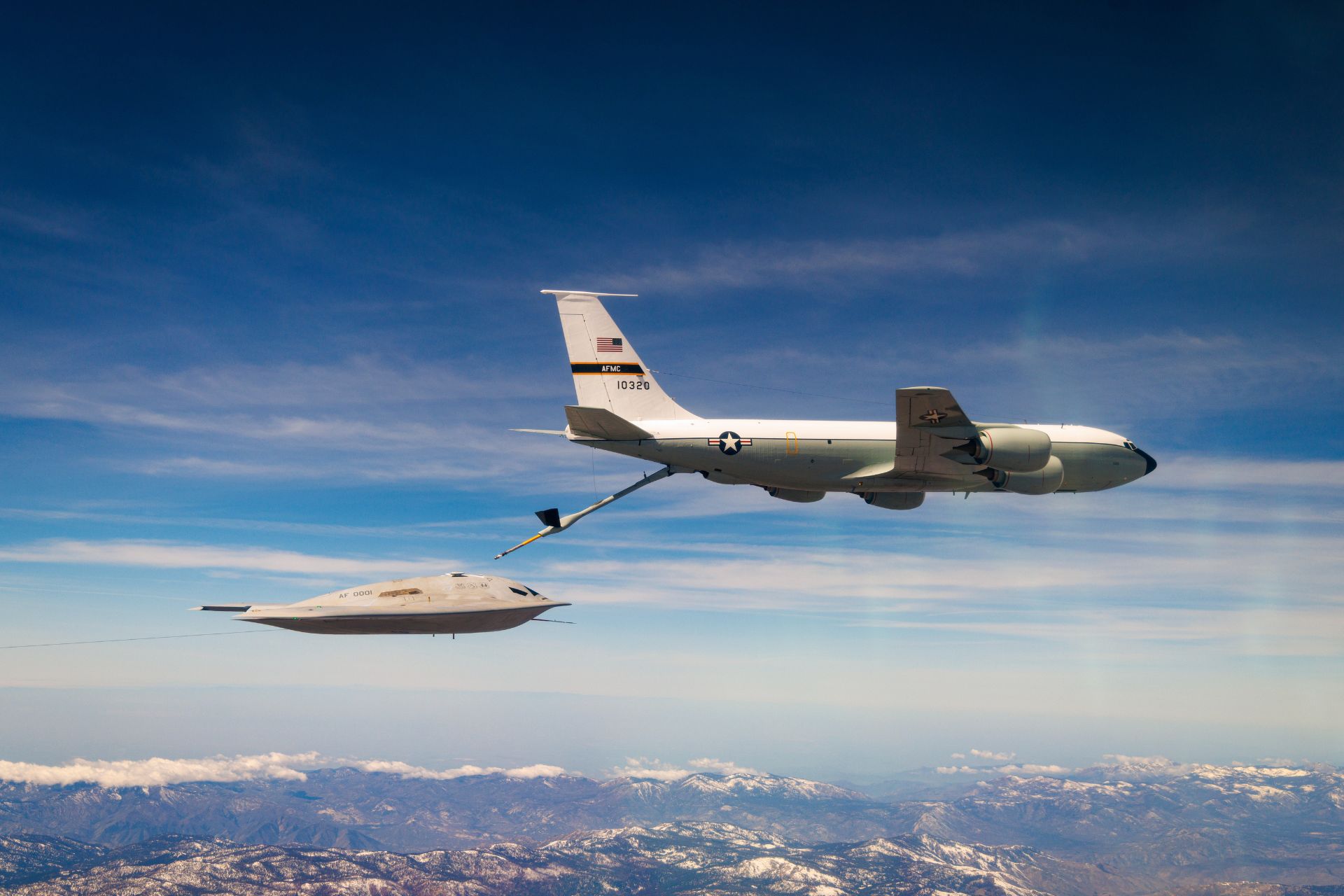
A B-21 Raider Bomber refuels from a KC-135 Stratotanker as part of testing to validate long-range penetrating strike capability and extend global operational reach. (Picture source: US DoD)
Aerial refueling trials involving a KC-135 Stratotanker have become a central element of this campaign. The KC-135 Stratotanker, a long-serving aerial refueling aircraft capable of transferring more than 90,000 kilograms of fuel depending on mission configuration, enables extended sortie duration and supports long-range strike profiles. During these tests, the B-21 connects via a dorsal receptacle located behind the cockpit, a configuration that differs from the rotating system used on the B-2 Spirit. Released imagery shows a two-piece clamshell door arrangement, suggesting refinements aimed at limiting radar signature while maintaining mechanical simplicity, consistent with low observable design requirements.
The U.S. Air Force confirmed on April 14, 2026, in an official statement accompanied by test imagery, that the B-21 successfully conducted aerial refueling operations as part of its ongoing evaluation program at Edwards Air Force Base. These tests are carried out jointly with Northrop Grumman and are intended to validate the aircraft’s performance envelope while reducing technical risk ahead of operational deployment. The announcement also highlighted the use of digital engineering and modern production processes designed to accelerate delivery timelines while ensuring system maturity.
The test campaign also provides insight into the aircraft’s aerodynamic configuration and sensor integration. Photographs show air data ports positioned forward of the cockpit, typical of early flight test instrumentation, along with air intake geometries that appear optimized for both stealth and engine efficiency. The Raider builds on the flying-wing configuration introduced with the B-2 while incorporating refinements in shaping and radar cross-section control through updated radar-absorbing materials and composite structures. Its slightly smaller size contributes to improved cost efficiency and maneuverability while maintaining low observability across a wide range of radar frequencies.
Fuel efficiency represents another defining characteristic. According to U.S. Air Force officials, the B-21 consumes substantially less fuel than legacy bombers such as the B-1B Lancer and B-52H Stratofortress. This reduction has direct operational implications. Lower fuel consumption reduces reliance on tanker support, which remains a constrained asset within the force structure. In practical terms, fewer refueling missions are required to sustain long-range operations, allowing tanker aircraft to be allocated to other tasks across multiple theaters.
The propulsion and performance envelope support this emphasis on endurance. The B-21 is expected to be powered by two stealth-optimized engines, likely derived from the Pratt & Whitney F-135 family, each generating more than 11,000 kilograms of thrust while limiting infrared and radar signatures. This configuration supports a cruising speed of around 870 kilometers per hour and a maximum speed near 1,050 kilometers per hour. With an estimated range of approximately 12,000 kilometers and a payload capacity between 12 and 13 tons, the aircraft is designed to conduct intercontinental missions with a high degree of autonomy.
Armament reflects the dual conventional and nuclear role assigned to the aircraft. The B-21 can carry B61 and B83 nuclear gravity bombs as well as the Long Range Stand Off (LRSO) nuclear cruise missile. For conventional missions, it is compatible with Joint Direct Attack Munition (JDAM) and Joint Air-to-Surface Standoff Missile (JASSM), along with the GBU-57 Massive Ordnance Penetrator (MOP), designed to engage deeply buried and hardened targets. Internal weapons bays are also expected to accommodate future systems, including hypersonic weapons, consistent with a design focused on long-term adaptability.
Avionics and mission systems contribute to survivability in contested environments. The B-21 integrates multi-sensor fusion, combining radar, infrared, and electronic warfare inputs into a unified operational picture. Its electronic warfare suite is designed to disrupt and degrade adversary air defense systems, including modern surface-to-air missile networks. Open-architecture software supports rapid updates and integration of new capabilities without major structural modifications, reducing upgrade timelines and enabling continuous adaptation.
The industrial dimension of the program is evolving in parallel. The U.S. Air Force maintains an official objective of at least 100 aircraft, although internal assessments indicate that a larger fleet could be required as threat environments evolve. In this context, the recent decision to increase production capacity by approximately 25 percent is primarily intended to accelerate delivery, with initial operational deployment expected around 2027. At the same time, this increase in production tempo creates the conditions for a potential expansion of the fleet in the future, should operational requirements evolve.
The program timeline indicates that the first operational aircraft will be delivered to Ellsworth Air Force Base in South Dakota around 2027, where infrastructure upgrades are already underway to support its arrival. These preparations include runway modifications and facilities adapted to low-observable maintenance requirements, reflecting a coordinated transition toward operational service.
Compared with existing U.S. bomber assets, the introduction of the B-21 is expected to alter force structure and employment concepts. Unlike the B-2 Spirit, which remains limited in number, and the B-52H, which lacks low observable characteristics, the B-21 combines reduced detectability with a design intended for larger-scale production. This combination supports a shift toward a more flexible and distributed long-range strike capability. As the aircraft enters service, it is likely to expand the range of options available to U.S. decision-makers by enabling sustained operations in contested environments while reducing dependence on legacy systems that face increasing limitations against modern air defense networks.
Written By Erwan Halna du Fretay – Defense Analyst, Army Recognition GroupErwan Halna du Fretay holds a Master’s degree in International Relations and has experience studying conflicts and global arms transfers. His research interests lie in security and strategic studies, particularly the dynamics of the defense industry, the evolution of military technologies, and the strategic transformation of armed forces.
{loadposition bannertop}
{loadposition sidebarpub}
The U.S. Air Force is advancing B-21 Raider testing at Edwards AFB, successfully integrating aerial refueling operations. This milestone strengthens the bomber’s long-range strike capability, a core pillar of U.S. strategic deterrence.
Recent flight tests, conducted with Northrop Grumman, mark a critical phase in validating the B-21’s endurance and global reach profile. Aerial refueling integration confirms the aircraft’s ability to sustain extended missions across contested theaters, a key requirement for penetrating strike operations. The program continues to emphasize concurrent testing and development, aiming to compress timelines while maintaining full system integration. These efforts suggest the Raider is progressing steadily toward initial operational capability later this decade.
Related topic: U.S. Considers Accelerating B-21 Raider Bomber Production with Second Assembly Line
Aerial refueling trials involving a KC-135 Stratotanker have become a central element of this campaign. The KC-135 Stratotanker, a long-serving aerial refueling aircraft capable of transferring more than 90,000 kilograms of fuel depending on mission configuration, enables extended sortie duration and supports long-range strike profiles. During these tests, the B-21 connects via a dorsal receptacle located behind the cockpit, a configuration that differs from the rotating system used on the B-2 Spirit. Released imagery shows a two-piece clamshell door arrangement, suggesting refinements aimed at limiting radar signature while maintaining mechanical simplicity, consistent with low observable design requirements.
The U.S. Air Force confirmed on April 14, 2026, in an official statement accompanied by test imagery, that the B-21 successfully conducted aerial refueling operations as part of its ongoing evaluation program at Edwards Air Force Base. These tests are carried out jointly with Northrop Grumman and are intended to validate the aircraft’s performance envelope while reducing technical risk ahead of operational deployment. The announcement also highlighted the use of digital engineering and modern production processes designed to accelerate delivery timelines while ensuring system maturity.
The test campaign also provides insight into the aircraft’s aerodynamic configuration and sensor integration. Photographs show air data ports positioned forward of the cockpit, typical of early flight test instrumentation, along with air intake geometries that appear optimized for both stealth and engine efficiency. The Raider builds on the flying-wing configuration introduced with the B-2 while incorporating refinements in shaping and radar cross-section control through updated radar-absorbing materials and composite structures. Its slightly smaller size contributes to improved cost efficiency and maneuverability while maintaining low observability across a wide range of radar frequencies.
Fuel efficiency represents another defining characteristic. According to U.S. Air Force officials, the B-21 consumes substantially less fuel than legacy bombers such as the B-1B Lancer and B-52H Stratofortress. This reduction has direct operational implications. Lower fuel consumption reduces reliance on tanker support, which remains a constrained asset within the force structure. In practical terms, fewer refueling missions are required to sustain long-range operations, allowing tanker aircraft to be allocated to other tasks across multiple theaters.
The propulsion and performance envelope support this emphasis on endurance. The B-21 is expected to be powered by two stealth-optimized engines, likely derived from the Pratt & Whitney F-135 family, each generating more than 11,000 kilograms of thrust while limiting infrared and radar signatures. This configuration supports a cruising speed of around 870 kilometers per hour and a maximum speed near 1,050 kilometers per hour. With an estimated range of approximately 12,000 kilometers and a payload capacity between 12 and 13 tons, the aircraft is designed to conduct intercontinental missions with a high degree of autonomy.
Armament reflects the dual conventional and nuclear role assigned to the aircraft. The B-21 can carry B61 and B83 nuclear gravity bombs as well as the Long Range Stand Off (LRSO) nuclear cruise missile. For conventional missions, it is compatible with Joint Direct Attack Munition (JDAM) and Joint Air-to-Surface Standoff Missile (JASSM), along with the GBU-57 Massive Ordnance Penetrator (MOP), designed to engage deeply buried and hardened targets. Internal weapons bays are also expected to accommodate future systems, including hypersonic weapons, consistent with a design focused on long-term adaptability.
Avionics and mission systems contribute to survivability in contested environments. The B-21 integrates multi-sensor fusion, combining radar, infrared, and electronic warfare inputs into a unified operational picture. Its electronic warfare suite is designed to disrupt and degrade adversary air defense systems, including modern surface-to-air missile networks. Open-architecture software supports rapid updates and integration of new capabilities without major structural modifications, reducing upgrade timelines and enabling continuous adaptation.
The industrial dimension of the program is evolving in parallel. The U.S. Air Force maintains an official objective of at least 100 aircraft, although internal assessments indicate that a larger fleet could be required as threat environments evolve. In this context, the recent decision to increase production capacity by approximately 25 percent is primarily intended to accelerate delivery, with initial operational deployment expected around 2027. At the same time, this increase in production tempo creates the conditions for a potential expansion of the fleet in the future, should operational requirements evolve.
The program timeline indicates that the first operational aircraft will be delivered to Ellsworth Air Force Base in South Dakota around 2027, where infrastructure upgrades are already underway to support its arrival. These preparations include runway modifications and facilities adapted to low-observable maintenance requirements, reflecting a coordinated transition toward operational service.
Compared with existing U.S. bomber assets, the introduction of the B-21 is expected to alter force structure and employment concepts. Unlike the B-2 Spirit, which remains limited in number, and the B-52H, which lacks low observable characteristics, the B-21 combines reduced detectability with a design intended for larger-scale production. This combination supports a shift toward a more flexible and distributed long-range strike capability. As the aircraft enters service, it is likely to expand the range of options available to U.S. decision-makers by enabling sustained operations in contested environments while reducing dependence on legacy systems that face increasing limitations against modern air defense networks.
Written By Erwan Halna du Fretay – Defense Analyst, Army Recognition Group
Erwan Halna du Fretay holds a Master’s degree in International Relations and has experience studying conflicts and global arms transfers. His research interests lie in security and strategic studies, particularly the dynamics of the defense industry, the evolution of military technologies, and the strategic transformation of armed forces.