U.S. Approves 70 New AIM-120C-8 AMRAAM Missiles to Strengthen South Korea Air Defense
{loadposition bannertop}
{loadposition sidebarpub}
The United States has approved a possible $292 million sale of AIM-120C-8 AMRAAM missiles to South Korea, announced on June 10, 2026, giving Seoul a stronger beyond-visual-range air combat option against regional air threats. The package would expand the Republic of Korea Air Force’s stock of modern interceptors for defensive counter-air missions over and around the Korean Peninsula.
The proposed sale includes 70 AIM-120C-8 missiles, guidance sections, support equipment, training, and logistics assistance, with RTX Corporation listed as the principal contractor. Beyond adding missiles, the deal strengthens South Korea’s air defense readiness and reflects a wider effort to build deeper precision-munitions reserves for a high-intensity regional conflict.
Related topic: Belgium emerges as top candidate for US AIM-120 AMRAAM missile co-production in Europe.
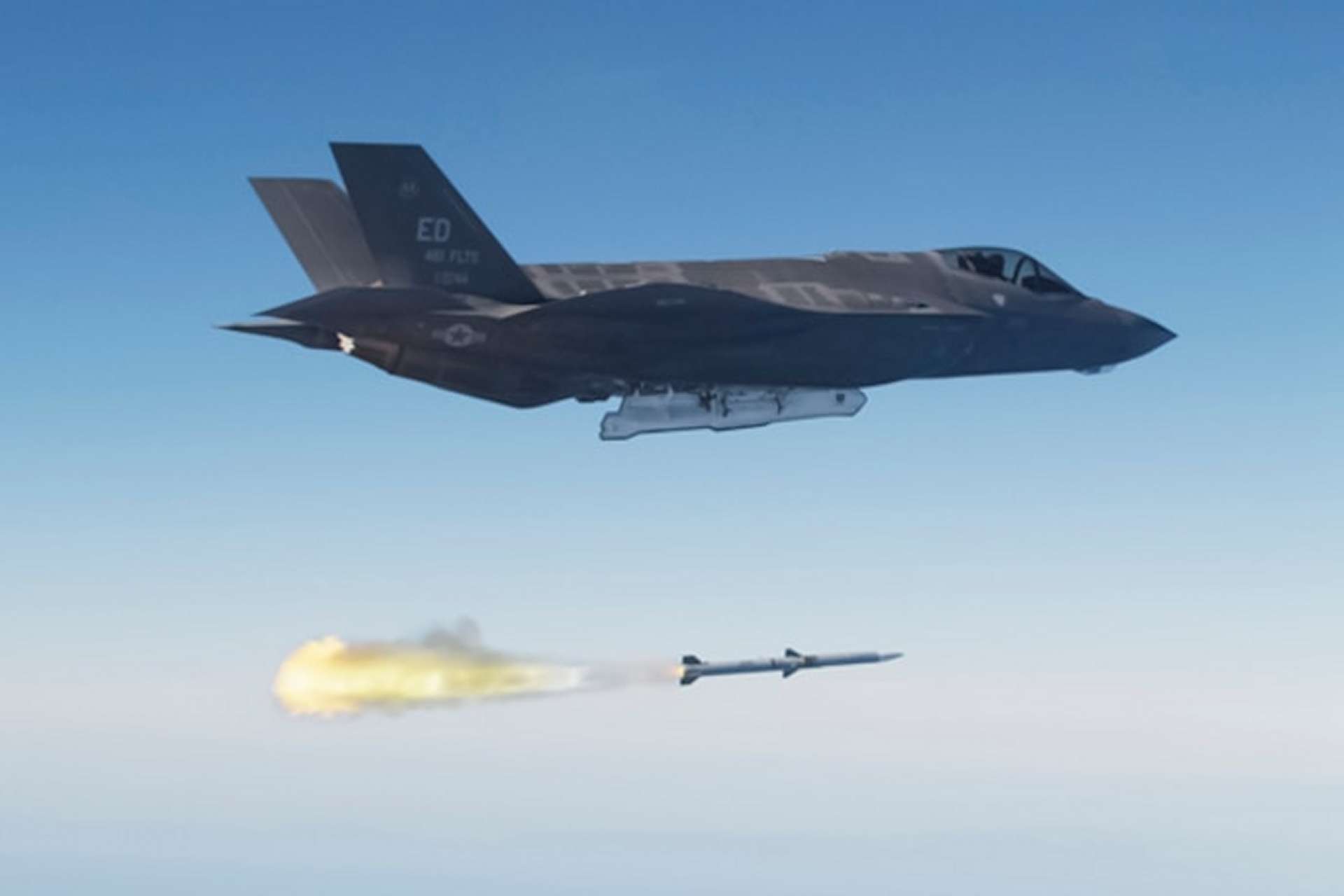
The United States has approved a possible $292 million sale of 70 AIM-120C-8 AMRAAM air-to-air missiles to South Korea, strengthening the Republic of Korea Air Force’s beyond-visual-range interception capability against aircraft, cruise-missile carriers, and other airborne threats near the Korean Peninsula (Picture source: U.S. DoW).
In October 2019, Washington approved a separate South Korean request for 120 AIM-120C-7/C-8 missiles at an estimated $253 million, explicitly for the F-15K, KF-16, and F-35 fleets. In December 2023, another F-35 munitions package included 39 AIM-120C-8 missiles and two guidance sections as part of a broader $271 million request that also covered JDAMs, Paveway II components, GBU-39 Small Diameter Bombs, and GBU-53 StormBreaker glide bombs. The 2026 request, therefore, brings the number of AIM-120C-series missiles approved for South Korea in these three publicly notified cases to 229, although Foreign Military Sale notifications state maximum estimated quantities and do not by themselves confirm final delivery numbers.
The AIM-120C-8 is the current international-production configuration of the AMRAAM family and derives its value from guidance, datalink, and endgame autonomy rather than from airframe size. The U.S. Air Force lists the AIM-120 as a 143.9-inch, 335-pound missile with a 7-inch body diameter, 20.7-inch wingspan, blast-fragmentation warhead, solid-rocket propulsion, inertial midcourse guidance, and active radar terminal homing. Its official public range remains listed only as “20+ miles,” a deliberately conservative figure that does not describe the classified engagement zones of later variants. In practice, missile reach depends on launch altitude, aircraft speed, target heading, target maneuver, electronic warfare conditions, and how long the missile can receive useful midcourse updates before its own radar seeker takes over.
The C-8 configuration is important because it is associated with the Form, Fit, Function Refresh program, known as F3R, which modernizes the guidance section by updating circuit cards, processors, and software architecture. Raytheon and the U.S. Air Force announced the first flight test of the AIM-120C-8 in September 2023, describing it as the latest international AMRAAM variant. The same modernization line also supports the U.S. AIM-120D-3, and U.S. reporting indicates that the F3R effort was intended to re-host legacy software while allowing future software changes to be introduced more rapidly. For South Korea, this matters because the missile will not only be a stock replacement item; it provides a path for better resistance to electronic countermeasures, improved flight management, and more relevant threat libraries as North Korean and regional air threats change.
The tactical function of the AIM-120C-8 is to give a fighter pilot a beyond-visual-range intercept option that does not require continuous radar illumination by the launching aircraft until impact. The missile can be launched using target data from the fighter’s radar and mission systems, fly an inertial course with updates during midcourse flight, and then activate its own radar seeker in the terminal phase. That sequence allows a South Korean F-35A, F-15K, or KF-16 pilot to change heading, descend, support another engagement, or defend against incoming missiles after launch. The AMRAAM is designed for look-down/shoot-down engagements, multiple launches against multiple targets, resistance to electronic countermeasures, and interception of high-, low-, and maneuvering targets. Those characteristics are directly relevant to Korean air defense, where targets may include combat aircraft, stand-off weapon carriers, low-flying cruise missiles, or aircraft attempting to exploit terrain and compressed warning times.
South Korea’s requirement is shaped by geography as much as by aircraft inventories. The distance between North Korean launch areas and South Korean population centers, ports, headquarters, and air bases is short, leaving little room for a slow transition from surveillance to engagement. Air bases such as Cheongju, Daegu, Suwon, and Seosan would be central to any sustained air campaign, but they are also fixed targets for missiles, long-range artillery rockets, special operations forces, and unmanned aerial vehicles. Additional AMRAAM stocks increase the number of fighters that can be generated with combat loads during a crisis and reduce the risk that early salvos, training consumption, or maintenance withdrawals quickly deplete the missile inventory.
The North Korean air threat is not limited to modern fighter aircraft. The Korean People’s Army Air and Air-Defence Force still relies heavily on older Soviet- and Chinese-origin aircraft, but quantity, dispersal, and surprise remain relevant in the opening phase of a conflict. Open-source estimates continue to assign North Korea several hundred combat aircraft, including MiG-29 fighters, MiG-23 fighters, Su-25 attack aircraft, and older MiG-21 and Chinese-derived aircraft. Many would be vulnerable to South Korean and U.S. fighters, but they could still force sorties, consume missiles, complicate identification, and provide cover for missile or drone attacks. The more immediate operational problem is the integration of those aircraft with cruise missiles, tactical ballistic missiles, artillery rockets, electronic warfare, and unmanned systems. In May 2026, North Korea tested tactical ballistic missiles, artillery rockets, and AI-guided precision cruise missiles, reinforcing the need for South Korea to maintain both ground-based and airborne interception capacity.
For the Republic of Korea Air Force, the AIM-120C-8 also improves the division of labor inside a layered defense network. Ground-based systems such as Patriot and Cheongung-II are essential against ballistic and aerodynamic threats, but they cannot substitute for fighters that can patrol forward, identify aircraft, engage before weapons release, and shift rapidly between the Yellow Sea, the Seoul metropolitan approaches, and the East Sea. A fighter armed with AMRAAM can force an adversary aircraft to maneuver defensively before it reaches launch range, which may be as important as destroying it. In practical terms, this reduces pressure on ground-based interceptors and helps protect high-value aircraft such as airborne early warning and control aircraft, tankers, electronic-intelligence aircraft, and strike fighters moving toward North Korean missile and command targets.
The sale also supports combined U.S.–South Korean operations by keeping a common missile family across allied aircraft. U.S. Air Force F-16s and F-35As operating in Korea, South Korean F-35As, KF-16s, and F-15Ks, and future South Korean fighter integration work all benefit from common stock management, training procedures, mission planning assumptions, and electronic-order-of-battle updates. This is especially relevant as Seoul expands its F-35A inventory: South Korea selected the F-35A in 2014, received its first aircraft for permanent basing at Cheongju in 2019, and announced an additional 20 aircraft in 2023. The missile request, therefore, aligns with aircraft procurement rather than standing apart from it.
The operational value of the 2026 package is concrete but bounded. Seventy AIM-120C-8 missiles will not change the peninsula’s military balance by themselves, and the U.S. notification uses the standard formula that the sale will not alter the regional balance. What it does is increase the number of modern, active-radar air-to-air missiles available to South Korean fighter units, add guidance sections and support capacity, and align the Republic of Korea Air Force munitions with newer AMRAAM production standards. For Seoul, this is a rational acquisition: North Korea is increasing the density and variety of its missile and aerial threats, while South Korea’s deterrence depends on keeping air bases open, protecting command aircraft, and preserving the ability to conduct defensive and offensive air operations after the first exchange. The AIM-120C-8 does not solve all of those problems, but it improves one measurable part of the kill chain: the probability that South Korean fighters can detect, engage, and disrupt airborne threats before those threats release weapons against defended territory.
Explore More Defense News
• Land Defense News• Naval Defense News• Defense Aerospace News
Written by Evan Lerouvillois, Defense Analyst.
Evan studied International Relations, and quickly specialized in defense and security. He is particularly interested in the influence of the defense sector on global geopolitics, and analyzes how technological innovations in defense, arms export contracts, and military strategies influence the international geopolitical scene.
{loadposition bannertop}
{loadposition sidebarpub}
The United States has approved a possible $292 million sale of AIM-120C-8 AMRAAM missiles to South Korea, announced on June 10, 2026, giving Seoul a stronger beyond-visual-range air combat option against regional air threats. The package would expand the Republic of Korea Air Force’s stock of modern interceptors for defensive counter-air missions over and around the Korean Peninsula.
The proposed sale includes 70 AIM-120C-8 missiles, guidance sections, support equipment, training, and logistics assistance, with RTX Corporation listed as the principal contractor. Beyond adding missiles, the deal strengthens South Korea’s air defense readiness and reflects a wider effort to build deeper precision-munitions reserves for a high-intensity regional conflict.
Related topic: Belgium emerges as top candidate for US AIM-120 AMRAAM missile co-production in Europe.
The United States has approved a possible $292 million sale of 70 AIM-120C-8 AMRAAM air-to-air missiles to South Korea, strengthening the Republic of Korea Air Force’s beyond-visual-range interception capability against aircraft, cruise-missile carriers, and other airborne threats near the Korean Peninsula (Picture source: U.S. DoW).
In October 2019, Washington approved a separate South Korean request for 120 AIM-120C-7/C-8 missiles at an estimated $253 million, explicitly for the F-15K, KF-16, and F-35 fleets. In December 2023, another F-35 munitions package included 39 AIM-120C-8 missiles and two guidance sections as part of a broader $271 million request that also covered JDAMs, Paveway II components, GBU-39 Small Diameter Bombs, and GBU-53 StormBreaker glide bombs. The 2026 request, therefore, brings the number of AIM-120C-series missiles approved for South Korea in these three publicly notified cases to 229, although Foreign Military Sale notifications state maximum estimated quantities and do not by themselves confirm final delivery numbers.
The AIM-120C-8 is the current international-production configuration of the AMRAAM family and derives its value from guidance, datalink, and endgame autonomy rather than from airframe size. The U.S. Air Force lists the AIM-120 as a 143.9-inch, 335-pound missile with a 7-inch body diameter, 20.7-inch wingspan, blast-fragmentation warhead, solid-rocket propulsion, inertial midcourse guidance, and active radar terminal homing. Its official public range remains listed only as “20+ miles,” a deliberately conservative figure that does not describe the classified engagement zones of later variants. In practice, missile reach depends on launch altitude, aircraft speed, target heading, target maneuver, electronic warfare conditions, and how long the missile can receive useful midcourse updates before its own radar seeker takes over.
The C-8 configuration is important because it is associated with the Form, Fit, Function Refresh program, known as F3R, which modernizes the guidance section by updating circuit cards, processors, and software architecture. Raytheon and the U.S. Air Force announced the first flight test of the AIM-120C-8 in September 2023, describing it as the latest international AMRAAM variant. The same modernization line also supports the U.S. AIM-120D-3, and U.S. reporting indicates that the F3R effort was intended to re-host legacy software while allowing future software changes to be introduced more rapidly. For South Korea, this matters because the missile will not only be a stock replacement item; it provides a path for better resistance to electronic countermeasures, improved flight management, and more relevant threat libraries as North Korean and regional air threats change.
The tactical function of the AIM-120C-8 is to give a fighter pilot a beyond-visual-range intercept option that does not require continuous radar illumination by the launching aircraft until impact. The missile can be launched using target data from the fighter’s radar and mission systems, fly an inertial course with updates during midcourse flight, and then activate its own radar seeker in the terminal phase. That sequence allows a South Korean F-35A, F-15K, or KF-16 pilot to change heading, descend, support another engagement, or defend against incoming missiles after launch. The AMRAAM is designed for look-down/shoot-down engagements, multiple launches against multiple targets, resistance to electronic countermeasures, and interception of high-, low-, and maneuvering targets. Those characteristics are directly relevant to Korean air defense, where targets may include combat aircraft, stand-off weapon carriers, low-flying cruise missiles, or aircraft attempting to exploit terrain and compressed warning times.
South Korea’s requirement is shaped by geography as much as by aircraft inventories. The distance between North Korean launch areas and South Korean population centers, ports, headquarters, and air bases is short, leaving little room for a slow transition from surveillance to engagement. Air bases such as Cheongju, Daegu, Suwon, and Seosan would be central to any sustained air campaign, but they are also fixed targets for missiles, long-range artillery rockets, special operations forces, and unmanned aerial vehicles. Additional AMRAAM stocks increase the number of fighters that can be generated with combat loads during a crisis and reduce the risk that early salvos, training consumption, or maintenance withdrawals quickly deplete the missile inventory.
The North Korean air threat is not limited to modern fighter aircraft. The Korean People’s Army Air and Air-Defence Force still relies heavily on older Soviet- and Chinese-origin aircraft, but quantity, dispersal, and surprise remain relevant in the opening phase of a conflict. Open-source estimates continue to assign North Korea several hundred combat aircraft, including MiG-29 fighters, MiG-23 fighters, Su-25 attack aircraft, and older MiG-21 and Chinese-derived aircraft. Many would be vulnerable to South Korean and U.S. fighters, but they could still force sorties, consume missiles, complicate identification, and provide cover for missile or drone attacks. The more immediate operational problem is the integration of those aircraft with cruise missiles, tactical ballistic missiles, artillery rockets, electronic warfare, and unmanned systems. In May 2026, North Korea tested tactical ballistic missiles, artillery rockets, and AI-guided precision cruise missiles, reinforcing the need for South Korea to maintain both ground-based and airborne interception capacity.
For the Republic of Korea Air Force, the AIM-120C-8 also improves the division of labor inside a layered defense network. Ground-based systems such as Patriot and Cheongung-II are essential against ballistic and aerodynamic threats, but they cannot substitute for fighters that can patrol forward, identify aircraft, engage before weapons release, and shift rapidly between the Yellow Sea, the Seoul metropolitan approaches, and the East Sea. A fighter armed with AMRAAM can force an adversary aircraft to maneuver defensively before it reaches launch range, which may be as important as destroying it. In practical terms, this reduces pressure on ground-based interceptors and helps protect high-value aircraft such as airborne early warning and control aircraft, tankers, electronic-intelligence aircraft, and strike fighters moving toward North Korean missile and command targets.
The sale also supports combined U.S.–South Korean operations by keeping a common missile family across allied aircraft. U.S. Air Force F-16s and F-35As operating in Korea, South Korean F-35As, KF-16s, and F-15Ks, and future South Korean fighter integration work all benefit from common stock management, training procedures, mission planning assumptions, and electronic-order-of-battle updates. This is especially relevant as Seoul expands its F-35A inventory: South Korea selected the F-35A in 2014, received its first aircraft for permanent basing at Cheongju in 2019, and announced an additional 20 aircraft in 2023. The missile request, therefore, aligns with aircraft procurement rather than standing apart from it.
The operational value of the 2026 package is concrete but bounded. Seventy AIM-120C-8 missiles will not change the peninsula’s military balance by themselves, and the U.S. notification uses the standard formula that the sale will not alter the regional balance. What it does is increase the number of modern, active-radar air-to-air missiles available to South Korean fighter units, add guidance sections and support capacity, and align the Republic of Korea Air Force munitions with newer AMRAAM production standards. For Seoul, this is a rational acquisition: North Korea is increasing the density and variety of its missile and aerial threats, while South Korea’s deterrence depends on keeping air bases open, protecting command aircraft, and preserving the ability to conduct defensive and offensive air operations after the first exchange. The AIM-120C-8 does not solve all of those problems, but it improves one measurable part of the kill chain: the probability that South Korean fighters can detect, engage, and disrupt airborne threats before those threats release weapons against defended territory.
Explore More Defense News
• Land Defense News
• Naval Defense News
• Defense Aerospace News
Written by Evan Lerouvillois, Defense Analyst.
Evan studied International Relations, and quickly specialized in defense and security. He is particularly interested in the influence of the defense sector on global geopolitics, and analyzes how technological innovations in defense, arms export contracts, and military strategies influence the international geopolitical scene.