Airbus Bird of Prey Drone Fires Frankenburg’s Mark I Missile in First Airborne Counter-Drone Test
{loadposition bannertop}
{loadposition sidebarpub}
On 30 March 2026, Airbus announced that its Bird of Prey interceptor drone had completed its first demonstration flight in northern Germany, marking a step in the evolution of counter-unmanned aerial systems. The test, which involved Frankenburg Technologies’ ultra-light Mark I missile, reflects ongoing efforts by European and NATO forces to address the proliferation of low-cost one-way attack drones with more cost-effective interception solutions.
The event also appears to mark the first time the Frankenburg Mark I has been fired from an airborne platform, giving the demonstration significance beyond a routine manufacturer milestone. By combining an uncrewed platform with a lightweight guided missile, the demonstration points to the emergence of mobile and scalable counter-UAS capabilities adapted to increasingly saturated threat environments.
Read also: Poland Emerging as Mass Production Hub for Estonia’s Frankenburg Mark I Anti-Drone Missiles
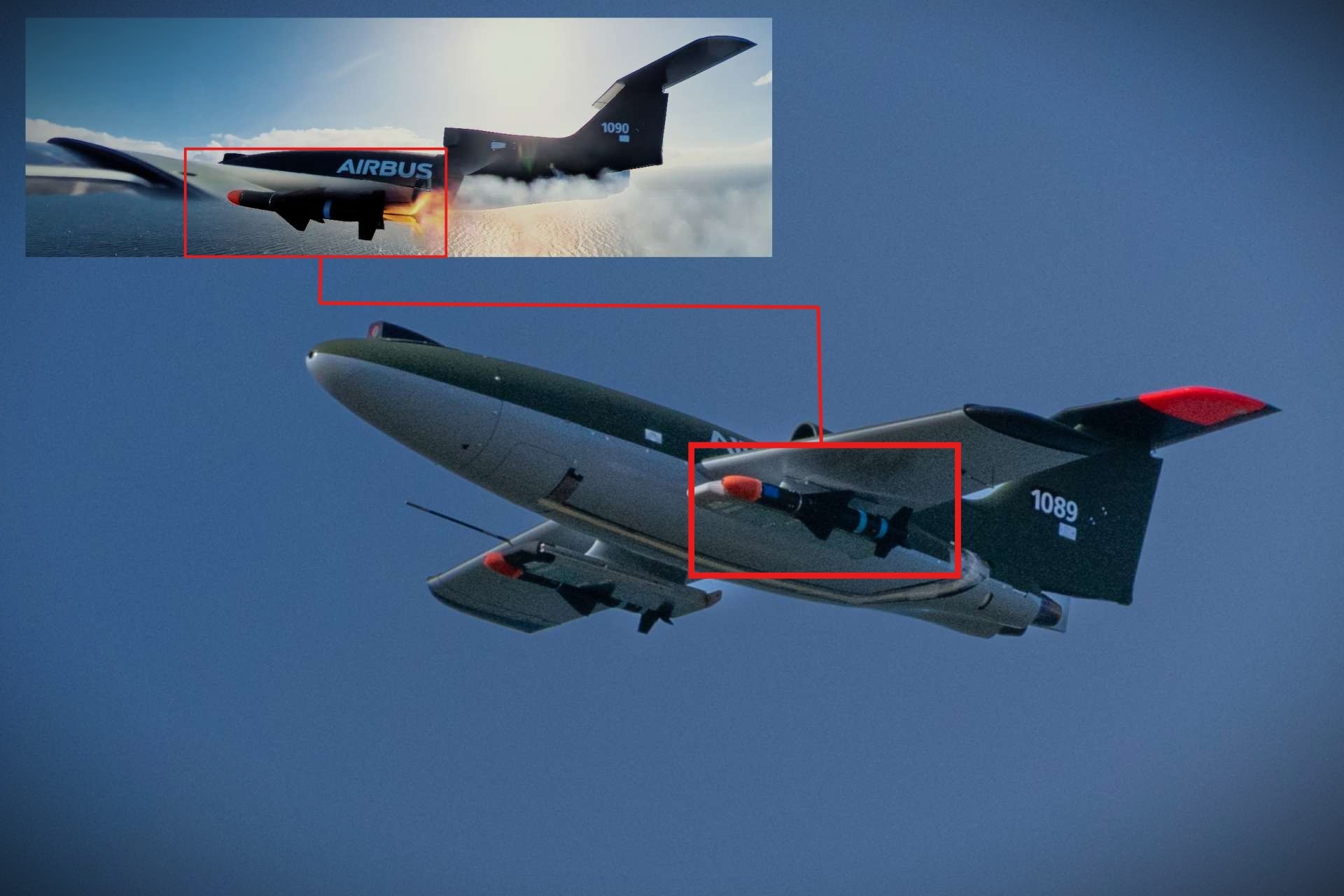
Airbus demonstrated its Bird of Prey interceptor drone using Mark I missile to autonomously detect and destroy a simulated kamikaze UAV, showcasing a lower-cost approach to countering mass drone threats (Picture Source: Airbus)
In the scenario described by Airbus, Bird of Prey autonomously searched for, detected, and classified a medium-sized one-way attack drone before engaging it with a Mark I air-to-air missile. That sequence is important because it shows more than a simple flight test or missile-release demonstration. It instead points to the maturation of a compact airborne counter-UAS kill chain in which sensing, classification, and hard-kill response are compressed into one mobile platform, reducing reaction times and potentially easing operator workload in situations where saturation attacks leave little time for manual engagement decisions. In practical terms, this shifts the event from a basic counter-UAS trial to an early proof point for an airborne interception layer able to respond faster than more traditionally cued short-range defences against time-sensitive drone threats.
The speed of the programme is itself part of the story. Airbus says the demonstration took place only nine months after the project began, a notably compressed timeline by defence aerospace standards and one that reflects the urgency now driving counter-drone adaptation across Europe. Rather than waiting for a clean-sheet programme, Airbus built the prototype around a modified Do-DT25 drone, a platform that in Bird of Prey form has a wingspan of 2.5 metres, a length of 3.1 metres, and a maximum take-off weight of 160 kilograms. This approach indicates an industrial preference for the rapid repurposing of existing aerial systems in order to field useful capabilities faster, an increasingly common response to the pace at which drone warfare is evolving. The development also fits into Airbus’ broader work on low-cost interceptor concepts, including the LOAD demonstrator unveiled in 2025, which had already pointed to reusable airborne effectors as a way to reduce the cost of defeating low-end aerial threats.
The missile dimension is central to the concept’s relevance. Airbus says the prototype carried four Mark I missiles, while the future operational version is expected to carry up to eight, immediately giving the system a multi-shot logic that is essential in counter-drone defence. The Mark I is presented as a high-subsonic, fire-and-forget interceptor with a range of up to 1.5 kilometres, a length of around 65 centimetres, and a weight of under 2 kilograms, making it the lightest guided interceptor developed to date, according to Airbus. That technical profile matters because it reveals a weapon optimised less for prestige performance than for short-range, repeated engagements against low-cost aerial threats.
Frankenburg itself has publicly framed its missile philosophy around systems that are far more affordable and faster to manufacture than traditional missiles, while Army Recognition recently reported that Poland’s PGZ and Frankenburg Technologies had launched cooperation around Mark I production, with a planned facility capable of manufacturing up to 10,000 missiles annually, an element that reinforces the industrial scalability behind the interceptor concept. This also appears to have been the first airborne firing of the Mark I, reinforcing the importance of the demonstration as both a missile milestone and a system-integration milestone. This industrial dimension is crucial because a low-cost interceptor only becomes strategically meaningful if it can be produced in sufficient volume to sustain repeated use during prolonged drone-intensive operations, rather than remaining a niche capability.
Tactically, Bird of Prey addresses the problem that has become one of the defining asymmetries of current air defence: the defender is too often forced to spend far more on the intercept than the attacker spends on the drone. In Ukraine, in the Middle East, and in other theatres shaped by massed unmanned threats, this imbalance has turned the economics of air defence into an operational issue in its own right. Airbus is therefore targeting a real capability gap when it presents Bird of Prey and the Mark I as an affordable interceptor pairing. The significance lies not only in the ability to shoot down a drone, but in the prospect of doing so without consuming high-end surface-to-air missiles designed for more demanding targets.
Seen in layered-defence terms, Bird of Prey is not intended to replace higher-end ground-based air-defence assets, but to preserve their missile inventories for cruise missiles, aircraft, helicopters, or other threats for which premium interceptors remain necessary. In that respect, the reported Polish production effort around Mark I adds an important industrial dimension, because a low-cost interceptor concept becomes strategically more credible when it is backed by prospects for European mass production rather than limited production.
That cost logic is reinforced by the reusable nature of the Bird of Prey platform. Airbus explicitly says the system is intended to engage and neutralise multiple kamikaze drones per mission at a comparatively low cost per kill, which gives it a potentially valuable place between traditional ground-based short-range air defence and expendable interceptors. In operational terms, such a system could be deployed to protect manoeuvre units, forward operating positions, logistics nodes, temporary headquarters, or other high-value assets that require mobile defence but do not justify the permanent commitment of larger missile batteries. The concept therefore suggests an airborne protective layer that can be moved rapidly, rearmed after sortie recovery, and used repeatedly in high-tempo environments. That makes the concept particularly relevant for forces seeking a mobile outer or intermediate defensive layer that can be repositioned quickly as drone threat axes shift across the battlefield.
Its strategic importance also depends on integration rather than platform performance alone. Airbus states that Bird of Prey is designed to operate within NATO’s integrated air-defence architecture through established command-and-control systems centred on Airbus’ Fortion IBMS. Airbus describes IBMS as an open-architecture battle management and fire-control software environment supporting counter-sUAS, VSHORAD, SHORAD, and MRAD systems. That matters because it means Bird of Prey is being positioned not as an isolated drone with missiles, but as a networked effector that can shorten the sensor-to-shooter chain and fit into wider national or allied layered air and missile defence structures. For procurement authorities, that kind of architectural compatibility is often as decisive as the raw performance of the interceptor itself. This networked dimension is one of the programme’s strongest selling points because it suggests Bird of Prey could be introduced as an additional effector inside existing defensive architectures rather than as a standalone solution requiring a separate command ecosystem.
The geopolitical backdrop makes the timing of the demonstration particularly significant. Armed forces across Europe are rebuilding very short-range and short-range air-defence layers after years in which many armies prioritised expeditionary operations over homeland protection and force protection against mass drone attacks. The wars in Ukraine and the Middle East have underlined how fixed installations, rear-area logistics, ammunition depots, troop concentrations, and mobile formations can all be threatened by relatively inexpensive one-way attack drones launched in large numbers. In that environment, a low-cost airborne interceptor carrying multiple ultra-light guided missiles corresponds to a broader doctrinal shift toward distributed, networked, and scalable defence rather than exclusive dependence on a smaller number of premium effectors. In that sense, the reported Polish production effort around the Mark I also fits a wider eastern-flank logic in which interceptor availability, stockpile resilience, and regional manufacturing capacity become nearly as important as raw missile performance.
Airbus and Frankenburg have already indicated the next stage by announcing additional flights with a live warhead throughout 2026 in order to further operationalise the system and demonstrate its full capabilities to potential customers. That caveat remains important, because the concept still has to prove itself in more demanding conditions, especially against denser raid profiles and under the pressure of realistic operational constraints. The next rounds of testing will therefore matter not only for validating lethality, but also for showing whether the concept can retain its economic and operational relevance against denser raids, more complex targeting environments, and repeated engagements over time. Even so, Bird of Prey already stands out as more than a demonstrator. Airbus is positioning it as part of a new generation of affordable, layered, and mobile air-defence tools designed for a battlefield where the decisive issue is no longer only whether a threat can be intercepted, but whether it can be intercepted repeatedly, quickly, and at a sustainable economic cost.
Written by Teoman S. Nicanci – Defense Analyst, Army Recognition Group
Teoman S. Nicanci holds degrees in Political Science, Comparative and International Politics, and International Relations and Diplomacy from leading Belgian universities, with research focused on Russian strategic behavior, defense technology, and modern warfare. He is a defense analyst at Army Recognition, specializing in the global defense industry, military armament, and emerging defense technologies.
{loadposition bannertop}
{loadposition sidebarpub}
On 30 March 2026, Airbus announced that its Bird of Prey interceptor drone had completed its first demonstration flight in northern Germany, marking a step in the evolution of counter-unmanned aerial systems. The test, which involved Frankenburg Technologies’ ultra-light Mark I missile, reflects ongoing efforts by European and NATO forces to address the proliferation of low-cost one-way attack drones with more cost-effective interception solutions.
The event also appears to mark the first time the Frankenburg Mark I has been fired from an airborne platform, giving the demonstration significance beyond a routine manufacturer milestone. By combining an uncrewed platform with a lightweight guided missile, the demonstration points to the emergence of mobile and scalable counter-UAS capabilities adapted to increasingly saturated threat environments.
Read also: Poland Emerging as Mass Production Hub for Estonia’s Frankenburg Mark I Anti-Drone Missiles
Airbus demonstrated its Bird of Prey interceptor drone using Mark I missile to autonomously detect and destroy a simulated kamikaze UAV, showcasing a lower-cost approach to countering mass drone threats (Picture Source: Airbus)
In the scenario described by Airbus, Bird of Prey autonomously searched for, detected, and classified a medium-sized one-way attack drone before engaging it with a Mark I air-to-air missile. That sequence is important because it shows more than a simple flight test or missile-release demonstration. It instead points to the maturation of a compact airborne counter-UAS kill chain in which sensing, classification, and hard-kill response are compressed into one mobile platform, reducing reaction times and potentially easing operator workload in situations where saturation attacks leave little time for manual engagement decisions. In practical terms, this shifts the event from a basic counter-UAS trial to an early proof point for an airborne interception layer able to respond faster than more traditionally cued short-range defences against time-sensitive drone threats.
The speed of the programme is itself part of the story. Airbus says the demonstration took place only nine months after the project began, a notably compressed timeline by defence aerospace standards and one that reflects the urgency now driving counter-drone adaptation across Europe. Rather than waiting for a clean-sheet programme, Airbus built the prototype around a modified Do-DT25 drone, a platform that in Bird of Prey form has a wingspan of 2.5 metres, a length of 3.1 metres, and a maximum take-off weight of 160 kilograms. This approach indicates an industrial preference for the rapid repurposing of existing aerial systems in order to field useful capabilities faster, an increasingly common response to the pace at which drone warfare is evolving. The development also fits into Airbus’ broader work on low-cost interceptor concepts, including the LOAD demonstrator unveiled in 2025, which had already pointed to reusable airborne effectors as a way to reduce the cost of defeating low-end aerial threats.
The missile dimension is central to the concept’s relevance. Airbus says the prototype carried four Mark I missiles, while the future operational version is expected to carry up to eight, immediately giving the system a multi-shot logic that is essential in counter-drone defence. The Mark I is presented as a high-subsonic, fire-and-forget interceptor with a range of up to 1.5 kilometres, a length of around 65 centimetres, and a weight of under 2 kilograms, making it the lightest guided interceptor developed to date, according to Airbus. That technical profile matters because it reveals a weapon optimised less for prestige performance than for short-range, repeated engagements against low-cost aerial threats.
Frankenburg itself has publicly framed its missile philosophy around systems that are far more affordable and faster to manufacture than traditional missiles, while Army Recognition recently reported that Poland’s PGZ and Frankenburg Technologies had launched cooperation around Mark I production, with a planned facility capable of manufacturing up to 10,000 missiles annually, an element that reinforces the industrial scalability behind the interceptor concept. This also appears to have been the first airborne firing of the Mark I, reinforcing the importance of the demonstration as both a missile milestone and a system-integration milestone. This industrial dimension is crucial because a low-cost interceptor only becomes strategically meaningful if it can be produced in sufficient volume to sustain repeated use during prolonged drone-intensive operations, rather than remaining a niche capability.
Tactically, Bird of Prey addresses the problem that has become one of the defining asymmetries of current air defence: the defender is too often forced to spend far more on the intercept than the attacker spends on the drone. In Ukraine, in the Middle East, and in other theatres shaped by massed unmanned threats, this imbalance has turned the economics of air defence into an operational issue in its own right. Airbus is therefore targeting a real capability gap when it presents Bird of Prey and the Mark I as an affordable interceptor pairing. The significance lies not only in the ability to shoot down a drone, but in the prospect of doing so without consuming high-end surface-to-air missiles designed for more demanding targets.
Seen in layered-defence terms, Bird of Prey is not intended to replace higher-end ground-based air-defence assets, but to preserve their missile inventories for cruise missiles, aircraft, helicopters, or other threats for which premium interceptors remain necessary. In that respect, the reported Polish production effort around Mark I adds an important industrial dimension, because a low-cost interceptor concept becomes strategically more credible when it is backed by prospects for European mass production rather than limited production.
That cost logic is reinforced by the reusable nature of the Bird of Prey platform. Airbus explicitly says the system is intended to engage and neutralise multiple kamikaze drones per mission at a comparatively low cost per kill, which gives it a potentially valuable place between traditional ground-based short-range air defence and expendable interceptors. In operational terms, such a system could be deployed to protect manoeuvre units, forward operating positions, logistics nodes, temporary headquarters, or other high-value assets that require mobile defence but do not justify the permanent commitment of larger missile batteries. The concept therefore suggests an airborne protective layer that can be moved rapidly, rearmed after sortie recovery, and used repeatedly in high-tempo environments. That makes the concept particularly relevant for forces seeking a mobile outer or intermediate defensive layer that can be repositioned quickly as drone threat axes shift across the battlefield.
Its strategic importance also depends on integration rather than platform performance alone. Airbus states that Bird of Prey is designed to operate within NATO’s integrated air-defence architecture through established command-and-control systems centred on Airbus’ Fortion IBMS. Airbus describes IBMS as an open-architecture battle management and fire-control software environment supporting counter-sUAS, VSHORAD, SHORAD, and MRAD systems. That matters because it means Bird of Prey is being positioned not as an isolated drone with missiles, but as a networked effector that can shorten the sensor-to-shooter chain and fit into wider national or allied layered air and missile defence structures. For procurement authorities, that kind of architectural compatibility is often as decisive as the raw performance of the interceptor itself. This networked dimension is one of the programme’s strongest selling points because it suggests Bird of Prey could be introduced as an additional effector inside existing defensive architectures rather than as a standalone solution requiring a separate command ecosystem.
The geopolitical backdrop makes the timing of the demonstration particularly significant. Armed forces across Europe are rebuilding very short-range and short-range air-defence layers after years in which many armies prioritised expeditionary operations over homeland protection and force protection against mass drone attacks. The wars in Ukraine and the Middle East have underlined how fixed installations, rear-area logistics, ammunition depots, troop concentrations, and mobile formations can all be threatened by relatively inexpensive one-way attack drones launched in large numbers. In that environment, a low-cost airborne interceptor carrying multiple ultra-light guided missiles corresponds to a broader doctrinal shift toward distributed, networked, and scalable defence rather than exclusive dependence on a smaller number of premium effectors. In that sense, the reported Polish production effort around the Mark I also fits a wider eastern-flank logic in which interceptor availability, stockpile resilience, and regional manufacturing capacity become nearly as important as raw missile performance.
Airbus and Frankenburg have already indicated the next stage by announcing additional flights with a live warhead throughout 2026 in order to further operationalise the system and demonstrate its full capabilities to potential customers. That caveat remains important, because the concept still has to prove itself in more demanding conditions, especially against denser raid profiles and under the pressure of realistic operational constraints. The next rounds of testing will therefore matter not only for validating lethality, but also for showing whether the concept can retain its economic and operational relevance against denser raids, more complex targeting environments, and repeated engagements over time. Even so, Bird of Prey already stands out as more than a demonstrator. Airbus is positioning it as part of a new generation of affordable, layered, and mobile air-defence tools designed for a battlefield where the decisive issue is no longer only whether a threat can be intercepted, but whether it can be intercepted repeatedly, quickly, and at a sustainable economic cost.
Written by Teoman S. Nicanci – Defense Analyst, Army Recognition Group
Teoman S. Nicanci holds degrees in Political Science, Comparative and International Politics, and International Relations and Diplomacy from leading Belgian universities, with research focused on Russian strategic behavior, defense technology, and modern warfare. He is a defense analyst at Army Recognition, specializing in the global defense industry, military armament, and emerging defense technologies.