Germany Partners with Australia to Deploy MQ-28 Ghost Bat Combat Drone by 2029
{loadposition bannertop}
{loadposition sidebarpub}
Rheinmetall and Boeing Defence Australia have partnered to push the MQ-28 Ghost Bat into Germany’s CCA program. The move accelerates Berlin’s push to field uncrewed combat aircraft while preserving domestic industrial control.
The agreement positions the Australian-developed MQ-28 Ghost Bat Drone as a leading candidate for Germany’s future Collaborative Combat Aircraft, with a projected entry into service around 2029. Rheinmetall will lead system integration and in-country sustainment, aligning with Germany’s sovereignty requirements, while Boeing brings a flight-tested platform already demonstrated with the Royal Australian Air Force. The partnership reflects a broader shift toward loyal wingman concepts designed to operate alongside crewed fighters such as the Eurofighter and future FCAS assets.
Read Also: Germany Evaluates MQ-28 Ghost Bat as Loyal Wingman to Support Existing Eurofighter Fleet Operations
Rheinmetall and Boeing push MQ-28 Ghost Bat for Germany’s CCA program, targeting uncrewed combat capability by 2029. (Picture source: Boeing Defence Australia)
The MQ-28 Ghost Bat, developed in Australia over nearly a decade, represents one of the most mature examples of a loyal wingman concept currently available. Designed to operate in conjunction with crewed fighter aircraft, it extends sensor reach and increases survivability by distributing tasks across multiple assets. The German requirement for CCA capabilities emerges in parallel with broader modernization efforts within the Luftwaffe, including the integration of F-35A aircraft and the Future Combat Air System (FCAS) program. Against this backdrop, the Rheinmetall Boeing partnership seeks to offer a solution that can be fielded more rapidly, while still allowing adaptation to national command structures and mission needs.
Announced on March 31, 2026, by Rheinmetall, the agreement formalizes the respective roles of both partners and outlines the industrial logic behind the proposal. Rheinmetall is designated as system integrator, a position that carries both technical and strategic weight within the German defence ecosystem. The company is tasked with ensuring compatibility between the MQ-28 and existing German command-and-control architectures, including secure data links and mission management systems. This includes integration into NATO-aligned networks, where interoperability and cyber resilience remain essential. At the same time, Rheinmetall is expected to establish a domestic support structure covering maintenance, logistics, and software updates, reinforcing supply security and national autonomy. The creation of a German-based engineering environment, shared with Australian teams, also points to a continuous development model rather than a fixed configuration.
The MQ-28 Ghost Bat Autonomous collaborative combat aircraft combines several features that explain its positioning as a ready solution. The aircraft has completed more than 150 test flights, demonstrating a level of maturity that reduces development risk for potential users. It measures approximately 11.7 meters in length with a wingspan of 7.3 meters and a maximum take-off weight close to 3,175 kilograms, placing it in a category compatible with dispersed and expeditionary operations. Its range exceeds 2,000 nautical miles, or more than 3,700 kilometers, allowing it to operate at extended distances from its launch base, which is critical for missions in contested environments. The drone is powered by a single turbofan engine and can reach speeds approaching Mach 0.9, while operating at altitudes above 40,000 feet, giving it performance characteristics aligned with fast-jet formations. In addition, its modular nose section allows rapid reconfiguration depending on mission requirements, whether for intelligence, surveillance, and reconnaissance (ISR), electronic warfare, or strike roles. This modularity also facilitates the integration of national payloads, a key requirement for Germany.
Autonomy remains central to the MQ-28’s concept of operations. The system is designed to execute tasks with limited human intervention, relying on onboard algorithms to navigate, coordinate with other assets, and respond to threats. Communication with crewed aircraft is maintained through secure data links, enabling real-time exchange of targeting data and mission updates. At the same time, the architecture allows for incremental software upgrades, which can introduce new behaviors or capabilities without requiring major hardware modifications. The aircraft can also fuse sensor and payload data from multiple cooperating assets, effectively acting as a forward node within a broader combat network and supporting early warning or targeting functions for the formation.
The MQ-28 is intended to act as a force multiplier within a networked air combat environment. It can accompany crewed fighters into contested airspace, performing forward sensing tasks that would otherwise expose pilots to risk. By extending the sensor envelope, it enables earlier detection of adversary systems, including radar emissions and airborne threats. The aircraft can also carry electronic warfare payloads, contributing to the suppression of enemy air defenses by jamming or deceiving hostile sensors. In a strike configuration, it may deliver precision-guided munitions against ground targets, coordinated with crewed aircraft to achieve synchronized effects. Its ability to operate with minimal additional workload for pilots reinforces its role as an enabler of distributed air operations, where multiple assets cooperate to saturate and confuse adversary defenses.
This partnership reflects a deeper and evolving pattern of defence cooperation between Germany and Australia. Over the past decade, Rheinmetall has established a strong industrial footprint in Australia, notably through the Boxer Combat Reconnaissance Vehicle program, under which more than 200 vehicles are being produced locally in Queensland. The Boxer, an 8×8 armored vehicle equipped with a modular mission system and typically armed with a 30 mm cannon, offers high mobility, protection against mines and improvised explosive devices, and advanced digital architecture for networked operations. This program has already demonstrated how German defence technology can be adapted to Australian requirements while building a sovereign industrial base. In parallel, Canberra has shown increasing interest in accessing European defence markets and technologies, particularly as it seeks to diversify its partnerships beyond the Indo-Pacific.
The MQ-28 cooperation can be seen as a reciprocal dynamic, where Australian-developed airpower capabilities enter the European defence ecosystem through a German industrial anchor. For Germany, this approach reduces development timelines and introduces a tested solution into a rapidly evolving operational environment. For Australia, it opens pathways into the European market, leveraging Rheinmetall’s position within NATO supply chains and procurement frameworks. More broadly, the deployment of collaborative combat aircraft such as the MQ-28 points to a structural transformation in air warfare, where distributed, human-machine teaming becomes central to maintaining air superiority. As these systems mature and proliferate, they are likely to redefine force structures, procurement priorities, and alliance interoperability across both the Euro-Atlantic and Indo-Pacific theatres.
Written By Erwan Halna du Fretay – Defense Analyst, Army Recognition GroupErwan Halna du Fretay holds a Master’s degree in International Relations and has experience studying conflicts and global arms transfers. His research interests lie in security and strategic studies, particularly the dynamics of the defense industry, the evolution of military technologies, and the strategic transformation of armed forces.
{loadposition bannertop}
{loadposition sidebarpub}
Rheinmetall and Boeing Defence Australia have partnered to push the MQ-28 Ghost Bat into Germany’s CCA program. The move accelerates Berlin’s push to field uncrewed combat aircraft while preserving domestic industrial control.
The agreement positions the Australian-developed MQ-28 Ghost Bat Drone as a leading candidate for Germany’s future Collaborative Combat Aircraft, with a projected entry into service around 2029. Rheinmetall will lead system integration and in-country sustainment, aligning with Germany’s sovereignty requirements, while Boeing brings a flight-tested platform already demonstrated with the Royal Australian Air Force. The partnership reflects a broader shift toward loyal wingman concepts designed to operate alongside crewed fighters such as the Eurofighter and future FCAS assets.
Read Also: Germany Evaluates MQ-28 Ghost Bat as Loyal Wingman to Support Existing Eurofighter Fleet Operations
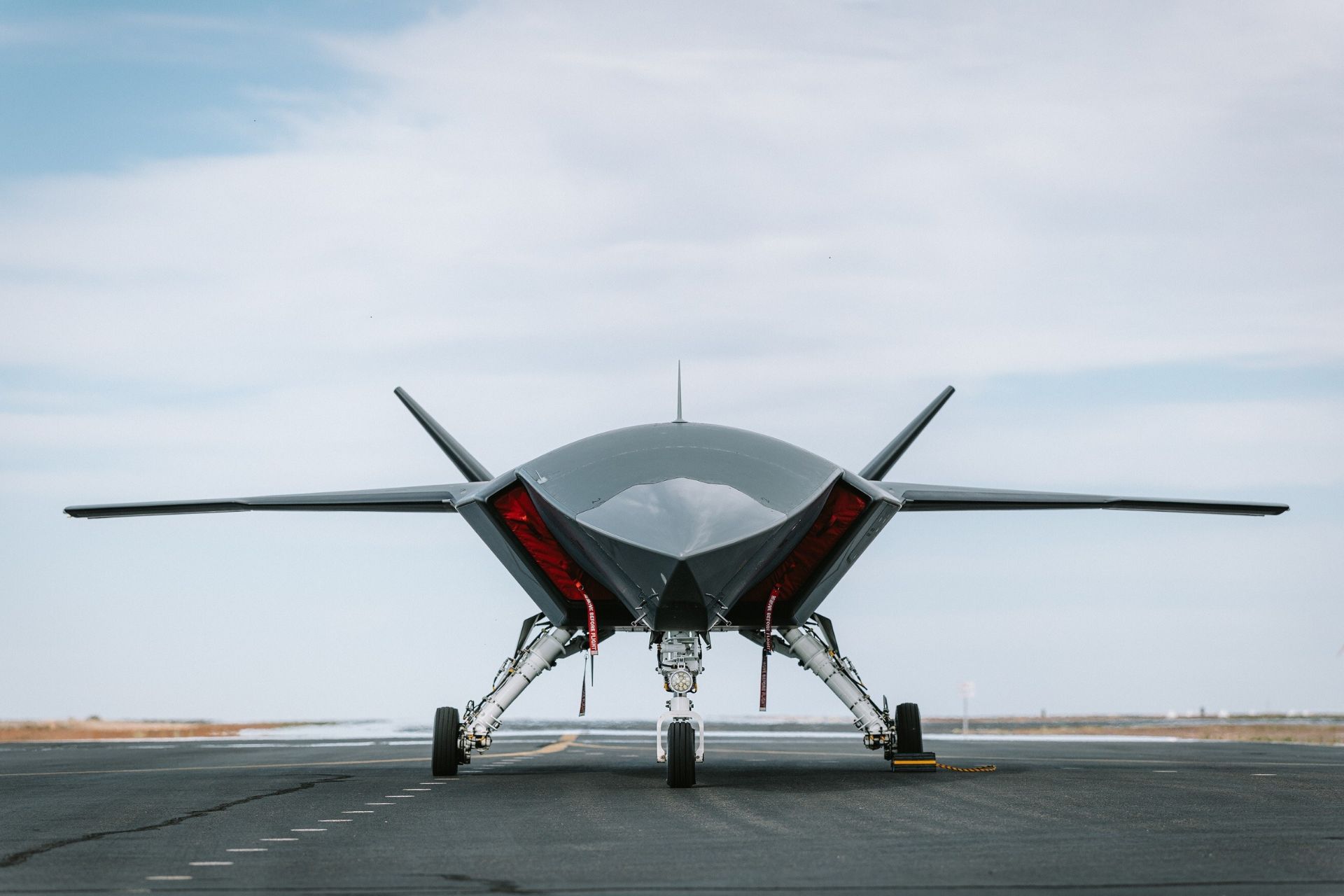
Rheinmetall and Boeing push MQ-28 Ghost Bat for Germany’s CCA program, targeting uncrewed combat capability by 2029. (Picture source: Boeing Defence Australia)
The MQ-28 Ghost Bat, developed in Australia over nearly a decade, represents one of the most mature examples of a loyal wingman concept currently available. Designed to operate in conjunction with crewed fighter aircraft, it extends sensor reach and increases survivability by distributing tasks across multiple assets. The German requirement for CCA capabilities emerges in parallel with broader modernization efforts within the Luftwaffe, including the integration of F-35A aircraft and the Future Combat Air System (FCAS) program. Against this backdrop, the Rheinmetall Boeing partnership seeks to offer a solution that can be fielded more rapidly, while still allowing adaptation to national command structures and mission needs.
Announced on March 31, 2026, by Rheinmetall, the agreement formalizes the respective roles of both partners and outlines the industrial logic behind the proposal. Rheinmetall is designated as system integrator, a position that carries both technical and strategic weight within the German defence ecosystem. The company is tasked with ensuring compatibility between the MQ-28 and existing German command-and-control architectures, including secure data links and mission management systems. This includes integration into NATO-aligned networks, where interoperability and cyber resilience remain essential. At the same time, Rheinmetall is expected to establish a domestic support structure covering maintenance, logistics, and software updates, reinforcing supply security and national autonomy. The creation of a German-based engineering environment, shared with Australian teams, also points to a continuous development model rather than a fixed configuration.
The MQ-28 Ghost Bat Autonomous collaborative combat aircraft combines several features that explain its positioning as a ready solution. The aircraft has completed more than 150 test flights, demonstrating a level of maturity that reduces development risk for potential users. It measures approximately 11.7 meters in length with a wingspan of 7.3 meters and a maximum take-off weight close to 3,175 kilograms, placing it in a category compatible with dispersed and expeditionary operations. Its range exceeds 2,000 nautical miles, or more than 3,700 kilometers, allowing it to operate at extended distances from its launch base, which is critical for missions in contested environments. The drone is powered by a single turbofan engine and can reach speeds approaching Mach 0.9, while operating at altitudes above 40,000 feet, giving it performance characteristics aligned with fast-jet formations. In addition, its modular nose section allows rapid reconfiguration depending on mission requirements, whether for intelligence, surveillance, and reconnaissance (ISR), electronic warfare, or strike roles. This modularity also facilitates the integration of national payloads, a key requirement for Germany.
Autonomy remains central to the MQ-28’s concept of operations. The system is designed to execute tasks with limited human intervention, relying on onboard algorithms to navigate, coordinate with other assets, and respond to threats. Communication with crewed aircraft is maintained through secure data links, enabling real-time exchange of targeting data and mission updates. At the same time, the architecture allows for incremental software upgrades, which can introduce new behaviors or capabilities without requiring major hardware modifications. The aircraft can also fuse sensor and payload data from multiple cooperating assets, effectively acting as a forward node within a broader combat network and supporting early warning or targeting functions for the formation.
The MQ-28 is intended to act as a force multiplier within a networked air combat environment. It can accompany crewed fighters into contested airspace, performing forward sensing tasks that would otherwise expose pilots to risk. By extending the sensor envelope, it enables earlier detection of adversary systems, including radar emissions and airborne threats. The aircraft can also carry electronic warfare payloads, contributing to the suppression of enemy air defenses by jamming or deceiving hostile sensors. In a strike configuration, it may deliver precision-guided munitions against ground targets, coordinated with crewed aircraft to achieve synchronized effects. Its ability to operate with minimal additional workload for pilots reinforces its role as an enabler of distributed air operations, where multiple assets cooperate to saturate and confuse adversary defenses.
This partnership reflects a deeper and evolving pattern of defence cooperation between Germany and Australia. Over the past decade, Rheinmetall has established a strong industrial footprint in Australia, notably through the Boxer Combat Reconnaissance Vehicle program, under which more than 200 vehicles are being produced locally in Queensland. The Boxer, an 8×8 armored vehicle equipped with a modular mission system and typically armed with a 30 mm cannon, offers high mobility, protection against mines and improvised explosive devices, and advanced digital architecture for networked operations. This program has already demonstrated how German defence technology can be adapted to Australian requirements while building a sovereign industrial base. In parallel, Canberra has shown increasing interest in accessing European defence markets and technologies, particularly as it seeks to diversify its partnerships beyond the Indo-Pacific.
The MQ-28 cooperation can be seen as a reciprocal dynamic, where Australian-developed airpower capabilities enter the European defence ecosystem through a German industrial anchor. For Germany, this approach reduces development timelines and introduces a tested solution into a rapidly evolving operational environment. For Australia, it opens pathways into the European market, leveraging Rheinmetall’s position within NATO supply chains and procurement frameworks. More broadly, the deployment of collaborative combat aircraft such as the MQ-28 points to a structural transformation in air warfare, where distributed, human-machine teaming becomes central to maintaining air superiority. As these systems mature and proliferate, they are likely to redefine force structures, procurement priorities, and alliance interoperability across both the Euro-Atlantic and Indo-Pacific theatres.
Written By Erwan Halna du Fretay – Defense Analyst, Army Recognition Group
Erwan Halna du Fretay holds a Master’s degree in International Relations and has experience studying conflicts and global arms transfers. His research interests lie in security and strategic studies, particularly the dynamics of the defense industry, the evolution of military technologies, and the strategic transformation of armed forces.