U.S. Air Force Pushes E-7A Wedgetail Into Service Planning After E-3 AWACS Combat Damage
{loadposition bannertop}
{loadposition sidebarpub}
The U.S. Air Force is advancing sustainment planning for the E-7A Wedgetail after a combat-damaged E-3 AWACS exposed fleet vulnerability.
A 10 March 2026 request for information issued by the Air Force Life Cycle Management Center seeks industry input on sustaining between two and 26 E-7A aircraft. The effort follows roughly $2.4 billion in Boeing contract modifications tied to engineering development and radar supply chain stability. Together, these steps indicate the Wedgetail program is shifting from concept to operational planning, with sustainment now a central concern.
Read also: Australia deploys E-7A Wedgetail aircraft to UAE and helps stop Iranian drone and missile attacks.
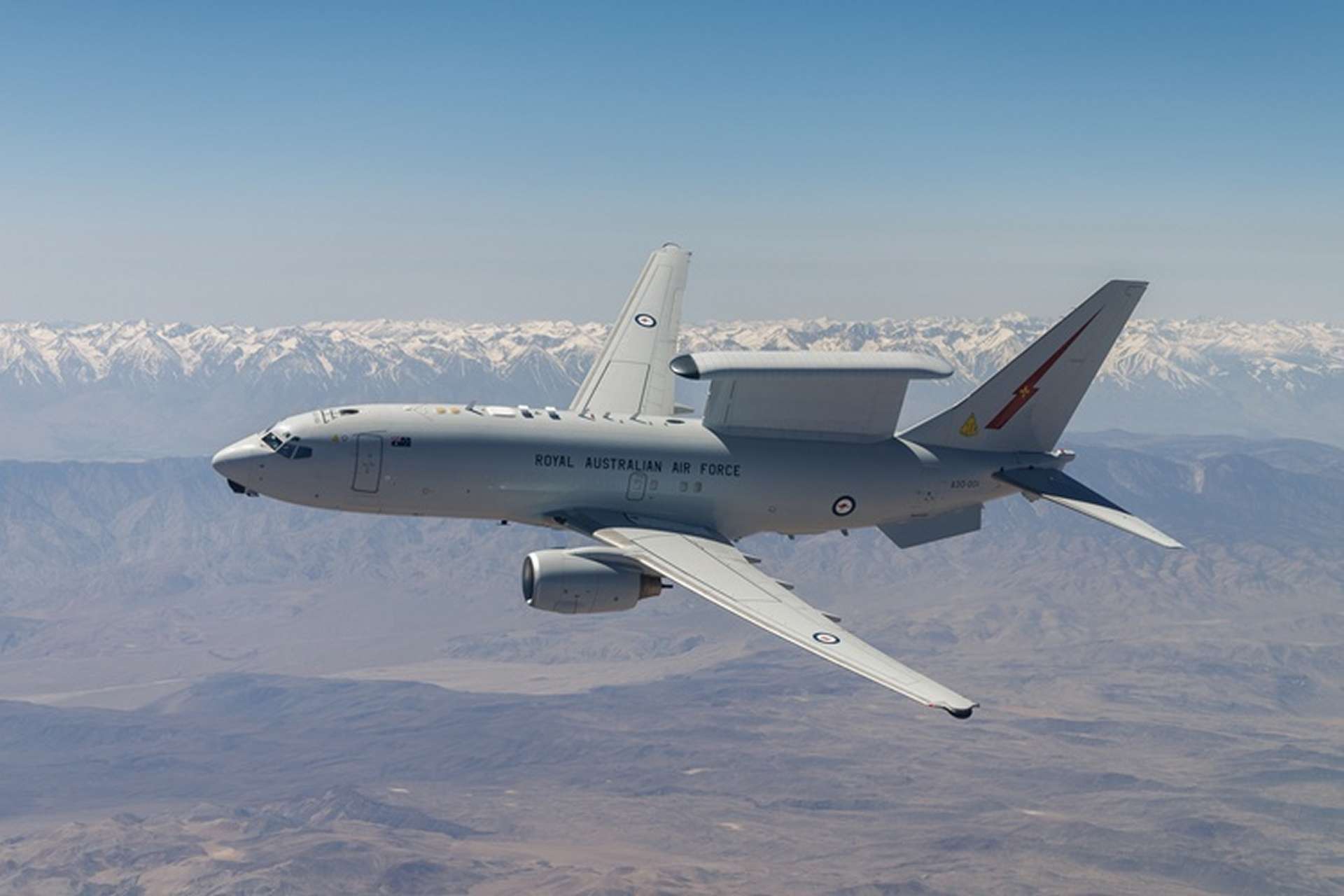
The U.S. Air Force’s E-7A Wedgetail push gains urgency as a recent Iranian strike damaging an E-3 AWACS highlights the growing operational risk of relying on an aging airborne early warning fleet (Picture source: U.S. DoW).
On 27 March, an Iranian missile and drone strike on Prince Sultan Air Base in Saudi Arabia damaged a U.S. E-3 AWACS and other aircraft, a sharp reminder that the United States is still heavily dependent on a shrinking fleet of high-value airborne battle managers for regional airpower orchestration. The Air Force had already awarded Boeing roughly $2.4 billion in contract modifications on 12 March to continue E-7 engineering and manufacturing development work and to address radar supply-chain issues; the RFI now suggests the service is also preparing for the decisive question of how to keep the fleet available once fielded.
The E-7A is not a weapon truck and carries no offensive armament. Its decisive combat value lies in the Northrop Grumman Multi-role Electronically Scanned Array, or MESA, mounted in the distinctive dorsal “top hat” rather than in the E-3’s rotating rotodome. That AESA-based sensor gives the Wedgetail unrestricted 360-degree coverage, simultaneous airborne, maritime and ground target awareness, advanced IFF functions and higher update rates, while also incorporating electronic protection features intended to preserve the picture under jamming. In operational terms, the aircraft’s real “armament” is information dominance: finding, classifying, prioritizing and distributing tracks fast enough for fighters, surface-based air defenses and joint commanders to act first.
That architecture delivers a clear tactical advantage over the E-3 Sentry it is meant to replace. The E-3’s 30-foot mechanically rotating radar dome refreshes its full picture in roughly 10 seconds and sits on a Boeing 707 airframe whose TF33 engines and legacy components have become a sustainment burden; Task & Purpose noted that spare parts for those engines are no longer manufactured, while the Air Force fact sheet still describes a radar range of more than 250 miles. By contrast, the E-7 is built on the far newer 737 Next Generation family, is configured around ten mission consoles, flies at up to 41,000 feet, and has an unrefueled range of about 3,500 nautical miles, giving the Air Force a platform with a broader commercial support base and a mission system designed for modern data-linked warfare rather than Cold War-era radar management.
The tactical implications are substantial. A Wedgetail orbit does far more than warn of incoming aircraft: it acts as an airborne command post that can fuse radar, electronic support, IFF, and communications into a live common operating picture and push that picture via secure UHF/VHF/HF, SATCOM, and Link 16 to fighters, tankers, ISR platforms and ground headquarters. RAF and Boeing descriptions stress the aircraft’s utility as a multi-domain battle-management node, and Northrop Grumman says MESA can track air, maritime, and ground targets simultaneously while concentrating energy in areas of emphasis to extend detection and improve track quality. For the Indo-Pacific or the Gulf, that translates into faster raid detection, better cruise-missile and drone cueing, cleaner airspace deconfliction and more effective control of distributed packages at long range.
This is also why the Iran-damaged E-3 is strategically relevant to the story. A specialized aerospace magazine reported that only 16 E-3s remained in the Air Force inventory and that the fleet’s fiscal 2024 mission-capable rate was about 56%, meaning the United States is already operating with limited depth in one of its most critical theater-level enabling missions. Losing or even heavily damaging one AWACS in combat conditions tightens the coverage math immediately, especially when AWACS aircraft are responsible for airspace control, aircraft deconfliction, tanker coordination and the real-time management of strikes. The point is that deferring replacement of the E-3 compounds risk by forcing the Air Force to lean harder on a fleet that is both operationally indispensable and mechanically exhausted.
The RFI is therefore important precisely because it deals with readiness rather than acquisition rhetoric. The Air Force’s document asks industry to compare three sustainment constructs: fully organic support, a hybrid field-level arrangement with contractor depot maintenance, and a hybrid-to-organic public-private partnership, and to model life-cycle cost, risks, materiel availability and transition timelines for a fleet that could stop at two aircraft or grow to twenty-six. That is the kind of analysis done when a program is moving beyond abstract advocacy and into force-design reality: how many maintainers are needed, where depots should be positioned, which tools and test equipment must be government-owned, and how quickly contractor dependence can be reduced.
There is still political and budgetary uncertainty around the Wedgetail. Reporting pointed out that the March contract actions satisfy congressional direction to continue development, but do not themselves commit the Air Force to full-rate production; Air Force Secretary Troy Meink also signaled that delivering a plan to Congress is not the same as funding it in future budgets. Even so, the combination of an EMD-phase contract expansion, radar industrial-base funding and a sustainment RFI points to a program that has regained institutional momentum after Congress rejected the service’s effort to kill it in 2025.
The E-7A is a force multiplier for the entire joint fight, not only for the Air Force: it sharpens the air picture feeding Patriot and future integrated air and missile defense networks, improves targeting quality for long-range fires, enhances coalition interoperability, and helps synchronize fighters, tankers, ISR and surface commanders across large theaters. The real value of airborne early warning aircraft is not the airframe itself but the ability to compress the kill chain for the entire force. The March RFI arrives at exactly the right moment: after a fresh demonstration that America’s legacy AWACS fleet remains indispensable, vulnerable and too small, the Pentagon is once again being reminded that modern sensor-battle managers are not optional overhead assets, but core infrastructure for winning the air battle.
{loadposition bannertop}
{loadposition sidebarpub}
The U.S. Air Force is advancing sustainment planning for the E-7A Wedgetail after a combat-damaged E-3 AWACS exposed fleet vulnerability.
A 10 March 2026 request for information issued by the Air Force Life Cycle Management Center seeks industry input on sustaining between two and 26 E-7A aircraft. The effort follows roughly $2.4 billion in Boeing contract modifications tied to engineering development and radar supply chain stability. Together, these steps indicate the Wedgetail program is shifting from concept to operational planning, with sustainment now a central concern.
Read also: Australia deploys E-7A Wedgetail aircraft to UAE and helps stop Iranian drone and missile attacks.
The U.S. Air Force’s E-7A Wedgetail push gains urgency as a recent Iranian strike damaging an E-3 AWACS highlights the growing operational risk of relying on an aging airborne early warning fleet (Picture source: U.S. DoW).
On 27 March, an Iranian missile and drone strike on Prince Sultan Air Base in Saudi Arabia damaged a U.S. E-3 AWACS and other aircraft, a sharp reminder that the United States is still heavily dependent on a shrinking fleet of high-value airborne battle managers for regional airpower orchestration. The Air Force had already awarded Boeing roughly $2.4 billion in contract modifications on 12 March to continue E-7 engineering and manufacturing development work and to address radar supply-chain issues; the RFI now suggests the service is also preparing for the decisive question of how to keep the fleet available once fielded.
The E-7A is not a weapon truck and carries no offensive armament. Its decisive combat value lies in the Northrop Grumman Multi-role Electronically Scanned Array, or MESA, mounted in the distinctive dorsal “top hat” rather than in the E-3’s rotating rotodome. That AESA-based sensor gives the Wedgetail unrestricted 360-degree coverage, simultaneous airborne, maritime and ground target awareness, advanced IFF functions and higher update rates, while also incorporating electronic protection features intended to preserve the picture under jamming. In operational terms, the aircraft’s real “armament” is information dominance: finding, classifying, prioritizing and distributing tracks fast enough for fighters, surface-based air defenses and joint commanders to act first.
That architecture delivers a clear tactical advantage over the E-3 Sentry it is meant to replace. The E-3’s 30-foot mechanically rotating radar dome refreshes its full picture in roughly 10 seconds and sits on a Boeing 707 airframe whose TF33 engines and legacy components have become a sustainment burden; Task & Purpose noted that spare parts for those engines are no longer manufactured, while the Air Force fact sheet still describes a radar range of more than 250 miles. By contrast, the E-7 is built on the far newer 737 Next Generation family, is configured around ten mission consoles, flies at up to 41,000 feet, and has an unrefueled range of about 3,500 nautical miles, giving the Air Force a platform with a broader commercial support base and a mission system designed for modern data-linked warfare rather than Cold War-era radar management.
The tactical implications are substantial. A Wedgetail orbit does far more than warn of incoming aircraft: it acts as an airborne command post that can fuse radar, electronic support, IFF, and communications into a live common operating picture and push that picture via secure UHF/VHF/HF, SATCOM, and Link 16 to fighters, tankers, ISR platforms and ground headquarters. RAF and Boeing descriptions stress the aircraft’s utility as a multi-domain battle-management node, and Northrop Grumman says MESA can track air, maritime, and ground targets simultaneously while concentrating energy in areas of emphasis to extend detection and improve track quality. For the Indo-Pacific or the Gulf, that translates into faster raid detection, better cruise-missile and drone cueing, cleaner airspace deconfliction and more effective control of distributed packages at long range.
This is also why the Iran-damaged E-3 is strategically relevant to the story. A specialized aerospace magazine reported that only 16 E-3s remained in the Air Force inventory and that the fleet’s fiscal 2024 mission-capable rate was about 56%, meaning the United States is already operating with limited depth in one of its most critical theater-level enabling missions. Losing or even heavily damaging one AWACS in combat conditions tightens the coverage math immediately, especially when AWACS aircraft are responsible for airspace control, aircraft deconfliction, tanker coordination and the real-time management of strikes. The point is that deferring replacement of the E-3 compounds risk by forcing the Air Force to lean harder on a fleet that is both operationally indispensable and mechanically exhausted.
The RFI is therefore important precisely because it deals with readiness rather than acquisition rhetoric. The Air Force’s document asks industry to compare three sustainment constructs: fully organic support, a hybrid field-level arrangement with contractor depot maintenance, and a hybrid-to-organic public-private partnership, and to model life-cycle cost, risks, materiel availability and transition timelines for a fleet that could stop at two aircraft or grow to twenty-six. That is the kind of analysis done when a program is moving beyond abstract advocacy and into force-design reality: how many maintainers are needed, where depots should be positioned, which tools and test equipment must be government-owned, and how quickly contractor dependence can be reduced.
There is still political and budgetary uncertainty around the Wedgetail. Reporting pointed out that the March contract actions satisfy congressional direction to continue development, but do not themselves commit the Air Force to full-rate production; Air Force Secretary Troy Meink also signaled that delivering a plan to Congress is not the same as funding it in future budgets. Even so, the combination of an EMD-phase contract expansion, radar industrial-base funding and a sustainment RFI points to a program that has regained institutional momentum after Congress rejected the service’s effort to kill it in 2025.
The E-7A is a force multiplier for the entire joint fight, not only for the Air Force: it sharpens the air picture feeding Patriot and future integrated air and missile defense networks, improves targeting quality for long-range fires, enhances coalition interoperability, and helps synchronize fighters, tankers, ISR and surface commanders across large theaters. The real value of airborne early warning aircraft is not the airframe itself but the ability to compress the kill chain for the entire force. The March RFI arrives at exactly the right moment: after a fresh demonstration that America’s legacy AWACS fleet remains indispensable, vulnerable and too small, the Pentagon is once again being reminded that modern sensor-battle managers are not optional overhead assets, but core infrastructure for winning the air battle.