Spain opens talks to acquire Turkish Kaan fighter jets instead of U.S.-made F-35s
{loadposition bannertop}
{loadposition sidebarpub}
Spain has opened preliminary negotiations with Türkiye over a possible acquisition of the Kaan stealth fighter, as confirmed by Turkish Aerospace Industries and reported by Infodefensa on May 7, 2026, signaling a major shift in Madrid’s combat aviation strategy away from dependence on U.S.-controlled defense ecosystems. The talks reflect growing Spanish concern over the operational risks created by aging Hornet and Harrier fleets, repeated FCAS delays, and restrictions tied to the F-35’s American-controlled software, logistics, and sustainment architecture.
Türkiye is positioning the twin-engine Kaan not only as a fifth-generation fighter but as a sovereign combat aviation platform that would allow Spain to control mission software, electronic warfare integration, datalinks, and parts of the sustainment chain through domestic industry participation. While the F-35 still retains clear advantages in operational maturity, stealth validation, and combat-proven sensor fusion, Madrid’s interest in Kaan highlights how software sovereignty, industrial autonomy, and flexible systems integration are becoming central factors in future fighter procurement decisions across Europe.
Related topic: Spain’s surprise move: Replacing American F-35 with Turkish Kaan stealth fighter?
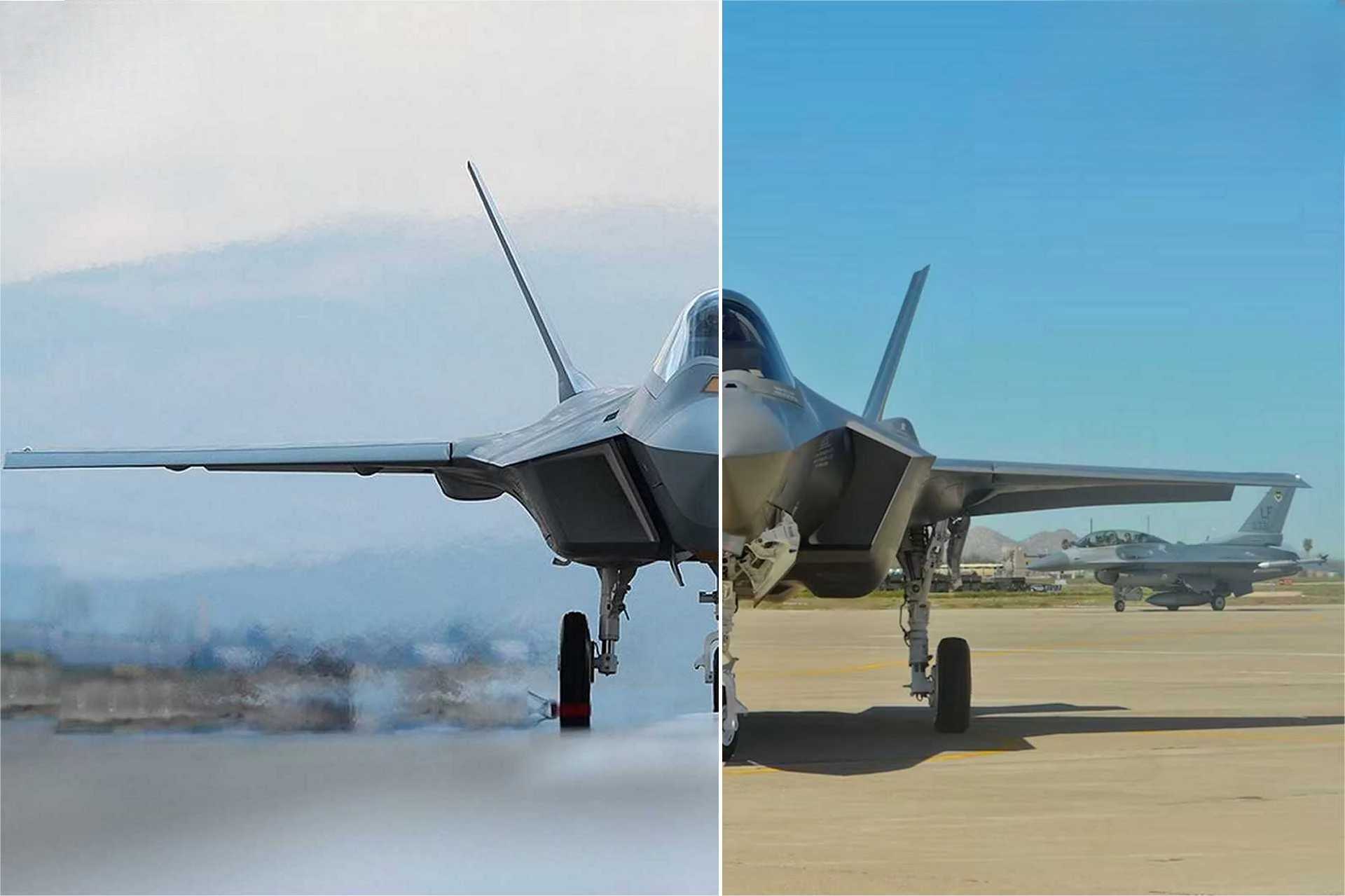
For Spain, the main advantage of the Kaan over the F-35 is that it offers far greater national control over software, weapons integration, maintenance, and industrial participation, allowing Madrid to operate and modify the aircraft with much less dependence on foreign authorization. (Picture source: TAI and US Air Force)
As reported by Infodefensa on May 7, 2026, Turkish Aerospace Industries (TAI) CEO, Mehmet Demiroğlu, confirmed during SAHA 2026 that Spain and Türkiye had entered preliminary government-to-government discussions regarding a potential Spanish acquisition of the Kaan stealth fighter. The talks followed Spain’s October 2025 approval of a €3.12 billion contract for 45 Turkish Hürjet advanced jet trainers under the SAETA II designation, with Airbus España responsible for integrating mission computers and selected avionics.
The negotiations emerged while Spain simultaneously confronts four problems: the aging EF-18 Hornet fleet, the approaching retirement of the AV-8B Harrier force, the suspension of F-35 procurement plans, and repeated FCAS delays. Turkish officials are therefore positioning the Kaan not simply as a fighter aircraft but as a new procurement model centered on sovereign software control, industrial participation, and reduced dependence on U.S.-controlled sustainment infrastructure. Spain’s Air Force currently operates roughly 70 EF-18A/B Hornets acquired between 1986 and 1990, with many aircraft now approaching or exceeding 8,000 flight hours after decades of NATO operations and expeditionary deployments.
The Halcón I and Halcón II Eurofighter contracts partially addressed the problem through the acquisition of 45 additional Typhoons, but the FCAS is not expected to reach operational service before 2040, leaving a projected capability gap of 10 to 15 years. By 2022, senior Spanish military officials had already concluded that additional fourth-generation fighter upgrades alone would not provide adequate survivability against modern integrated air defense systems. The F-35A consequently emerged as the preferred operational replacement for parts of the Air Force, but Madrid refrained from procurement because the political leadership increasingly prioritized industrial autonomy and European aerospace sovereignty over the rapid acquisition of an operational fifth-generation fighter.
The Spanish Navy faces a more restrictive challenge because its fixed-wing aviation capability depends entirely on 12 to 13 EAV-8B+ Harrier II aircraft operated aboard the Juan Carlos I amphibious assault ship. The vessel lacks catapult launch systems and therefore requires STOVL aircraft, and the F-35B remains to date the only operational fifth-generation STOVL fighter available internationally. Rivals like the Kaan, FCAS, GCAP, KF-21, Rafale, and Eurofighter do not possess operational STOVL variants compatible with Spanish naval requirements. Without the F-35B, Spain would face three alternatives after Harrier retirement: abandoning fixed-wing naval aviation, reversing its position and purchasing the F-35B, or replacing Juan Carlos I with a larger catapult-equipped carrier capable of operating conventional naval fighters.
The naval aviation issue, therefore, remains the strongest operational argument favoring eventual Spanish acquisition of at least a limited number of F-35Bs. Political resistance toward the F-35 accelerated between 2021 and 2025 as Spanish officials increasingly viewed the aircraft as a dependency relationship tied to American-controlled software and sustainment infrastructure. Mission data files, software updates, electronic warfare databases, logistics management, and deep maintenance remain connected to ODIN and associated U.S.-controlled architecture, which Spanish officials increasingly considered incompatible with sovereign operational autonomy.
The Kaan proposal directly targets these concerns by offering Spain authority to integrate national datalinks, domestic mission software, indigenous electronic warfare systems, and sovereign weapons architecture without centralized foreign approval. Turkish negotiators also emphasized that Spain could retain partial control over avionics adaptation and mission-system customization through domestic industry participation. Madrid’s interest in Kaan, therefore, could reflect a deeper shift in procurement logic where sovereignty and political flexibility increasingly influence fighter acquisition decisions.
Turkish Aerospace Industries structured the Kaan proposal around the same industrial logic already established through the Hürjet and SAETA II agreement signed in October 2025. Under that framework, Airbus España manages mission-system integration while the Turkish industry provides the aircraft structure, allowing Spain to participate directly in the integration and sustainment chain rather than acting solely as an end-user customer like the F-35. Turkish negotiators are proposing a similar structure for the Kaan, involving avionics integration, software adaptation, industrial workload distribution, and potentially sovereign mission-data management.
Companies already associated with the SAETA II ecosystem, including Indra, GMV, Sener, AERTEC, Grupo Oesía, and Orbital, could therefore become involved in future Kaan integration and sustainment activities. Like South Korea’s approach with the K2 Black Panther tank, Ankara is effectively offering Madrid a participation in a broader sovereign aerospace architecture rather than a conventional off-the-shelf fighter acquisition. For now, the Kaan remains in prototype and developmental testing after conducting its maiden flight on February 21, 2024, and the program still faces major technological milestones before operational service entry.
Turkish Aerospace Industries plans additional prototypes during 2026 and 2027 to expand testing of avionics, stealth management, mission integration, and aerodynamic performance. Current prototypes are powered by two General Electric F110 engines derived from the same engine family used by Turkish F-16s, but Türkiye intends to replace them later with the indigenous TF3500 engine currently under development. Turkish officials continue targeting initial operational capability around 2029, although the timeline remains closely linked to propulsion development and systems integration progress.
The aircraft was also designed from the beginning to operate within a manned-unmanned teaming environment involving stealth UCAVs and autonomous support aircraft. Turkish officials argue that the Kaan may eventually offer operational advantages over the F-35 in areas related to kinematic performance, payload capacity, survivability, and sovereign systems integration. The twin-engine configuration potentially provides greater thrust margins and increased survivability compared to the F-35’s single Pratt & Whitney F135 engine, as Turkish Aerospace Industries projects a maximum speed of Mach 1.8 compared to the F-35A’s Mach 1.6.
Turkish sources additionally claim the Kaan may eventually carry up to 10 tons of payload compared to roughly 8.1 tons for the F-35A, although actual low-observable internal carriage capacity remains unclear publicly. Ankara also emphasizes that partner countries would possess greater authority to integrate national missiles, datalinks, and sovereign mission software than is possible inside the F-35 ecosystem. Turkish officials further argue that the Kaan may ultimately achieve lower procurement and lifecycle sustainment costs than the F-35. The F-35 nevertheless retains major advantages in operational maturity, sensor fusion, stealth credibility, and logistics integration that the Kaan has not yet demonstrated.
More than 1,000 F-35 aircraft have already been produced for over 15 countries, accumulating extensive operational experience across NATO exercises and real combat operations. The aircraft’s primary advantage, however, lies in its sensor fusion architecture, integrating radar, electronic warfare systems, targeting sensors, datalinks, and offboard network inputs into a unified real-time battlespace picture. American stealth engineering also benefits from decades of accumulated experience, beginning with the F-117, B-2, and F-22, while Kaan’s true radar cross-section and stealth-maintenance requirements remain unknown because the aircraft has not entered operational service.
As a result, the comparison between the two aircraft currently centers less on direct operational equivalence and more on the tradeoff between combat maturity and sovereign industrial flexibility. The propulsion issue remains the largest structural vulnerability affecting the Kaan program because Türkiye still depends partially on American engine technology despite positioning the aircraft as an alternative to U.S.-controlled defense ecosystems. Current Kaan prototypes continue relying on U.S.-made F110 engines, meaning future exports could remain indirectly subject to American licensing approval until the TF3500 becomes operational.
Indigenous fighter engine development remains one of the most difficult sectors within advanced combat aviation because propulsion reliability directly affects fuel efficiency, thermal management, maintenance cycles, stealth integration, and aircraft performance. Delays inside the TF3500 program could therefore affect production schedules, exportability, sustainment planning, and long-term operating costs for future foreign customers, including Spain. Madrid must consequently evaluate whether the aircraft’s promised advantages regarding software sovereignty and industrial participation compensate for unresolved propulsion risks.
Spain formally remains committed to FCAS through Airbus and Indra participation, but the program continues suffering from persistent disputes between Dassault Aviation and Airbus regarding intellectual property, workshare distribution, and leadership authority. These disagreements have repeatedly delayed progress, while Germany reportedly warned in 2025 that unresolved tensions could threaten the continuation of the entire program.
Spain nevertheless continues supporting FCAS because withdrawal would weaken its aerospace-industrial position inside Europe and reduce domestic participation in sixth-generation combat aviation technologies. At the same time, Madrid increasingly appears to be pursuing contingency solutions in case FCAS timelines continue slipping beyond the 2040 horizon. The Kaan discussions, therefore, function partly as strategic hedging while illustrating the growing fragmentation of Europe’s future combat aviation landscape between FCAS, GCAP, F-35 operators, and emerging external suppliers such as Türkiye and South Korea.
Written by Jérôme Brahy
Jérôme Brahy is a defense analyst and documentalist at Army Recognition. He specializes in naval modernization, aviation, drones, armored vehicles, and artillery, with a focus on strategic developments in the United States, China, Ukraine, Russia, Türkiye, and Belgium. His analyses go beyond the facts, providing context, identifying key actors, and explaining why defense news matters on a global scale.
{loadposition bannertop}
{loadposition sidebarpub}
Spain has opened preliminary negotiations with Türkiye over a possible acquisition of the Kaan stealth fighter, as confirmed by Turkish Aerospace Industries and reported by Infodefensa on May 7, 2026, signaling a major shift in Madrid’s combat aviation strategy away from dependence on U.S.-controlled defense ecosystems. The talks reflect growing Spanish concern over the operational risks created by aging Hornet and Harrier fleets, repeated FCAS delays, and restrictions tied to the F-35’s American-controlled software, logistics, and sustainment architecture.
Türkiye is positioning the twin-engine Kaan not only as a fifth-generation fighter but as a sovereign combat aviation platform that would allow Spain to control mission software, electronic warfare integration, datalinks, and parts of the sustainment chain through domestic industry participation. While the F-35 still retains clear advantages in operational maturity, stealth validation, and combat-proven sensor fusion, Madrid’s interest in Kaan highlights how software sovereignty, industrial autonomy, and flexible systems integration are becoming central factors in future fighter procurement decisions across Europe.
Related topic: Spain’s surprise move: Replacing American F-35 with Turkish Kaan stealth fighter?
For Spain, the main advantage of the Kaan over the F-35 is that it offers far greater national control over software, weapons integration, maintenance, and industrial participation, allowing Madrid to operate and modify the aircraft with much less dependence on foreign authorization. (Picture source: TAI and US Air Force)
As reported by Infodefensa on May 7, 2026, Turkish Aerospace Industries (TAI) CEO, Mehmet Demiroğlu, confirmed during SAHA 2026 that Spain and Türkiye had entered preliminary government-to-government discussions regarding a potential Spanish acquisition of the Kaan stealth fighter. The talks followed Spain’s October 2025 approval of a €3.12 billion contract for 45 Turkish Hürjet advanced jet trainers under the SAETA II designation, with Airbus España responsible for integrating mission computers and selected avionics.
The negotiations emerged while Spain simultaneously confronts four problems: the aging EF-18 Hornet fleet, the approaching retirement of the AV-8B Harrier force, the suspension of F-35 procurement plans, and repeated FCAS delays. Turkish officials are therefore positioning the Kaan not simply as a fighter aircraft but as a new procurement model centered on sovereign software control, industrial participation, and reduced dependence on U.S.-controlled sustainment infrastructure. Spain’s Air Force currently operates roughly 70 EF-18A/B Hornets acquired between 1986 and 1990, with many aircraft now approaching or exceeding 8,000 flight hours after decades of NATO operations and expeditionary deployments.
The Halcón I and Halcón II Eurofighter contracts partially addressed the problem through the acquisition of 45 additional Typhoons, but the FCAS is not expected to reach operational service before 2040, leaving a projected capability gap of 10 to 15 years. By 2022, senior Spanish military officials had already concluded that additional fourth-generation fighter upgrades alone would not provide adequate survivability against modern integrated air defense systems. The F-35A consequently emerged as the preferred operational replacement for parts of the Air Force, but Madrid refrained from procurement because the political leadership increasingly prioritized industrial autonomy and European aerospace sovereignty over the rapid acquisition of an operational fifth-generation fighter.
The Spanish Navy faces a more restrictive challenge because its fixed-wing aviation capability depends entirely on 12 to 13 EAV-8B+ Harrier II aircraft operated aboard the Juan Carlos I amphibious assault ship. The vessel lacks catapult launch systems and therefore requires STOVL aircraft, and the F-35B remains to date the only operational fifth-generation STOVL fighter available internationally. Rivals like the Kaan, FCAS, GCAP, KF-21, Rafale, and Eurofighter do not possess operational STOVL variants compatible with Spanish naval requirements. Without the F-35B, Spain would face three alternatives after Harrier retirement: abandoning fixed-wing naval aviation, reversing its position and purchasing the F-35B, or replacing Juan Carlos I with a larger catapult-equipped carrier capable of operating conventional naval fighters.
The naval aviation issue, therefore, remains the strongest operational argument favoring eventual Spanish acquisition of at least a limited number of F-35Bs. Political resistance toward the F-35 accelerated between 2021 and 2025 as Spanish officials increasingly viewed the aircraft as a dependency relationship tied to American-controlled software and sustainment infrastructure. Mission data files, software updates, electronic warfare databases, logistics management, and deep maintenance remain connected to ODIN and associated U.S.-controlled architecture, which Spanish officials increasingly considered incompatible with sovereign operational autonomy.
The Kaan proposal directly targets these concerns by offering Spain authority to integrate national datalinks, domestic mission software, indigenous electronic warfare systems, and sovereign weapons architecture without centralized foreign approval. Turkish negotiators also emphasized that Spain could retain partial control over avionics adaptation and mission-system customization through domestic industry participation. Madrid’s interest in Kaan, therefore, could reflect a deeper shift in procurement logic where sovereignty and political flexibility increasingly influence fighter acquisition decisions.
Turkish Aerospace Industries structured the Kaan proposal around the same industrial logic already established through the Hürjet and SAETA II agreement signed in October 2025. Under that framework, Airbus España manages mission-system integration while the Turkish industry provides the aircraft structure, allowing Spain to participate directly in the integration and sustainment chain rather than acting solely as an end-user customer like the F-35. Turkish negotiators are proposing a similar structure for the Kaan, involving avionics integration, software adaptation, industrial workload distribution, and potentially sovereign mission-data management.
Companies already associated with the SAETA II ecosystem, including Indra, GMV, Sener, AERTEC, Grupo Oesía, and Orbital, could therefore become involved in future Kaan integration and sustainment activities. Like South Korea’s approach with the K2 Black Panther tank, Ankara is effectively offering Madrid a participation in a broader sovereign aerospace architecture rather than a conventional off-the-shelf fighter acquisition. For now, the Kaan remains in prototype and developmental testing after conducting its maiden flight on February 21, 2024, and the program still faces major technological milestones before operational service entry.
Turkish Aerospace Industries plans additional prototypes during 2026 and 2027 to expand testing of avionics, stealth management, mission integration, and aerodynamic performance. Current prototypes are powered by two General Electric F110 engines derived from the same engine family used by Turkish F-16s, but Türkiye intends to replace them later with the indigenous TF3500 engine currently under development. Turkish officials continue targeting initial operational capability around 2029, although the timeline remains closely linked to propulsion development and systems integration progress.
The aircraft was also designed from the beginning to operate within a manned-unmanned teaming environment involving stealth UCAVs and autonomous support aircraft. Turkish officials argue that the Kaan may eventually offer operational advantages over the F-35 in areas related to kinematic performance, payload capacity, survivability, and sovereign systems integration. The twin-engine configuration potentially provides greater thrust margins and increased survivability compared to the F-35’s single Pratt & Whitney F135 engine, as Turkish Aerospace Industries projects a maximum speed of Mach 1.8 compared to the F-35A’s Mach 1.6.
Turkish sources additionally claim the Kaan may eventually carry up to 10 tons of payload compared to roughly 8.1 tons for the F-35A, although actual low-observable internal carriage capacity remains unclear publicly. Ankara also emphasizes that partner countries would possess greater authority to integrate national missiles, datalinks, and sovereign mission software than is possible inside the F-35 ecosystem. Turkish officials further argue that the Kaan may ultimately achieve lower procurement and lifecycle sustainment costs than the F-35. The F-35 nevertheless retains major advantages in operational maturity, sensor fusion, stealth credibility, and logistics integration that the Kaan has not yet demonstrated.
More than 1,000 F-35 aircraft have already been produced for over 15 countries, accumulating extensive operational experience across NATO exercises and real combat operations. The aircraft’s primary advantage, however, lies in its sensor fusion architecture, integrating radar, electronic warfare systems, targeting sensors, datalinks, and offboard network inputs into a unified real-time battlespace picture. American stealth engineering also benefits from decades of accumulated experience, beginning with the F-117, B-2, and F-22, while Kaan’s true radar cross-section and stealth-maintenance requirements remain unknown because the aircraft has not entered operational service.
As a result, the comparison between the two aircraft currently centers less on direct operational equivalence and more on the tradeoff between combat maturity and sovereign industrial flexibility. The propulsion issue remains the largest structural vulnerability affecting the Kaan program because Türkiye still depends partially on American engine technology despite positioning the aircraft as an alternative to U.S.-controlled defense ecosystems. Current Kaan prototypes continue relying on U.S.-made F110 engines, meaning future exports could remain indirectly subject to American licensing approval until the TF3500 becomes operational.
Indigenous fighter engine development remains one of the most difficult sectors within advanced combat aviation because propulsion reliability directly affects fuel efficiency, thermal management, maintenance cycles, stealth integration, and aircraft performance. Delays inside the TF3500 program could therefore affect production schedules, exportability, sustainment planning, and long-term operating costs for future foreign customers, including Spain. Madrid must consequently evaluate whether the aircraft’s promised advantages regarding software sovereignty and industrial participation compensate for unresolved propulsion risks.
Spain formally remains committed to FCAS through Airbus and Indra participation, but the program continues suffering from persistent disputes between Dassault Aviation and Airbus regarding intellectual property, workshare distribution, and leadership authority. These disagreements have repeatedly delayed progress, while Germany reportedly warned in 2025 that unresolved tensions could threaten the continuation of the entire program.
Spain nevertheless continues supporting FCAS because withdrawal would weaken its aerospace-industrial position inside Europe and reduce domestic participation in sixth-generation combat aviation technologies. At the same time, Madrid increasingly appears to be pursuing contingency solutions in case FCAS timelines continue slipping beyond the 2040 horizon. The Kaan discussions, therefore, function partly as strategic hedging while illustrating the growing fragmentation of Europe’s future combat aviation landscape between FCAS, GCAP, F-35 operators, and emerging external suppliers such as Türkiye and South Korea.
Written by Jérôme Brahy
Jérôme Brahy is a defense analyst and documentalist at Army Recognition. He specializes in naval modernization, aviation, drones, armored vehicles, and artillery, with a focus on strategic developments in the United States, China, Ukraine, Russia, Türkiye, and Belgium. His analyses go beyond the facts, providing context, identifying key actors, and explaining why defense news matters on a global scale.