Greece could buy 3 C-390 transport aircraft from Brazil by May 2026 to replace U.S. C-130 fleet
{loadposition bannertop}
{loadposition sidebarpub}
Greece is moving toward a final decision to acquire Embraer C-390 Millennium aircraft, aiming to restore critical airlift capacity as its aging C-130 fleet struggles to sustain operations. Expected between April and May 2026, the choice will directly affect the country’s ability to move forces, supply island outposts, and support NATO missions under growing readiness pressure.
Brazil’s C-390 offers higher payload, faster transit speeds, and multi-role flexibility, enabling more missions per day while reducing maintenance strain through commercially derived engines. Its ability to combine transport, medical evacuation, and aerial refueling in a single platform aligns with broader trends toward adaptable, high-tempo air mobility and strengthens Greece’s operational reach and endurance.
Related topic: Brazil confirms talks with U.S. Air Force to use KC-390 Millennium as a new complementary tanker
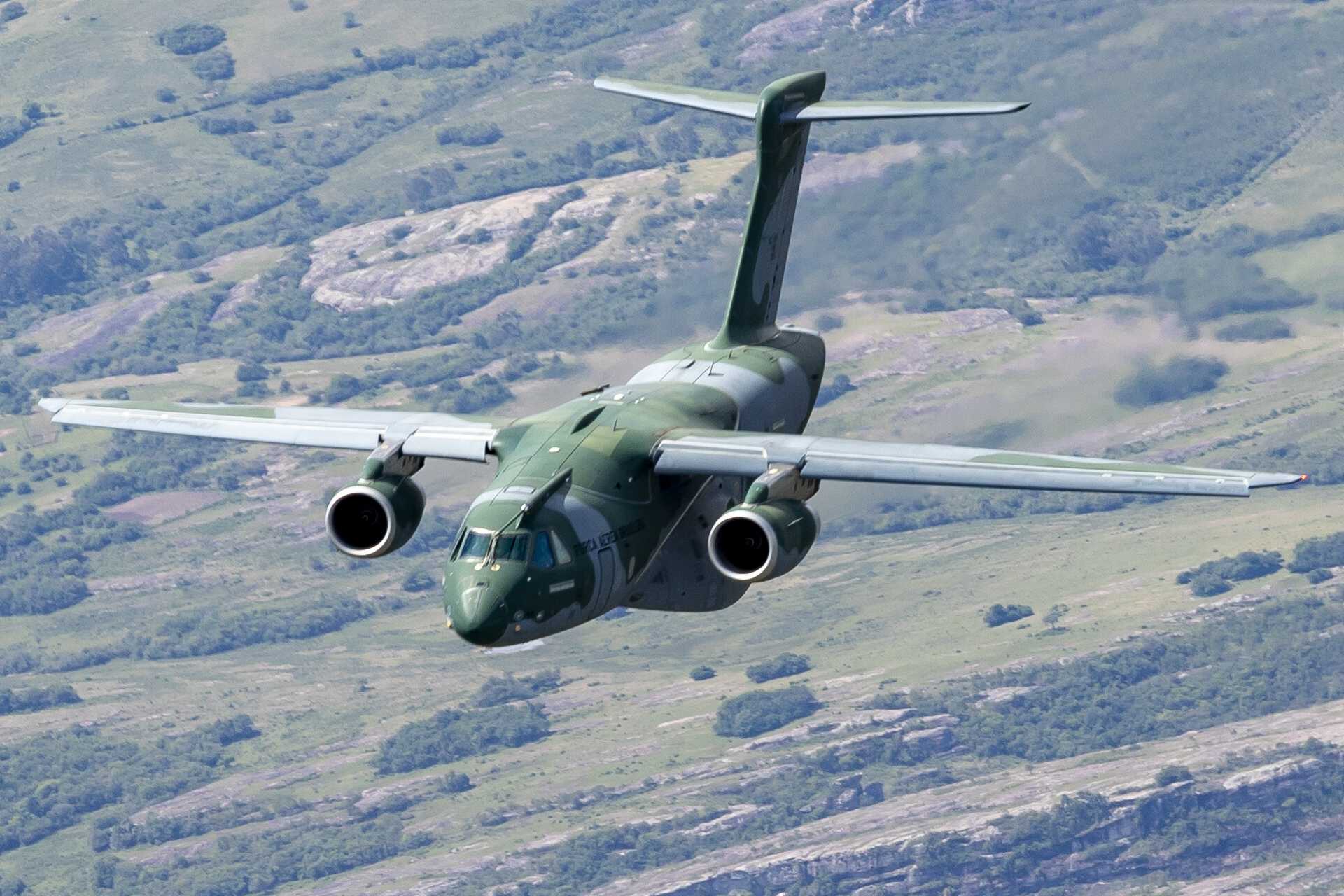
The current C-130 fleet condition remains a central driver behind the possible C-390 purchase, as the original Greek force of nearly twenty C-130H aircraft has declined to an operational availability of only four to seven units during the 2025–2026 period. (Picture source: Brazil Air Force)
On April 17, 2026, OnAlert revealed that the pending decision on the acquisition of three C-390 Millennium aircraft for the Hellenic Air Force is entering its final phase, with a decision window set between April and May 2026. The procurement, which could be initiated through a government-to-government framework with Portugal, covers an initial tranche of three aircraft, with a planned second phase adding three more units, to replace the C-130H Hercules fleet introduced in 1975, which is now approaching the end of its service life. The evaluation process includes acquisition cost, lifecycle cost, operational availability, and mission versatility, with the C-130J Super Hercules proposed by Lockheed Martin as the alternative solution.
The decision is driven by measurable declines in readiness and increasing sustainment costs, alongside the requirement to expand mission capability beyond transport. Institutional approval has already been secured at both military and political levels, allowing immediate transition to contractual steps once the selection is confirmed. The existing Greek C-130 fleet shows a significant reduction in usable aircraft, with approximately twenty C-130H units originally acquired, but only four to seven aircraft operational during the 2025–2026 period. Airframes have accumulated 45 to 50 years of service, resulting in structural fatigue, corrosion issues, and increased inspection requirements that extend maintenance cycles.
Depot-level overhauls are further slowed by limited technical personnel and constrained infrastructure capacity, while spare parts availability is affected by declining global supply for legacy systems. The cost per flight hour has increased as maintenance intensity rises, while mission reliability decreases. At the same time, the Greek Air Force’s operational requirements remain constant, including airlift to island regions, aeromedical evacuation, and support for NATO and international deployments, creating a mismatch between demand and available sortie generation. Attempts to secure additional aircraft through U.S. Excess Defense Articles were not pursued due to refurbishment costs exceeding operational value.
The net effect is now a sustained gap in Greece’s strategic and tactical airlift capacity. The procurement framework is structured in two phases, with three aircraft in the first phase and a follow-on option for three additional units, allowing staged financial commitment and operational integration. A formal decision is expected within May 2026 to launch procurement procedures, with prior alignment achieved between the Hellenic General Staff and government authorities. The phased acquisition model reduces immediate budget impact while enabling gradual restoration of capability.
Delivery timelines are dependent on production scheduling and funding availability, with no fixed dates publicly confirmed. Integration into service is planned incrementally, allowing overlap with remaining C-130H operations during the transition period. Cooperation with Portugal provides access to an established operational user base, including training pipelines and maintenance procedures. This reduces initial implementation risk, shortens the time required to reach operational status, and allows reassessment before committing to the second phase. The Brazilian C-390 Millennium, developed by Embraer, shows quantifiable differences compared to the C-130J in key metrics such as payload, speed, and propulsion.
The aircraft carries up to 26 tons of cargo, compared to about 20 tons for the C-130J, and operates at a cruise speed of 470 knots or about 870 km/h, compared to 360 knots or about 670 km/h. The Millennium has a range of about 5,500 km with a 15-ton payload and a service ceiling of about 36,000 ft. The propulsion system consists of two IAE V2500 turbofan engines, widely used in commercial aviation, which simplifies maintenance and improves spare parts availability compared to military engines. The Brazilian aircraft can also transport up to 80 personnel or equivalent cargo configurations, supporting both tactical and strategic missions.
The jet configuration reduces transit time and increases sortie rates compared to turboprop designs, directly improving operational tempo and mission efficiency when compared to the turboprop C-130. Moreover, the operational role of the C-390 extends across multiple mission sets, including tactical and strategic airlift, airdrop operations for personnel and cargo, aeromedical evacuation, search and rescue, and humanitarian assistance. Aeromedical evacuation can be conducted using modular medical kits, allowing rapid reconfiguration depending on mission requirements.
The KC-390 configuration, which enables aerial refueling, is now proposed to the U.S. Air Force as a complementary tanker aircraft, in a context where tanker demand continues to exceed available capacity. For Greece, the C-390’s multi-role capability reduces the need for separate aircraft types for each mission category and allows consolidation of resources within a single fleet. Therefore, this transport aircraft can support both domestic operations, such as island logistics and emergency response, and international missions within NATO or coalition frameworks. The ability to switch between roles without major structural modification is a key operational parameter, as it improves force structure planning and long-term fleet composition.
The KC-390’s aerial refueling capability is based on a probe-and-drogue system using a hose-and-basket configuration, enabling compatibility with aircraft equipped for this method, including the 24 French Rafale fighters purchased by Greece. This allows extension of combat aircraft radius of action and increased time-on-station, particularly in maritime and island operational environments. The capability reduces dependence on allied tanker assets and introduces an organic refueling function within the Hellenic Air Force for the first time. A future option for boom refueling is under consideration by Embraer, which would expand compatibility to additional aircraft types if implemented.
The tanker function supports sustained air operations and improves mission flexibility. It also enables more efficient use of fighter aircraft by reducing the need for forward basing, which has direct implications for operational planning and force projection. The C-390’s survivability features include an integrated defensive aids suite designed for operations in contested or semi-permissive environments, incorporating radar warning receivers, missile approach warning systems, and laser warning receivers. Countermeasures include chaff and flare dispensers, along with the option for directed infrared countermeasures to defeat infrared-guided missiles. These systems allow the aircraft to operate in higher-threat environments compared to the aging C-130, expanding its operational envelope.
In missions such as evacuation under threat conditions and logistics support to forward-deployed units, this increased survivability reduces operational risk and enhances mission reliability. It also allows the Brazilian aircraft to be used in scenarios where older transport aircraft, such as the C-130, would be restricted. Industrial and support considerations focus on long-term sustainability, with the potential establishment of a domestic maintenance infrastructure in Greece to support the fleet. The use of commercially derived engines contributes to lower lifecycle costs and improved spare parts availability, reducing maintenance downtime.
Domestic support capability would allow maintenance, repair, and overhaul activities to be conducted locally, increasing operational autonomy and reducing dependency on external providers. In contrast, the C-130J benefits from a mature global support network but involves a more complex logistics chain. The Greek evaluation, therefore, includes trade-offs between established support systems and projected cost efficiency. Maintenance structure directly affects fleet availability and operational readiness. These factors are critical in long-term cost calculations. The European operational environment provides an additional advantage for Greece, as the C-390 is already in service or on order with Portugal, the Netherlands, Austria, Sweden, the Czech Republic, Hungary, and Lithuania.
This creates a multi-national user group within NATO, enabling shared logistics, training, and maintenance practices. Portugal acts as an initial integration partner with operational experience on the aircraft, providing a reference for procedures and support. Participation in this user group allows access to shared spare parts pools and coordinated sustainment efforts. It also facilitates interoperability in joint operations and reduces the risk associated with adopting a new aircraft type. The growing number of operators supports the long-term viability of the program. This network structure affects both operational efficiency and cost distribution.
Written by Jérôme Brahy
Jérôme Brahy is a defense analyst and documentalist at Army Recognition. He specializes in naval modernization, aviation, drones, armored vehicles, and artillery, with a focus on strategic developments in the United States, China, Ukraine, Russia, Türkiye, and Belgium. His analyses go beyond the facts, providing context, identifying key actors, and explaining why defense news matters on a global scale.
{loadposition bannertop}
{loadposition sidebarpub}
Greece is moving toward a final decision to acquire Embraer C-390 Millennium aircraft, aiming to restore critical airlift capacity as its aging C-130 fleet struggles to sustain operations. Expected between April and May 2026, the choice will directly affect the country’s ability to move forces, supply island outposts, and support NATO missions under growing readiness pressure.
Brazil’s C-390 offers higher payload, faster transit speeds, and multi-role flexibility, enabling more missions per day while reducing maintenance strain through commercially derived engines. Its ability to combine transport, medical evacuation, and aerial refueling in a single platform aligns with broader trends toward adaptable, high-tempo air mobility and strengthens Greece’s operational reach and endurance.
Related topic: Brazil confirms talks with U.S. Air Force to use KC-390 Millennium as a new complementary tanker
The current C-130 fleet condition remains a central driver behind the possible C-390 purchase, as the original Greek force of nearly twenty C-130H aircraft has declined to an operational availability of only four to seven units during the 2025–2026 period. (Picture source: Brazil Air Force)
On April 17, 2026, OnAlert revealed that the pending decision on the acquisition of three C-390 Millennium aircraft for the Hellenic Air Force is entering its final phase, with a decision window set between April and May 2026. The procurement, which could be initiated through a government-to-government framework with Portugal, covers an initial tranche of three aircraft, with a planned second phase adding three more units, to replace the C-130H Hercules fleet introduced in 1975, which is now approaching the end of its service life. The evaluation process includes acquisition cost, lifecycle cost, operational availability, and mission versatility, with the C-130J Super Hercules proposed by Lockheed Martin as the alternative solution.
The decision is driven by measurable declines in readiness and increasing sustainment costs, alongside the requirement to expand mission capability beyond transport. Institutional approval has already been secured at both military and political levels, allowing immediate transition to contractual steps once the selection is confirmed. The existing Greek C-130 fleet shows a significant reduction in usable aircraft, with approximately twenty C-130H units originally acquired, but only four to seven aircraft operational during the 2025–2026 period. Airframes have accumulated 45 to 50 years of service, resulting in structural fatigue, corrosion issues, and increased inspection requirements that extend maintenance cycles.
Depot-level overhauls are further slowed by limited technical personnel and constrained infrastructure capacity, while spare parts availability is affected by declining global supply for legacy systems. The cost per flight hour has increased as maintenance intensity rises, while mission reliability decreases. At the same time, the Greek Air Force’s operational requirements remain constant, including airlift to island regions, aeromedical evacuation, and support for NATO and international deployments, creating a mismatch between demand and available sortie generation. Attempts to secure additional aircraft through U.S. Excess Defense Articles were not pursued due to refurbishment costs exceeding operational value.
The net effect is now a sustained gap in Greece’s strategic and tactical airlift capacity. The procurement framework is structured in two phases, with three aircraft in the first phase and a follow-on option for three additional units, allowing staged financial commitment and operational integration. A formal decision is expected within May 2026 to launch procurement procedures, with prior alignment achieved between the Hellenic General Staff and government authorities. The phased acquisition model reduces immediate budget impact while enabling gradual restoration of capability.
Delivery timelines are dependent on production scheduling and funding availability, with no fixed dates publicly confirmed. Integration into service is planned incrementally, allowing overlap with remaining C-130H operations during the transition period. Cooperation with Portugal provides access to an established operational user base, including training pipelines and maintenance procedures. This reduces initial implementation risk, shortens the time required to reach operational status, and allows reassessment before committing to the second phase. The Brazilian C-390 Millennium, developed by Embraer, shows quantifiable differences compared to the C-130J in key metrics such as payload, speed, and propulsion.
The aircraft carries up to 26 tons of cargo, compared to about 20 tons for the C-130J, and operates at a cruise speed of 470 knots or about 870 km/h, compared to 360 knots or about 670 km/h. The Millennium has a range of about 5,500 km with a 15-ton payload and a service ceiling of about 36,000 ft. The propulsion system consists of two IAE V2500 turbofan engines, widely used in commercial aviation, which simplifies maintenance and improves spare parts availability compared to military engines. The Brazilian aircraft can also transport up to 80 personnel or equivalent cargo configurations, supporting both tactical and strategic missions.
The jet configuration reduces transit time and increases sortie rates compared to turboprop designs, directly improving operational tempo and mission efficiency when compared to the turboprop C-130. Moreover, the operational role of the C-390 extends across multiple mission sets, including tactical and strategic airlift, airdrop operations for personnel and cargo, aeromedical evacuation, search and rescue, and humanitarian assistance. Aeromedical evacuation can be conducted using modular medical kits, allowing rapid reconfiguration depending on mission requirements.
The KC-390 configuration, which enables aerial refueling, is now proposed to the U.S. Air Force as a complementary tanker aircraft, in a context where tanker demand continues to exceed available capacity. For Greece, the C-390’s multi-role capability reduces the need for separate aircraft types for each mission category and allows consolidation of resources within a single fleet. Therefore, this transport aircraft can support both domestic operations, such as island logistics and emergency response, and international missions within NATO or coalition frameworks. The ability to switch between roles without major structural modification is a key operational parameter, as it improves force structure planning and long-term fleet composition.
The KC-390’s aerial refueling capability is based on a probe-and-drogue system using a hose-and-basket configuration, enabling compatibility with aircraft equipped for this method, including the 24 French Rafale fighters purchased by Greece. This allows extension of combat aircraft radius of action and increased time-on-station, particularly in maritime and island operational environments. The capability reduces dependence on allied tanker assets and introduces an organic refueling function within the Hellenic Air Force for the first time. A future option for boom refueling is under consideration by Embraer, which would expand compatibility to additional aircraft types if implemented.
The tanker function supports sustained air operations and improves mission flexibility. It also enables more efficient use of fighter aircraft by reducing the need for forward basing, which has direct implications for operational planning and force projection. The C-390’s survivability features include an integrated defensive aids suite designed for operations in contested or semi-permissive environments, incorporating radar warning receivers, missile approach warning systems, and laser warning receivers. Countermeasures include chaff and flare dispensers, along with the option for directed infrared countermeasures to defeat infrared-guided missiles. These systems allow the aircraft to operate in higher-threat environments compared to the aging C-130, expanding its operational envelope.
In missions such as evacuation under threat conditions and logistics support to forward-deployed units, this increased survivability reduces operational risk and enhances mission reliability. It also allows the Brazilian aircraft to be used in scenarios where older transport aircraft, such as the C-130, would be restricted. Industrial and support considerations focus on long-term sustainability, with the potential establishment of a domestic maintenance infrastructure in Greece to support the fleet. The use of commercially derived engines contributes to lower lifecycle costs and improved spare parts availability, reducing maintenance downtime.
Domestic support capability would allow maintenance, repair, and overhaul activities to be conducted locally, increasing operational autonomy and reducing dependency on external providers. In contrast, the C-130J benefits from a mature global support network but involves a more complex logistics chain. The Greek evaluation, therefore, includes trade-offs between established support systems and projected cost efficiency. Maintenance structure directly affects fleet availability and operational readiness. These factors are critical in long-term cost calculations. The European operational environment provides an additional advantage for Greece, as the C-390 is already in service or on order with Portugal, the Netherlands, Austria, Sweden, the Czech Republic, Hungary, and Lithuania.
This creates a multi-national user group within NATO, enabling shared logistics, training, and maintenance practices. Portugal acts as an initial integration partner with operational experience on the aircraft, providing a reference for procedures and support. Participation in this user group allows access to shared spare parts pools and coordinated sustainment efforts. It also facilitates interoperability in joint operations and reduces the risk associated with adopting a new aircraft type. The growing number of operators supports the long-term viability of the program. This network structure affects both operational efficiency and cost distribution.
Written by Jérôme Brahy
Jérôme Brahy is a defense analyst and documentalist at Army Recognition. He specializes in naval modernization, aviation, drones, armored vehicles, and artillery, with a focus on strategic developments in the United States, China, Ukraine, Russia, Türkiye, and Belgium. His analyses go beyond the facts, providing context, identifying key actors, and explaining why defense news matters on a global scale.