Türkiye’s New MB01 Hybrid Bomber Drone Could Offer NATO a Low-Cost Alternative to Armed Helicopters
{loadposition bannertop}
{loadposition sidebarpub}
Turkish company TEUSAN unveiled the TEU HBR MB01 hybrid multirotor UAV at SAHA 2026 in Istanbul with an integrated automatic bomb-release system, highlighting a heavy rotary-wing drone built to deliver larger payloads and sustained battlefield support missions. The platform’s fuel-electric propulsion and 50 kg payload capacity, revealed during the exhibition, position it as a lower-cost alternative to helicopters and larger armed UAVs for precision strike, resupply, and persistent frontline operations.
Displayed at the Istanbul Expo Center alongside Turkish air defense, missile, and electronic warfare systems, the MB01 reflects the growing shift toward heavier unmanned aircraft able to combine endurance with controlled munition delivery. It’s reported that two-hour endurance expands operational flexibility for surveillance and strike missions while supporting the broader trend toward autonomous battlefield systems with greater lift capacity and survivability than commercial quadcopters.
Related topic: Türkiye HAN Deploys Baran Anti-Drone Weapon on Kangal UGV for Mobile Counter-UAS Defense.
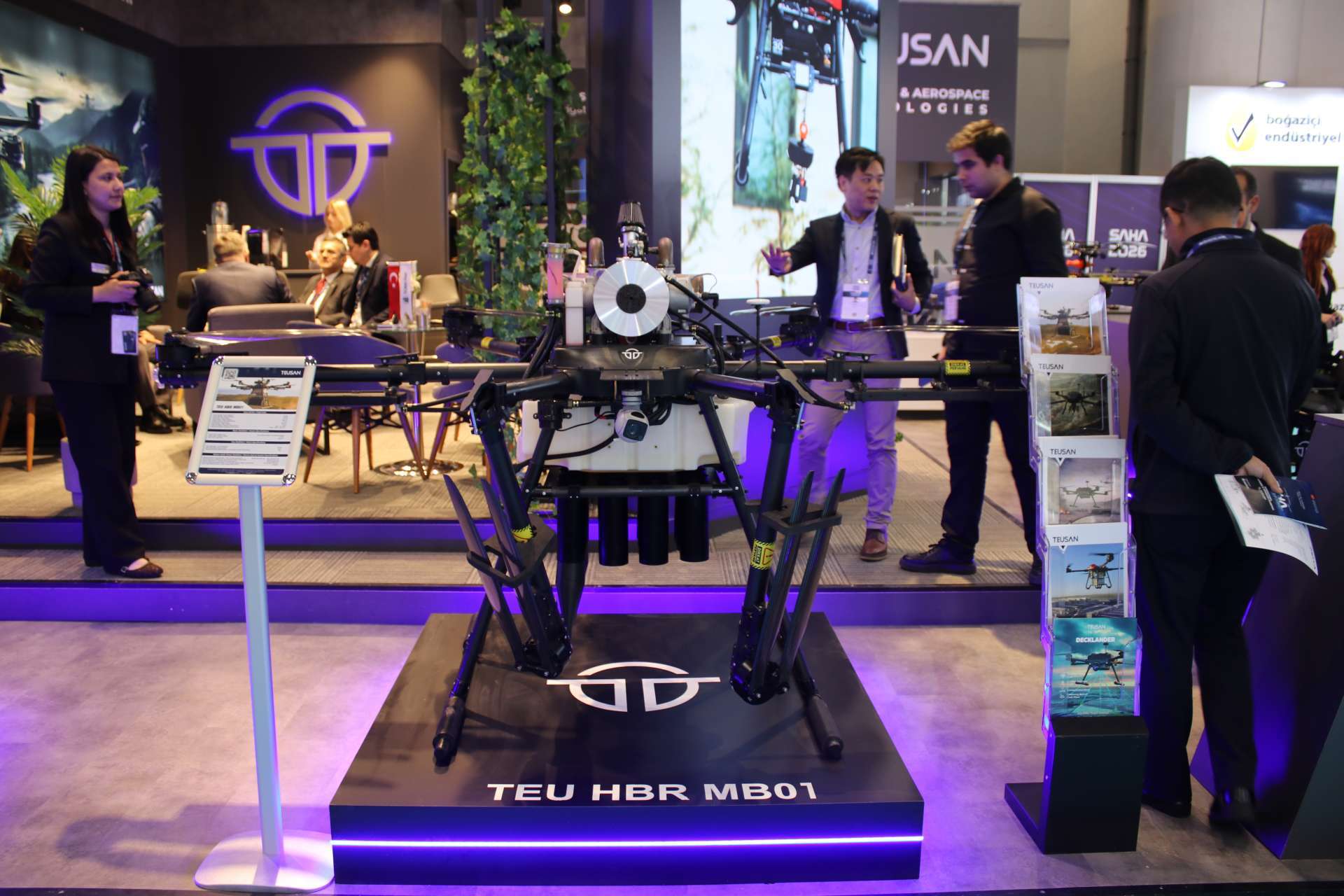
Turkish company TEUSAN displayed the TEU HBR MB01 hybrid multirotor UAV at SAHA 2026, showing a 50 kg payload-class drone with a two-hour endurance and automatic bomb-release mechanism for tactical resupply, surveillance, and controlled munition delivery (Picture source: Army Recognition Group).
The exhibition data card identifies the TEU HBR MB01 as a 76 kg drone with a 126 kg maximum takeoff weight and a 50 kg payload. It is listed with a 2,000 m flight altitude, 10 km flight distance, 20 km flight range, and 120 minutes of flight time, with an operating temperature envelope from -20°C to +60°C. Folded dimensions are given as 1,400 x 1,400 x 1,450 mm, which indicates that the aircraft is intended to be transportable by light vehicle rather than dependent on dedicated airfield infrastructure. The load system is described with a 55 kg carrying capacity, 30 m rope length, and an automatic bomber mechanism, suggesting that TEUSAN is positioning the aircraft for both underslung logistics and gravity-release strike missions.
The propulsion data is central to understanding the design. The MB01 uses a gasoline-fueled two-stroke engine rated at 27 hp, rather than relying only on onboard batteries. That choice usually reflects a trade-off: increased endurance and payload margin in exchange for higher acoustic and thermal signatures, more maintenance, and a more complex fuel and engine support chain. For tactical units, the practical advantage is time over target. A 120-minute endurance figure gives the operator enough margin for launch, transit, target search, release, battle damage observation, and return, whereas battery-powered heavy-lift quadcopters often lose endurance rapidly once loaded near maximum capacity.
The sensor fit shown on the TEUSAN data card also indicates that the MB01 is not designed only as a flying cargo carrier. The electro-optical package includes a day camera with 3840 x 2160 resolution at 30 frames per second, 40x optical zoom, an infrared camera sensor listed at 640 x 512 resolution at 30 frames per second, an infrared field of view of 22.9° x 18.4° with a 19 mm lens, and a laser rangefinder with a range greater than 1,200 m. These specifications matter because a bomber UAV has limited military value if it cannot locate and verify a target under poor light, at standoff distance, or from an altitude that reduces exposure to small-arms fire. The combination of zoom, thermal imagery, and laser ranging allows the crew to identify a fighting position, vehicle, mortar point, or logistics cache before release, although accuracy would still depend on stabilization, wind, flight-control software, release altitude, and the type of munition carried.
The automatic bomber mechanism is the distinguishing feature of the MB01 configuration displayed at SAHA. The term does not identify the exact munition family, fuse arrangement, release rack layout, or fire-control method, so it should not be treated as a confirmed precision-guided strike system. More likely, based on current battlefield practice, the aircraft is intended to carry multiple small gravity munitions or a heavier single load released from a controlled hover or slow forward flight. Compared with one-way loitering munitions, the reusable UAV has a different economic logic: the aircraft returns after the mission, but it must operate closer to enemy air defenses, electronic warfare systems, and small-arms engagement zones. This makes navigation resilience, datalink security, acoustic signature, and maintenance reliability as important as payload weight.
TEUSAN’s wider product background helps explain the MB01’s development path. The company’s public profile presents a progression from prototype work in the early 2020s toward hybrid UAVs for logistics, agriculture, mapping, surveillance, and reconnaissance. The MB01 appears to adapt that heavy-lift hybrid architecture for a military role by adding a release mechanism and a stronger sensor package. This is consistent with a broader Turkish trend in which civilian or dual-use UAV engineering is being modified for battlefield tasks, including resupply, target observation, and strike support.
No confirmed military operator was identified on the exhibition material, and no country can currently be described as a verified user of the TEU HBR MB01 based on the information displayed with the system. Türkiye would be the most plausible initial user or test environment because of the domestic supplier base, the country’s operational experience with UAVs, and its interest in low-cost unmanned strike options. Export prospects would depend on testing, munition certification, communications security, reliability under field conditions, and compliance with end-user controls. For a foreign army, the most realistic first use would not be deep strike, but battalion- or brigade-level missions within a controlled tactical radius: night interdiction, resupply of isolated positions, delivery of engineering or medical loads, observation of enemy trenches, and attacks against exposed logistics points.
In comparative terms, the MB01 sits between smaller battlefield bomber drones and heavier cargo UAVs. Ukraine’s Vampire-type heavy bomber drone is often associated with night attacks and a lower payload class, while the British Malloy T-150 is generally presented as a cargo UAV with a payload figure around 68 kg and higher dash speed, but without the same emphasis on a bomber mechanism in its baseline logistics role. DJI’s FlyCart 30 and FlyingBasket’s FB3 illustrate the commercial end of the heavy-lift market, with strong cargo relevance but no inherent military release system. The MB01’s operational value would therefore depend less on the headline 50 kg payload than on whether TEUSAN can demonstrate repeatable release accuracy, stable hovering under load, resistance to jamming, rapid field servicing, and safe integration with standardized munitions. Those factors will determine whether the TEU HBR MB01 remains a trade-show armed UAV concept or becomes a practical tactical aircraft for units that need a reusable, heavier-payload alternative to small quadcopters and expendable strike drones.
{loadposition bannertop}
{loadposition sidebarpub}
Turkish company TEUSAN unveiled the TEU HBR MB01 hybrid multirotor UAV at SAHA 2026 in Istanbul with an integrated automatic bomb-release system, highlighting a heavy rotary-wing drone built to deliver larger payloads and sustained battlefield support missions. The platform’s fuel-electric propulsion and 50 kg payload capacity, revealed during the exhibition, position it as a lower-cost alternative to helicopters and larger armed UAVs for precision strike, resupply, and persistent frontline operations.
Displayed at the Istanbul Expo Center alongside Turkish air defense, missile, and electronic warfare systems, the MB01 reflects the growing shift toward heavier unmanned aircraft able to combine endurance with controlled munition delivery. It’s reported that two-hour endurance expands operational flexibility for surveillance and strike missions while supporting the broader trend toward autonomous battlefield systems with greater lift capacity and survivability than commercial quadcopters.
Related topic: Türkiye HAN Deploys Baran Anti-Drone Weapon on Kangal UGV for Mobile Counter-UAS Defense.
Turkish company TEUSAN displayed the TEU HBR MB01 hybrid multirotor UAV at SAHA 2026, showing a 50 kg payload-class drone with a two-hour endurance and automatic bomb-release mechanism for tactical resupply, surveillance, and controlled munition delivery (Picture source: Army Recognition Group).
The exhibition data card identifies the TEU HBR MB01 as a 76 kg drone with a 126 kg maximum takeoff weight and a 50 kg payload. It is listed with a 2,000 m flight altitude, 10 km flight distance, 20 km flight range, and 120 minutes of flight time, with an operating temperature envelope from -20°C to +60°C. Folded dimensions are given as 1,400 x 1,400 x 1,450 mm, which indicates that the aircraft is intended to be transportable by light vehicle rather than dependent on dedicated airfield infrastructure. The load system is described with a 55 kg carrying capacity, 30 m rope length, and an automatic bomber mechanism, suggesting that TEUSAN is positioning the aircraft for both underslung logistics and gravity-release strike missions.
The propulsion data is central to understanding the design. The MB01 uses a gasoline-fueled two-stroke engine rated at 27 hp, rather than relying only on onboard batteries. That choice usually reflects a trade-off: increased endurance and payload margin in exchange for higher acoustic and thermal signatures, more maintenance, and a more complex fuel and engine support chain. For tactical units, the practical advantage is time over target. A 120-minute endurance figure gives the operator enough margin for launch, transit, target search, release, battle damage observation, and return, whereas battery-powered heavy-lift quadcopters often lose endurance rapidly once loaded near maximum capacity.
The sensor fit shown on the TEUSAN data card also indicates that the MB01 is not designed only as a flying cargo carrier. The electro-optical package includes a day camera with 3840 x 2160 resolution at 30 frames per second, 40x optical zoom, an infrared camera sensor listed at 640 x 512 resolution at 30 frames per second, an infrared field of view of 22.9° x 18.4° with a 19 mm lens, and a laser rangefinder with a range greater than 1,200 m. These specifications matter because a bomber UAV has limited military value if it cannot locate and verify a target under poor light, at standoff distance, or from an altitude that reduces exposure to small-arms fire. The combination of zoom, thermal imagery, and laser ranging allows the crew to identify a fighting position, vehicle, mortar point, or logistics cache before release, although accuracy would still depend on stabilization, wind, flight-control software, release altitude, and the type of munition carried.
The automatic bomber mechanism is the distinguishing feature of the MB01 configuration displayed at SAHA. The term does not identify the exact munition family, fuse arrangement, release rack layout, or fire-control method, so it should not be treated as a confirmed precision-guided strike system. More likely, based on current battlefield practice, the aircraft is intended to carry multiple small gravity munitions or a heavier single load released from a controlled hover or slow forward flight. Compared with one-way loitering munitions, the reusable UAV has a different economic logic: the aircraft returns after the mission, but it must operate closer to enemy air defenses, electronic warfare systems, and small-arms engagement zones. This makes navigation resilience, datalink security, acoustic signature, and maintenance reliability as important as payload weight.
TEUSAN’s wider product background helps explain the MB01’s development path. The company’s public profile presents a progression from prototype work in the early 2020s toward hybrid UAVs for logistics, agriculture, mapping, surveillance, and reconnaissance. The MB01 appears to adapt that heavy-lift hybrid architecture for a military role by adding a release mechanism and a stronger sensor package. This is consistent with a broader Turkish trend in which civilian or dual-use UAV engineering is being modified for battlefield tasks, including resupply, target observation, and strike support.
No confirmed military operator was identified on the exhibition material, and no country can currently be described as a verified user of the TEU HBR MB01 based on the information displayed with the system. Türkiye would be the most plausible initial user or test environment because of the domestic supplier base, the country’s operational experience with UAVs, and its interest in low-cost unmanned strike options. Export prospects would depend on testing, munition certification, communications security, reliability under field conditions, and compliance with end-user controls. For a foreign army, the most realistic first use would not be deep strike, but battalion- or brigade-level missions within a controlled tactical radius: night interdiction, resupply of isolated positions, delivery of engineering or medical loads, observation of enemy trenches, and attacks against exposed logistics points.
In comparative terms, the MB01 sits between smaller battlefield bomber drones and heavier cargo UAVs. Ukraine’s Vampire-type heavy bomber drone is often associated with night attacks and a lower payload class, while the British Malloy T-150 is generally presented as a cargo UAV with a payload figure around 68 kg and higher dash speed, but without the same emphasis on a bomber mechanism in its baseline logistics role. DJI’s FlyCart 30 and FlyingBasket’s FB3 illustrate the commercial end of the heavy-lift market, with strong cargo relevance but no inherent military release system. The MB01’s operational value would therefore depend less on the headline 50 kg payload than on whether TEUSAN can demonstrate repeatable release accuracy, stable hovering under load, resistance to jamming, rapid field servicing, and safe integration with standardized munitions. Those factors will determine whether the TEU HBR MB01 remains a trade-show armed UAV concept or becomes a practical tactical aircraft for units that need a reusable, heavier-payload alternative to small quadcopters and expendable strike drones.