U.S. Army Dark Eagle Hypersonic Missile Moves Toward Combat Deployment Under $2.7B Leidos Contract
{loadposition bannertop}
{loadposition sidebarpub}
Leidos has secured a $2.7 billion U.S. Army contract to push the Common Hypersonic Glide Body and its Thermal Protection Shield from testing into production, a move that could determine whether the Army’s Dark Eagle and the Navy’s Conventional Prompt Strike missiles become deployable combat weapons rather than limited demonstration systems. Announced by the Virginia-based company on May 12, 2026, the award strengthens the industrial backbone behind America’s long-range hypersonic strike effort after years of test failures, integration delays, and uncertain fielding timelines.
The contract focuses on the most technically demanding part of the weapon: the maneuvering glide body and heat shield that must survive atmospheric flight above Mach 5 while maintaining guidance, control, and strike accuracy against heavily defended targets. Because the Army and Navy share the same hypersonic architecture, reliable production of these components is critical for expanding U.S. long-range precision strike capability in potential Indo-Pacific conflicts where speed, survivability, and the ability to penetrate advanced air defenses are increasingly central to deterrence and operational planning.
Related topic: US puts new Dark Eagle hypersonic missile under Strategic Command control for key global strike missions.
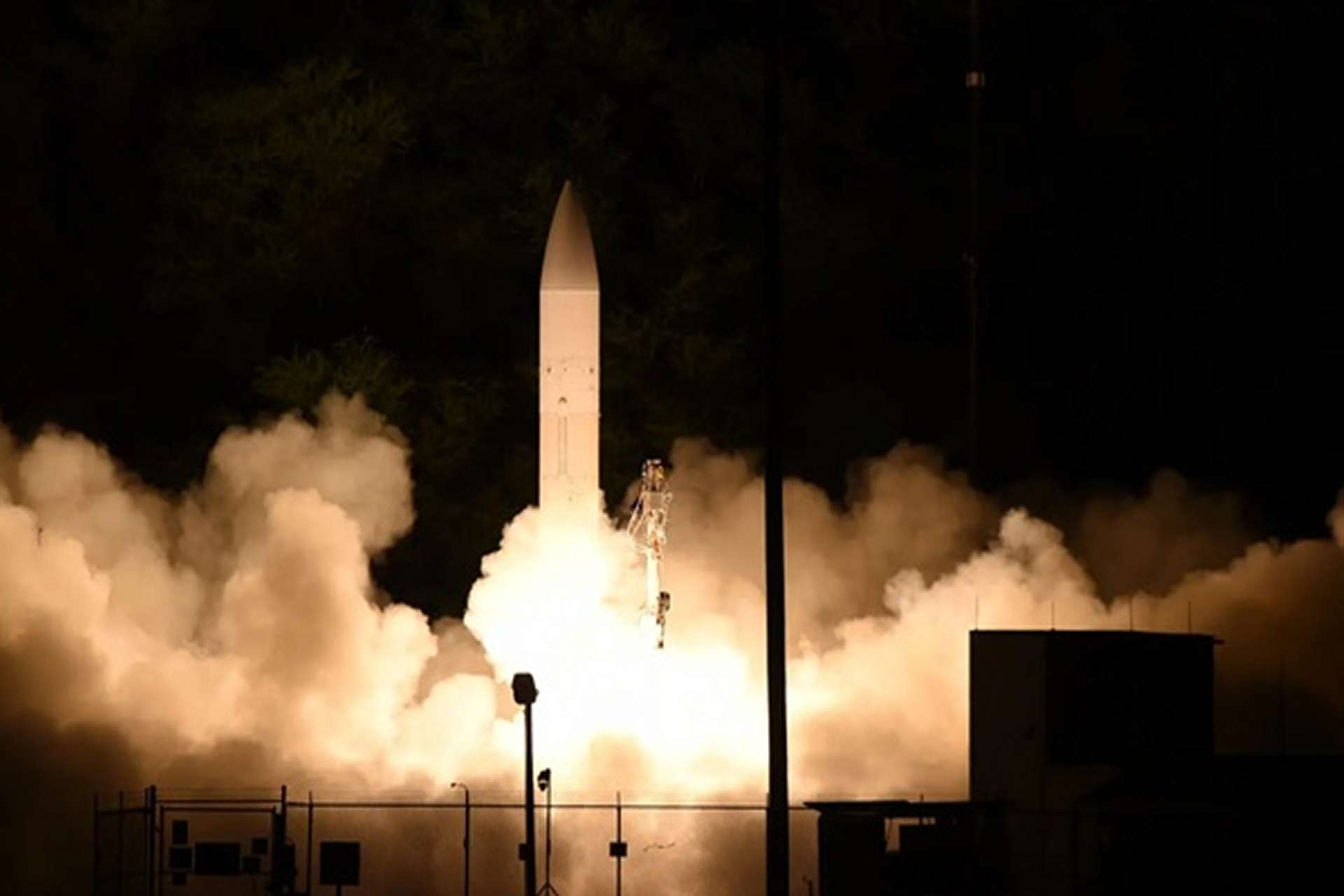
Leidos will accelerate production of the Common Hypersonic Glide Body and Thermal Protection Shield for the U.S. Army’s Dark Eagle and the U.S. Navy’s Conventional Prompt Strike missile, supporting a shared hypersonic strike capability designed to engage high-value, time-sensitive targets at long range (Picture source: U.S. DoW).
The Common Hypersonic Glide Body is the maneuvering payload section shared by the Army and Navy, while the Thermal Protection Shield protects the vehicle, guidance equipment, warhead section, wiring, and structural materials during atmospheric flight at speeds above Mach 5. In practical terms, this is the part of the missile that separates after boost, flies inside the atmosphere rather than following a predictable high ballistic arc, and uses lift and maneuver to complicate tracking and interception. The Congressional Research Service notes that the Army missile uses the C-HGB with the Navy’s 34.5-inch booster, forming the All Up Round plus Canister carried by Army launchers and adapted for Navy use. That common architecture explains why the Leidos contract matters for both services: production failure in the glide body or heat shield would affect the Army’s road-mobile Dark Eagle missile and the Navy’s sea-based Conventional Prompt Strike missile at the same time.
For the Army, Dark Eagle is planned as a battery-level weapon, not a massed rocket artillery asset. A Long-Range Hypersonic Weapon battery consists of four transporter erector launchers on modified M870A4 trailers, with two All Up Rounds per launcher, giving a full battery eight missiles; it also includes one Battery Operations Center and one support vehicle. The reported range is about 1,725 miles, with the Army describing the missile as capable of traveling well above 3,800 miles per hour and operating near the upper atmosphere until the terminal phase. Bravo Battery, 1st Battalion, 17th Field Artillery Regiment, 3rd Multi-Domain Task Force, was activated at Joint Base Lewis-McChord on December 12, 2025, to operate Dark Eagle, after the 3rd Multi-Domain Task Force had demonstrated deployment of the missile equipment to Australia in July 2025. This links the weapon directly to Indo-Pacific operational planning rather than to continental test activity alone.
The technical challenge is not simply speed: a hypersonic glide vehicle must survive aerodynamic heating, pressure loads, vibration, plasma effects, and control-surface stress while still keeping its inertial navigation, mission computer, actuators, and warhead functioning accurately. The Congressional Budget Office assessed that shielding electronics, predicting aerodynamics, and validating materials at sustained temperatures as high as 3,000 degrees Fahrenheit require extensive flight testing. This explains the emphasis on the Thermal Protection Shield in the Leidos award: if thermal margins are inadequate, the missile may still launch correctly but fail later through guidance degradation, structural deformation, or loss of control authority. It also explains why production is difficult. Unlike a conventional ballistic reentry body, the glide vehicle spends much of its flight in the atmosphere, where maneuverability gives tactical benefit but also increases thermal and structural demands.
The development record shows a program moving forward, but not without measurable friction. The common Army-Navy missile effort suffered a failed first All Up Round test in June 2022, followed by missed or scrubbed test events in March and September 2023 because of preflight issues. Successful end-to-end tests were conducted in June and December 2024, with the December event using an Army Battery Operations Center and transporter erector launcher for the first time. CRS reported that the Army had missed its original fiscal year 2023 fielding goal and that integration issues affected missile production, because the first operational battery could not be completed until the current design was demonstrated through flight testing. The March 26, 2026, launch, therefore, matters because it adds another data point after the 2024 recovery sequence and supports the transition from demonstration missiles to repeatable manufacturing.
The United States needs this type of missile for a narrow but important mission set: striking high-value, time-sensitive, heavily defended targets at ranges where aircraft, shorter-range missiles, or forward bases may not be available early in a conflict. CBO concluded that hypersonic missiles are most relevant when a target must be hit within roughly 15 to 30 minutes from thousands of kilometers away, particularly in anti-access and area-denial scenarios involving China or Russia. The likely targets are not generic battlefield positions, but air-defense nodes, long-range missile launchers, over-the-horizon radars, command posts, and other assets that enable an adversary to keep U.S. forces at a distance. The same CBO analysis is also a warning against overstatement: hypersonic weapons are costly and would probably be a limited-inventory option, not a substitute for Tomahawk cruise missiles, Precision Strike Missiles, SM-6 variants, or future lower-cost ballistic missiles with maneuverable reentry vehicles.
For the Navy, the same missile family is intended to put conventional prompt strike at sea. NAVSEA has stated that Conventional Prompt Strike is planned for Zumwalt-class guided-missile destroyers starting in the mid-2020s and for Block V Virginia-class attack submarines starting in the early 2030s. The Zumwalt integration replaces the ship’s original 155 mm Advanced Gun System mission with large missile tubes for the CPS All Up Round, while the submarine variant would provide a harder-to-detect launch option. The common missile gives the Navy and Army a shared industrial base, but it also creates shared exposure: booster production, C-HGB output, heat-shield quality control, canister integration, and test-range capacity all become pacing factors. This is why the Leidos contract should be read as a production-capacity measure, not only as a technology award.
The foreign comparison is the main reason U.S. hypersonic development has congressional attention. China already fields the DF-17, a road-mobile medium-range ballistic missile carrying the DF-ZF hypersonic glide vehicle; CSIS lists the DF-17 at 11 meters long, about 15,000 kg launch weight, Mach 5-10 glide speed, and 1,800-2,500 km range. CRS also states that China’s DF-27 likely has a hypersonic glide payload option with conventional land-attack, anti-ship, and nuclear roles, while Russia fields Avangard as a nuclear intercontinental glide vehicle and has deployed Zircon and Kinzhal for regional strike missions. India, France, Australia, Japan, Germany, South Korea, and others are developing related technologies, but China and Russia have done more to place hypersonic weapons into operational force structures. The U.S. issue is therefore not whether hypersonic flight is technically possible; it is whether the United States can produce enough reliable missiles, train enough crews, and connect enough sensors to make Dark Eagle and CPS usable in a real contingency rather than only successful in controlled flight tests.
{loadposition bannertop}
{loadposition sidebarpub}
Leidos has secured a $2.7 billion U.S. Army contract to push the Common Hypersonic Glide Body and its Thermal Protection Shield from testing into production, a move that could determine whether the Army’s Dark Eagle and the Navy’s Conventional Prompt Strike missiles become deployable combat weapons rather than limited demonstration systems. Announced by the Virginia-based company on May 12, 2026, the award strengthens the industrial backbone behind America’s long-range hypersonic strike effort after years of test failures, integration delays, and uncertain fielding timelines.
The contract focuses on the most technically demanding part of the weapon: the maneuvering glide body and heat shield that must survive atmospheric flight above Mach 5 while maintaining guidance, control, and strike accuracy against heavily defended targets. Because the Army and Navy share the same hypersonic architecture, reliable production of these components is critical for expanding U.S. long-range precision strike capability in potential Indo-Pacific conflicts where speed, survivability, and the ability to penetrate advanced air defenses are increasingly central to deterrence and operational planning.
Related topic: US puts new Dark Eagle hypersonic missile under Strategic Command control for key global strike missions.
Leidos will accelerate production of the Common Hypersonic Glide Body and Thermal Protection Shield for the U.S. Army’s Dark Eagle and the U.S. Navy’s Conventional Prompt Strike missile, supporting a shared hypersonic strike capability designed to engage high-value, time-sensitive targets at long range (Picture source: U.S. DoW).
The Common Hypersonic Glide Body is the maneuvering payload section shared by the Army and Navy, while the Thermal Protection Shield protects the vehicle, guidance equipment, warhead section, wiring, and structural materials during atmospheric flight at speeds above Mach 5. In practical terms, this is the part of the missile that separates after boost, flies inside the atmosphere rather than following a predictable high ballistic arc, and uses lift and maneuver to complicate tracking and interception. The Congressional Research Service notes that the Army missile uses the C-HGB with the Navy’s 34.5-inch booster, forming the All Up Round plus Canister carried by Army launchers and adapted for Navy use. That common architecture explains why the Leidos contract matters for both services: production failure in the glide body or heat shield would affect the Army’s road-mobile Dark Eagle missile and the Navy’s sea-based Conventional Prompt Strike missile at the same time.
For the Army, Dark Eagle is planned as a battery-level weapon, not a massed rocket artillery asset. A Long-Range Hypersonic Weapon battery consists of four transporter erector launchers on modified M870A4 trailers, with two All Up Rounds per launcher, giving a full battery eight missiles; it also includes one Battery Operations Center and one support vehicle. The reported range is about 1,725 miles, with the Army describing the missile as capable of traveling well above 3,800 miles per hour and operating near the upper atmosphere until the terminal phase. Bravo Battery, 1st Battalion, 17th Field Artillery Regiment, 3rd Multi-Domain Task Force, was activated at Joint Base Lewis-McChord on December 12, 2025, to operate Dark Eagle, after the 3rd Multi-Domain Task Force had demonstrated deployment of the missile equipment to Australia in July 2025. This links the weapon directly to Indo-Pacific operational planning rather than to continental test activity alone.
The technical challenge is not simply speed: a hypersonic glide vehicle must survive aerodynamic heating, pressure loads, vibration, plasma effects, and control-surface stress while still keeping its inertial navigation, mission computer, actuators, and warhead functioning accurately. The Congressional Budget Office assessed that shielding electronics, predicting aerodynamics, and validating materials at sustained temperatures as high as 3,000 degrees Fahrenheit require extensive flight testing. This explains the emphasis on the Thermal Protection Shield in the Leidos award: if thermal margins are inadequate, the missile may still launch correctly but fail later through guidance degradation, structural deformation, or loss of control authority. It also explains why production is difficult. Unlike a conventional ballistic reentry body, the glide vehicle spends much of its flight in the atmosphere, where maneuverability gives tactical benefit but also increases thermal and structural demands.
The development record shows a program moving forward, but not without measurable friction. The common Army-Navy missile effort suffered a failed first All Up Round test in June 2022, followed by missed or scrubbed test events in March and September 2023 because of preflight issues. Successful end-to-end tests were conducted in June and December 2024, with the December event using an Army Battery Operations Center and transporter erector launcher for the first time. CRS reported that the Army had missed its original fiscal year 2023 fielding goal and that integration issues affected missile production, because the first operational battery could not be completed until the current design was demonstrated through flight testing. The March 26, 2026, launch, therefore, matters because it adds another data point after the 2024 recovery sequence and supports the transition from demonstration missiles to repeatable manufacturing.
The United States needs this type of missile for a narrow but important mission set: striking high-value, time-sensitive, heavily defended targets at ranges where aircraft, shorter-range missiles, or forward bases may not be available early in a conflict. CBO concluded that hypersonic missiles are most relevant when a target must be hit within roughly 15 to 30 minutes from thousands of kilometers away, particularly in anti-access and area-denial scenarios involving China or Russia. The likely targets are not generic battlefield positions, but air-defense nodes, long-range missile launchers, over-the-horizon radars, command posts, and other assets that enable an adversary to keep U.S. forces at a distance. The same CBO analysis is also a warning against overstatement: hypersonic weapons are costly and would probably be a limited-inventory option, not a substitute for Tomahawk cruise missiles, Precision Strike Missiles, SM-6 variants, or future lower-cost ballistic missiles with maneuverable reentry vehicles.
For the Navy, the same missile family is intended to put conventional prompt strike at sea. NAVSEA has stated that Conventional Prompt Strike is planned for Zumwalt-class guided-missile destroyers starting in the mid-2020s and for Block V Virginia-class attack submarines starting in the early 2030s. The Zumwalt integration replaces the ship’s original 155 mm Advanced Gun System mission with large missile tubes for the CPS All Up Round, while the submarine variant would provide a harder-to-detect launch option. The common missile gives the Navy and Army a shared industrial base, but it also creates shared exposure: booster production, C-HGB output, heat-shield quality control, canister integration, and test-range capacity all become pacing factors. This is why the Leidos contract should be read as a production-capacity measure, not only as a technology award.
The foreign comparison is the main reason U.S. hypersonic development has congressional attention. China already fields the DF-17, a road-mobile medium-range ballistic missile carrying the DF-ZF hypersonic glide vehicle; CSIS lists the DF-17 at 11 meters long, about 15,000 kg launch weight, Mach 5-10 glide speed, and 1,800-2,500 km range. CRS also states that China’s DF-27 likely has a hypersonic glide payload option with conventional land-attack, anti-ship, and nuclear roles, while Russia fields Avangard as a nuclear intercontinental glide vehicle and has deployed Zircon and Kinzhal for regional strike missions. India, France, Australia, Japan, Germany, South Korea, and others are developing related technologies, but China and Russia have done more to place hypersonic weapons into operational force structures. The U.S. issue is therefore not whether hypersonic flight is technically possible; it is whether the United States can produce enough reliable missiles, train enough crews, and connect enough sensors to make Dark Eagle and CPS usable in a real contingency rather than only successful in controlled flight tests.