U.S. Marines to Replace F/A-18 Hornet by 2030 with 420 F-35 Fighters for Indo-Pacific Warfare
{loadposition bannertop}
{loadposition sidebarpub}
The U.S. Marine Corps is approaching the final stage of a sweeping transformation of its tactical aviation force as it prepares to retire the F/A-18 Hornet by 2030 and transition almost entirely to the Lockheed Martin F-35 Lightning II, according to information released as the service accelerates modernization of its combat air arm. The shift marks more than the replacement of a legacy fighter platform, as Marine aviation is being reorganized around survivability, sensor fusion, and distributed operations designed to operate inside heavily contested battlespaces against advanced air defense threats.
The F-35 will become the backbone of Marine expeditionary air power, combining stealth, advanced sensors, and networked targeting capabilities that allow dispersed units to detect, share, and engage threats across a wider battlespace with greater speed and survivability. The transition also reshapes pilot training, maintenance infrastructure, and expeditionary deployment concepts, reflecting a broader U.S. military move toward smaller but more connected fifth-generation combat forces optimized for future high-intensity warfare.
Related Topic: U.S. Marine VMFA 224 replaces F/A-18D fighter jets with F-35B gaining stealth power.
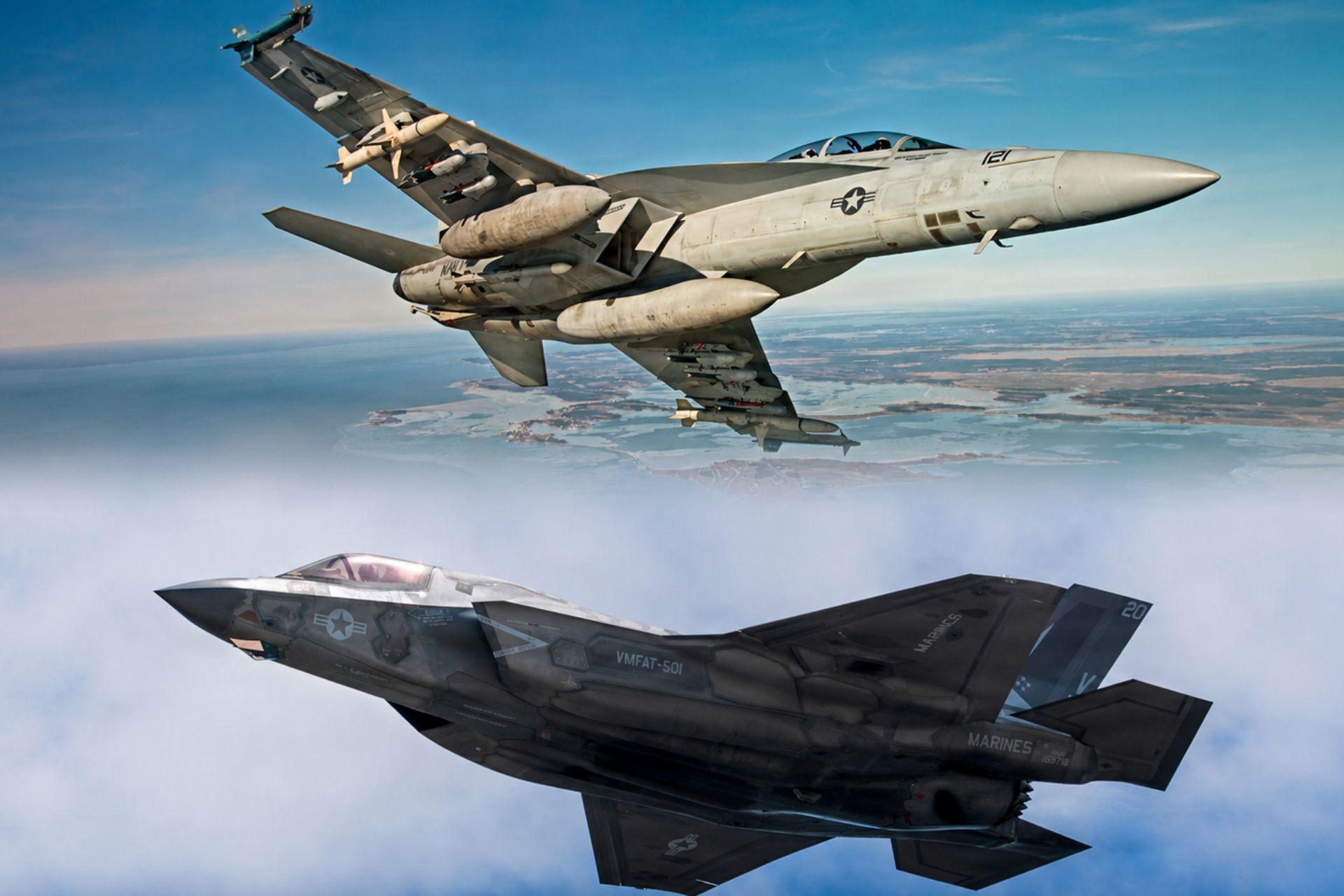
U.S. Marine Corps F/A-18 Hornet fighters prepare for retirement as the service transitions to a 420-aircraft F-35 fleet focused on Indo-Pacific operations. (Picture source: US DoD)
For Marine aviation planners, the transition is no longer simply about replacing aging airframes. The F/A-18 Hornet still provides reliable strike and close-air-support capabilities, yet its survivability margin continues to narrow against modern integrated air-defense systems equipped with Active Electronically Scanned Array (AESA) radars, long-range surface-to-air missiles, and layered electronic-warfare architectures. At the same time, the Marine Corps increasingly prioritizes Expeditionary Advanced Base Operations (EABO), a concept requiring aircraft capable of operating from dispersed locations, amphibious assault ships, and temporary forward positions across contested maritime regions. In that environment, stealth, sensor networking, and rapid data-sharing become operational necessities rather than optional enhancements.
Stars and Stripes reported on 8 May 2026 that an internal administrative message confirmed the complete retirement timeline for the Hornet fleet and the elimination of maintenance occupations tied directly to the aircraft. The message states that Marines serving in specialties linked to the F/A-18 airframe, power plant systems, electrical systems, navigation equipment, and radar maintenance will either retrain for F-35-related functions, transfer to other occupations, or leave the service at the end of their enlistment contracts. The memo also warns that no future promotion or retention opportunities will remain inside the shrinking F/A-18 maintenance community, illustrating how deeply the transition extends beyond operational squadrons alone.
The withdrawal schedule now provides a precise roadmap for the end of Marine Hornet operations. Marine Corps Air Station Beaufort in South Carolina is expected to complete the transition by August 2028, followed by Marine Corps Air Station Miramar in California in August 2029. The final Marine Corps Hornets stationed at Naval Air Station Joint Reserve Base Fort Worth in Texas are scheduled to leave service in August 2030. Meanwhile, the Marine Aviation Plan 2026 calls for an eventual fleet of approximately 420 F-35 aircraft distributed between the F-35B and F-35C variants.
The Marine Corps relies primarily on the F-35B Short Takeoff and Vertical Landing (STOVL) variant, an aircraft specifically designed for expeditionary operations from short runways and amphibious assault ships. Powered by the Pratt & Whitney F135 engine generating roughly 43,000 pounds of thrust, the F-35B uses a shaft-driven lift fan system that enables vertical landing operations while preserving supersonic flight capability. The F-35C carrier variant, intended for operations aboard U.S. Navy aircraft carriers, incorporates larger wings, reinforced landing gear, and expanded fuel capacity to support catapult launches and arrested recoveries during long-range maritime strike missions.
The technological gap separating the F-35 from legacy Marine Hornets extends far beyond stealth characteristics alone. The aircraft integrates the AN/APG-81 Active Electronically Scanned Array (AESA) radar, the Electro-Optical Targeting System (EOTS), and the Distributed Aperture System (DAS), allowing pilots to track multiple airborne and surface targets while maintaining reduced radar observability. Through Multifunction Advanced Data Link (MADL) and Link 16 connectivity, the aircraft can transmit targeting data to naval vessels, airborne warning aircraft, artillery units, and other combat assets in near real time. In practice, the F-35 increasingly functions as an airborne sensor and command node capable of feeding information into a broader joint-force kill chain rather than operating solely as a strike fighter.
This evolution aligns closely with Marine Corps concepts for distributed maritime warfare in the Indo-Pacific theater. The F-35B allows aviation detachments to disperse across island chains, austere expeditionary strips, and amphibious vessels while retaining precision-strike capability close to contested littoral zones. Its reduced radar signature complicates enemy targeting cycles during the opening phases of a conflict, particularly against anti-access and area-denial networks developed by China. Internal carriage of AIM-120 Advanced Medium Range Air-to-Air Missiles (AMRAAM) and Joint Direct Attack Munition (JDAM) precision-guided bombs enables stealth strike operations before hostile radar systems can fully establish targeting solutions. Nevertheless, the aircraft still faces sustainment challenges linked to maintenance complexity, spare-parts availability, and operational readiness rates that remain under scrutiny within the Pentagon.
The Marine Corps is also accepting a structural risk by concentrating most of its tactical aviation capability around a single aircraft family. Earlier generations of Marine aviation distributed operational risk between Harrier, Hornet, and other legacy systems. By contrast, the future force will depend heavily on the availability and resilience of the F-35 ecosystem itself. Although this standardization simplifies logistics, pilot training, software integration, and network interoperability, it also increases exposure should technical issues affect the fleet globally.
At the geopolitical level, the retirement of the Marine Hornet fleet reflects the accelerating shift of U.S. military planning toward high-intensity competition with peer adversaries in the Indo-Pacific. Washington increasingly prioritizes low-observable aircraft capable of surviving inside heavily defended battlespaces while contributing to distributed sensor and strike networks shared with allied forces. The Marine Corps therefore, becomes one of the first major American combat aviation branches moving toward an almost entirely fifth-generation tactical fleet. More broadly, the disappearance of the F/A-18 Hornet from Marine service symbolizes the gradual end of the post-Cold War expeditionary aviation model and the emergence of a force structure built around persistent connectivity, distributed lethality, and multi-domain operations against technologically advanced opponents.
{loadposition bannertop}
{loadposition sidebarpub}
The U.S. Marine Corps is approaching the final stage of a sweeping transformation of its tactical aviation force as it prepares to retire the F/A-18 Hornet by 2030 and transition almost entirely to the Lockheed Martin F-35 Lightning II, according to information released as the service accelerates modernization of its combat air arm. The shift marks more than the replacement of a legacy fighter platform, as Marine aviation is being reorganized around survivability, sensor fusion, and distributed operations designed to operate inside heavily contested battlespaces against advanced air defense threats.
The F-35 will become the backbone of Marine expeditionary air power, combining stealth, advanced sensors, and networked targeting capabilities that allow dispersed units to detect, share, and engage threats across a wider battlespace with greater speed and survivability. The transition also reshapes pilot training, maintenance infrastructure, and expeditionary deployment concepts, reflecting a broader U.S. military move toward smaller but more connected fifth-generation combat forces optimized for future high-intensity warfare.
Related Topic: U.S. Marine VMFA 224 replaces F/A-18D fighter jets with F-35B gaining stealth power.
U.S. Marine Corps F/A-18 Hornet fighters prepare for retirement as the service transitions to a 420-aircraft F-35 fleet focused on Indo-Pacific operations. (Picture source: US DoD)
For Marine aviation planners, the transition is no longer simply about replacing aging airframes. The F/A-18 Hornet still provides reliable strike and close-air-support capabilities, yet its survivability margin continues to narrow against modern integrated air-defense systems equipped with Active Electronically Scanned Array (AESA) radars, long-range surface-to-air missiles, and layered electronic-warfare architectures. At the same time, the Marine Corps increasingly prioritizes Expeditionary Advanced Base Operations (EABO), a concept requiring aircraft capable of operating from dispersed locations, amphibious assault ships, and temporary forward positions across contested maritime regions. In that environment, stealth, sensor networking, and rapid data-sharing become operational necessities rather than optional enhancements.
Stars and Stripes reported on 8 May 2026 that an internal administrative message confirmed the complete retirement timeline for the Hornet fleet and the elimination of maintenance occupations tied directly to the aircraft. The message states that Marines serving in specialties linked to the F/A-18 airframe, power plant systems, electrical systems, navigation equipment, and radar maintenance will either retrain for F-35-related functions, transfer to other occupations, or leave the service at the end of their enlistment contracts. The memo also warns that no future promotion or retention opportunities will remain inside the shrinking F/A-18 maintenance community, illustrating how deeply the transition extends beyond operational squadrons alone.
The withdrawal schedule now provides a precise roadmap for the end of Marine Hornet operations. Marine Corps Air Station Beaufort in South Carolina is expected to complete the transition by August 2028, followed by Marine Corps Air Station Miramar in California in August 2029. The final Marine Corps Hornets stationed at Naval Air Station Joint Reserve Base Fort Worth in Texas are scheduled to leave service in August 2030. Meanwhile, the Marine Aviation Plan 2026 calls for an eventual fleet of approximately 420 F-35 aircraft distributed between the F-35B and F-35C variants.
The Marine Corps relies primarily on the F-35B Short Takeoff and Vertical Landing (STOVL) variant, an aircraft specifically designed for expeditionary operations from short runways and amphibious assault ships. Powered by the Pratt & Whitney F135 engine generating roughly 43,000 pounds of thrust, the F-35B uses a shaft-driven lift fan system that enables vertical landing operations while preserving supersonic flight capability. The F-35C carrier variant, intended for operations aboard U.S. Navy aircraft carriers, incorporates larger wings, reinforced landing gear, and expanded fuel capacity to support catapult launches and arrested recoveries during long-range maritime strike missions.
The technological gap separating the F-35 from legacy Marine Hornets extends far beyond stealth characteristics alone. The aircraft integrates the AN/APG-81 Active Electronically Scanned Array (AESA) radar, the Electro-Optical Targeting System (EOTS), and the Distributed Aperture System (DAS), allowing pilots to track multiple airborne and surface targets while maintaining reduced radar observability. Through Multifunction Advanced Data Link (MADL) and Link 16 connectivity, the aircraft can transmit targeting data to naval vessels, airborne warning aircraft, artillery units, and other combat assets in near real time. In practice, the F-35 increasingly functions as an airborne sensor and command node capable of feeding information into a broader joint-force kill chain rather than operating solely as a strike fighter.
This evolution aligns closely with Marine Corps concepts for distributed maritime warfare in the Indo-Pacific theater. The F-35B allows aviation detachments to disperse across island chains, austere expeditionary strips, and amphibious vessels while retaining precision-strike capability close to contested littoral zones. Its reduced radar signature complicates enemy targeting cycles during the opening phases of a conflict, particularly against anti-access and area-denial networks developed by China. Internal carriage of AIM-120 Advanced Medium Range Air-to-Air Missiles (AMRAAM) and Joint Direct Attack Munition (JDAM) precision-guided bombs enables stealth strike operations before hostile radar systems can fully establish targeting solutions. Nevertheless, the aircraft still faces sustainment challenges linked to maintenance complexity, spare-parts availability, and operational readiness rates that remain under scrutiny within the Pentagon.
The Marine Corps is also accepting a structural risk by concentrating most of its tactical aviation capability around a single aircraft family. Earlier generations of Marine aviation distributed operational risk between Harrier, Hornet, and other legacy systems. By contrast, the future force will depend heavily on the availability and resilience of the F-35 ecosystem itself. Although this standardization simplifies logistics, pilot training, software integration, and network interoperability, it also increases exposure should technical issues affect the fleet globally.
At the geopolitical level, the retirement of the Marine Hornet fleet reflects the accelerating shift of U.S. military planning toward high-intensity competition with peer adversaries in the Indo-Pacific. Washington increasingly prioritizes low-observable aircraft capable of surviving inside heavily defended battlespaces while contributing to distributed sensor and strike networks shared with allied forces. The Marine Corps therefore, becomes one of the first major American combat aviation branches moving toward an almost entirely fifth-generation tactical fleet. More broadly, the disappearance of the F/A-18 Hornet from Marine service symbolizes the gradual end of the post-Cold War expeditionary aviation model and the emergence of a force structure built around persistent connectivity, distributed lethality, and multi-domain operations against technologically advanced opponents.