Belgium Moves Toward Armed MQ-9B with U.S. Hellfire and UK Brimstone Missiles for NATO Strike Missions
{loadposition bannertop}
{loadposition sidebarpub}
Belgium is preparing to field an armed MQ-9B SkyGuardian capability as the Ministry of Defence advances missile acquisitions for the Air Component’s future drone fleet at Florennes Air Base, transforming the platform from a surveillance asset into a precision-strike system. The move, highlighted as Brussels deepens integration of European and U.S. weapons, expands Belgium’s ability to conduct rapid counterterrorism operations, support ground forces, and contribute more directly to NATO combat and deterrence missions.
The planned integration of air-to-ground missiles will give the MQ-9B the ability to engage targets with precision while maintaining long-endurance intelligence and surveillance coverage across contested areas. The shift reflects a broader NATO trend toward arming remotely piloted aircraft to combine persistent reconnaissance with immediate strike capability, reducing response times and increasing operational flexibility in future coalition operations.
Related News: US approves AGM-184 Joint Strike Missile sale to Belgium for F-35A stealth strike operations
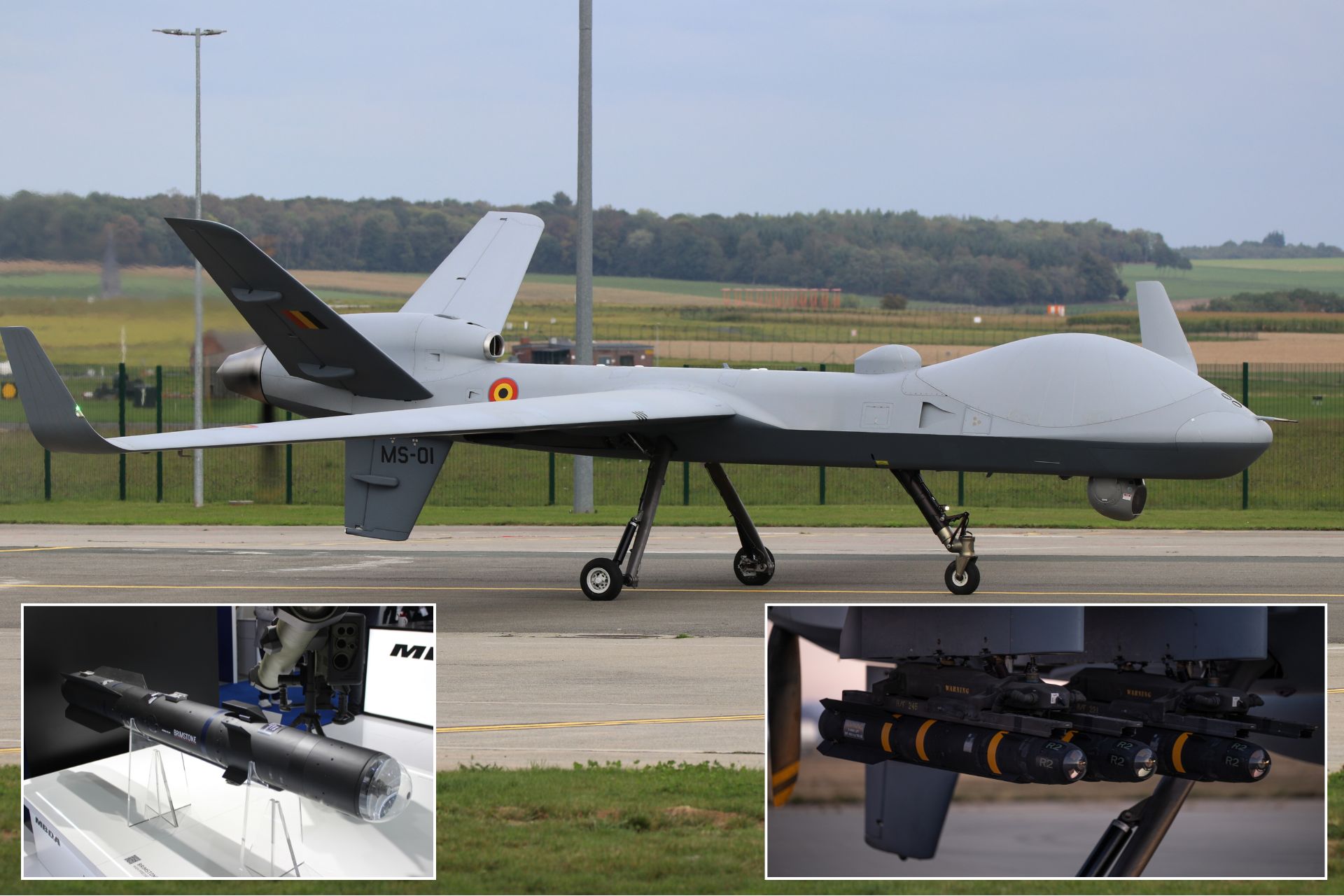
Belgium’s first MQ-9B SkyGuardian during its rollout presentation at Florennes Air Base with added Brimstone (left) and Hellfire (right) missile images (Picture source: Army Recognition Group)
The MQ-9B program represents one of Belgium’s largest recent investments in unmanned aerial systems. Brussels ordered four MQ-9B SkyGuardian drones from U.S. manufacturer General Atomics Aeronautical Systems, with options allowing the fleet to expand to six aircraft. The contract, which includes ground-control stations, training, infrastructure, and logistical support, amounts to several hundred million euros. The first aircraft arrived at Florennes Air Base in August 2025 and conducted its first flight in Belgian airspace on September 23, 2025. Before the MQ-9B acquisition, Belgium already operated MQ-9A Reaper drones primarily for ISR missions, including deployments in the Sahel and within allied operations, but without an integrated strike capability.
Designed as the latest development within the MQ-9 family, the SkyGuardian can remain airborne for more than 40 hours depending on mission configuration, operate above 12,000 meters, and integrate into civilian-controlled airspace through its detect-and-avoid systems. The aircraft also uses beyond-line-of-sight satellite communications, electro-optical and infrared sensors, and an open architecture allowing the future integration of additional payloads and weapons. These characteristics provide Belgium with a broader persistent-surveillance capability than its previous ISR assets.
Army Recognition reported in September 2025 that Belgian Air Component Commander Major General Geert De Decker confirmed the Belgian military was actively studying the integration of precision-guided munitions onto the MQ-9B, with the Brimstone missile specifically identified among the candidate systems under consideration. Information published on May 22, 2026, by Belgian media now indicates that the preparatory phase is moving into concrete procurement decisions. A separate €10 million contract has been placed with MBDA for Brimstone missiles, while a package valued at approximately $30 million is expected to cover AGM-114 Hellfire missiles and associated support equipment.
The Brimstone missile developed by MBDA UK is one of the best-known lightweight air-to-ground missiles currently used by European air forces. Originally designed as an anti-armor weapon, it progressively evolved into a multi-role precision munition capable of engaging moving vehicles, small maritime targets, and lightly protected objectives with reduced collateral effects. The missile combines a millimeter-wave radar seeker with semi-active laser guidance in its latest configurations, allowing either autonomous fire-and-forget engagements or laser-designated attacks depending on operational requirements. Its operational use by the Royal Air Force in Libya, Iraq, and Syria contributed to its adoption in environments where target discrimination and controlled effects are operational priorities.
Belgium is simultaneously advancing the integration of the U.S.-made AGM-114R2 Hellfire missile. Already widely used on MQ-9 drones operated by the United States and allied countries, the Hellfire represents a mature solution fully compatible with the SkyGuardian architecture. The AGM-114R2 measures approximately 1.8 meters in length, weighs around 49 kilograms, and reaches speeds close to Mach 1.3 through a solid-fuel rocket motor. Guidance relies on semi-active laser homing, requiring continuous target illumination either from the drone itself or from a separate airborne or ground-based designator. Its programmable multi-purpose warhead can be configured for direct impact, delayed penetration, or airburst effects against vehicles, fortified positions, or infantry groups.
Operationally, the Brimstone and Hellfire combination gives the Belgian MQ-9B fleet complementary engagement profiles. Brimstone provides rapid engagement capability against moving targets with greater terminal autonomy through its radar seeker, while Hellfire remains a widely used and comparatively straightforward weapon suited for long-duration armed-surveillance missions. A Belgian MQ-9B could therefore monitor an area for several hours before immediately engaging a hostile vehicle, light boat, or hostile firing position identified through onboard electro-optical systems. Within NATO operations, this endurance also allows the maintenance of persistent armed overwatch with fewer crewed-aircraft sorties.
The development reflects a wider doctrinal evolution visible across several European NATO members since the beginning of the war in Ukraine and the increase in hybrid activities near the alliance’s eastern borders. For several years, Belgium maintained a cautious position regarding armed Medium Altitude Long Endurance (MALE) drones because of parliamentary debates linked to rules of engagement and political oversight of force employment. Those reservations are progressively giving way to a more pragmatic approach centered on the controlled integration of precision-strike systems within NATO operational architectures. In the longer term, Belgian MQ-9Bs operating alongside future F-35A aircraft and allied command networks are expected to contribute to a distributed surveillance and precision-strike structure increasingly central to European deterrence planning.
Written By Erwan Halna du Fretay – Defense Analyst, Army Recognition GroupErwan Halna du Fretay holds a Master’s degree in International Relations and has experience studying conflicts and global arms transfers. His research interests lie in security and strategic studies, particularly the dynamics of the defense industry, the evolution of military technologies, and the strategic transformation of armed forces.
{loadposition bannertop}
{loadposition sidebarpub}
Belgium is preparing to field an armed MQ-9B SkyGuardian capability as the Ministry of Defence advances missile acquisitions for the Air Component’s future drone fleet at Florennes Air Base, transforming the platform from a surveillance asset into a precision-strike system. The move, highlighted as Brussels deepens integration of European and U.S. weapons, expands Belgium’s ability to conduct rapid counterterrorism operations, support ground forces, and contribute more directly to NATO combat and deterrence missions.
The planned integration of air-to-ground missiles will give the MQ-9B the ability to engage targets with precision while maintaining long-endurance intelligence and surveillance coverage across contested areas. The shift reflects a broader NATO trend toward arming remotely piloted aircraft to combine persistent reconnaissance with immediate strike capability, reducing response times and increasing operational flexibility in future coalition operations.
Related News: US approves AGM-184 Joint Strike Missile sale to Belgium for F-35A stealth strike operations
The MQ-9B program represents one of Belgium’s largest recent investments in unmanned aerial systems. Brussels ordered four MQ-9B SkyGuardian drones from U.S. manufacturer General Atomics Aeronautical Systems, with options allowing the fleet to expand to six aircraft. The contract, which includes ground-control stations, training, infrastructure, and logistical support, amounts to several hundred million euros. The first aircraft arrived at Florennes Air Base in August 2025 and conducted its first flight in Belgian airspace on September 23, 2025. Before the MQ-9B acquisition, Belgium already operated MQ-9A Reaper drones primarily for ISR missions, including deployments in the Sahel and within allied operations, but without an integrated strike capability.
Designed as the latest development within the MQ-9 family, the SkyGuardian can remain airborne for more than 40 hours depending on mission configuration, operate above 12,000 meters, and integrate into civilian-controlled airspace through its detect-and-avoid systems. The aircraft also uses beyond-line-of-sight satellite communications, electro-optical and infrared sensors, and an open architecture allowing the future integration of additional payloads and weapons. These characteristics provide Belgium with a broader persistent-surveillance capability than its previous ISR assets.
Army Recognition reported in September 2025 that Belgian Air Component Commander Major General Geert De Decker confirmed the Belgian military was actively studying the integration of precision-guided munitions onto the MQ-9B, with the Brimstone missile specifically identified among the candidate systems under consideration. Information published on May 22, 2026, by Belgian media now indicates that the preparatory phase is moving into concrete procurement decisions. A separate €10 million contract has been placed with MBDA for Brimstone missiles, while a package valued at approximately $30 million is expected to cover AGM-114 Hellfire missiles and associated support equipment.
The Brimstone missile developed by MBDA UK is one of the best-known lightweight air-to-ground missiles currently used by European air forces. Originally designed as an anti-armor weapon, it progressively evolved into a multi-role precision munition capable of engaging moving vehicles, small maritime targets, and lightly protected objectives with reduced collateral effects. The missile combines a millimeter-wave radar seeker with semi-active laser guidance in its latest configurations, allowing either autonomous fire-and-forget engagements or laser-designated attacks depending on operational requirements. Its operational use by the Royal Air Force in Libya, Iraq, and Syria contributed to its adoption in environments where target discrimination and controlled effects are operational priorities.
Belgium is simultaneously advancing the integration of the U.S.-made AGM-114R2 Hellfire missile. Already widely used on MQ-9 drones operated by the United States and allied countries, the Hellfire represents a mature solution fully compatible with the SkyGuardian architecture. The AGM-114R2 measures approximately 1.8 meters in length, weighs around 49 kilograms, and reaches speeds close to Mach 1.3 through a solid-fuel rocket motor. Guidance relies on semi-active laser homing, requiring continuous target illumination either from the drone itself or from a separate airborne or ground-based designator. Its programmable multi-purpose warhead can be configured for direct impact, delayed penetration, or airburst effects against vehicles, fortified positions, or infantry groups.
Operationally, the Brimstone and Hellfire combination gives the Belgian MQ-9B fleet complementary engagement profiles. Brimstone provides rapid engagement capability against moving targets with greater terminal autonomy through its radar seeker, while Hellfire remains a widely used and comparatively straightforward weapon suited for long-duration armed-surveillance missions. A Belgian MQ-9B could therefore monitor an area for several hours before immediately engaging a hostile vehicle, light boat, or hostile firing position identified through onboard electro-optical systems. Within NATO operations, this endurance also allows the maintenance of persistent armed overwatch with fewer crewed-aircraft sorties.
The development reflects a wider doctrinal evolution visible across several European NATO members since the beginning of the war in Ukraine and the increase in hybrid activities near the alliance’s eastern borders. For several years, Belgium maintained a cautious position regarding armed Medium Altitude Long Endurance (MALE) drones because of parliamentary debates linked to rules of engagement and political oversight of force employment. Those reservations are progressively giving way to a more pragmatic approach centered on the controlled integration of precision-strike systems within NATO operational architectures. In the longer term, Belgian MQ-9Bs operating alongside future F-35A aircraft and allied command networks are expected to contribute to a distributed surveillance and precision-strike structure increasingly central to European deterrence planning.
Written By Erwan Halna du Fretay – Defense Analyst, Army Recognition Group
Erwan Halna du Fretay holds a Master’s degree in International Relations and has experience studying conflicts and global arms transfers. His research interests lie in security and strategic studies, particularly the dynamics of the defense industry, the evolution of military technologies, and the strategic transformation of armed forces.