Türkiye unveils new 42,000 lbf Güçhan turbofan to rival F-35’s engine performance
{loadposition bannertop}
{loadposition sidebarpub}
Türkiye has publicly revealed the new 42,000 lbf-class Güçhan turbofan engine at SAHA 2026 in Istanbul, placing the country for the first time in the same high-thrust fighter propulsion category as the engines powering the U.S. F-35 Lightning II and F-22 Raptor stealth fighters. Unveiled in May 2026, the program signals Ankara’s push to break dependence on imported combat aircraft engines and gain full control over future fighter production, exportability, and long-term operational autonomy.
The Güçhan’s dimensions, airflow, and low 0.68:1 bypass ratio closely align with fifth-generation fighter engine architecture optimized for stealth integration, high acceleration, and sustained afterburning performance rather than fuel efficiency. Its emergence alongside Türkiye’s existing TF35000 program suggests the country is now pursuing multiple advanced propulsion paths simultaneously, potentially supporting future variants of the TAI Kaan or next-generation unmanned combat aircraft as global competition intensifies in high-performance military aviation.
Related topic: First B-52J bomber flight approaches as US Air Force completes Rolls-Royce F130 engine review
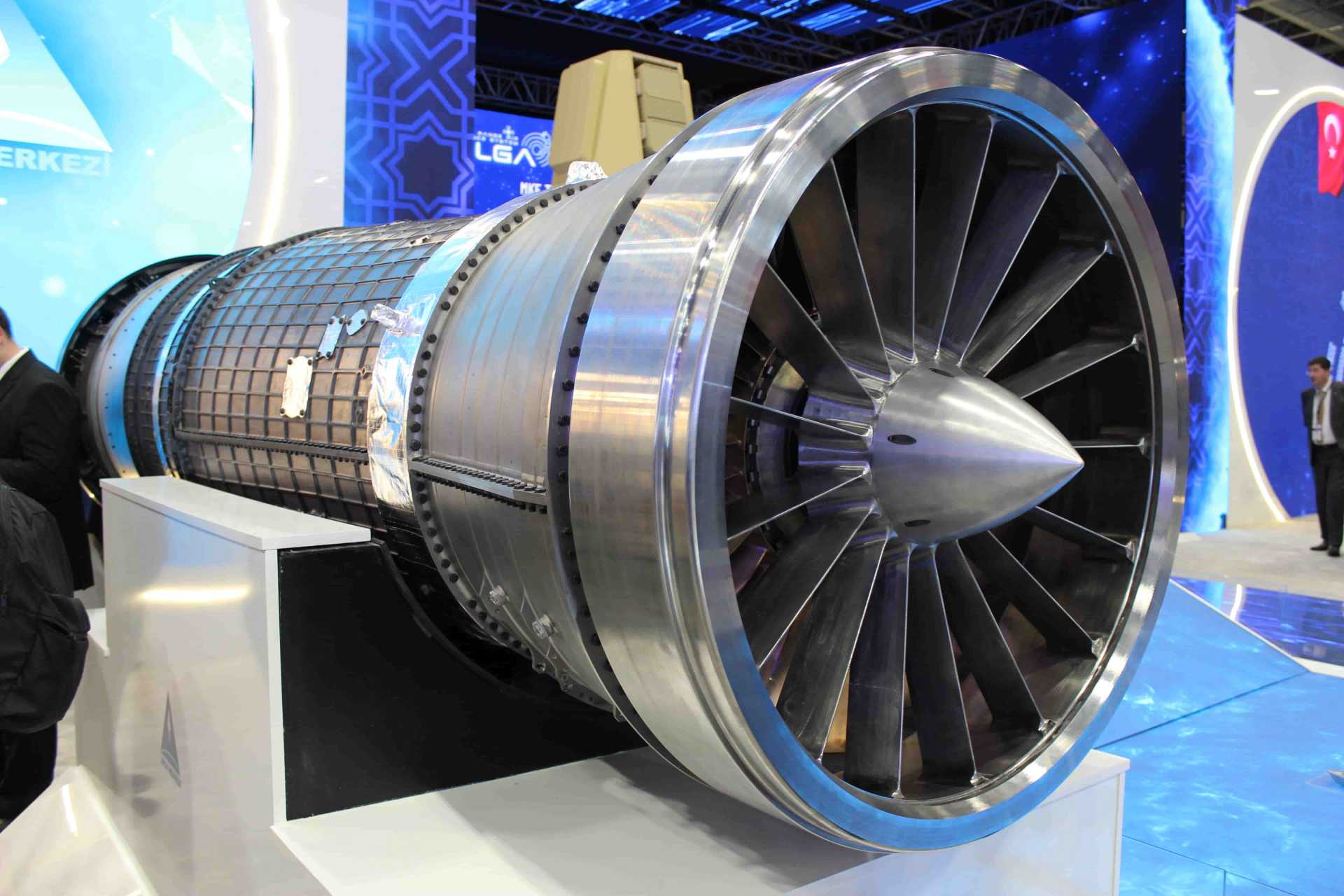
The appearance of the Güçhan shows that Türkiye is trying to develop its own high-performance fighter jet engine in the same power category as the engine used on the Lockheed Martin F-35 Lightning II. (Picture source: Army Recognition)
On May 5, 2026, Türkiye revealed the Güçhan turbofan jet engine during the SAHA 2026 exhibition in Istanbul, marking the first public appearance of a previously undisclosed 42,000 lbf-class military propulsion program directly managed by the Turkish Ministry of National Defense R&D Center. The engine appeared without earlier prototype exposure, contract disclosure, flight-test announcements, or industrial rollout chronology, despite entering a propulsion category occupied by only a small number of nations worldwide.
The Güçhan was displayed beside Turkish Engine Industries (TEI) projects such as the TF6000 (6,000 lbf), TF10000 (6,000 lbf), and TF35000 (35,000 lbf), but unlike those programs, no aircraft integration roadmap, demonstrator configuration, or production schedule accompanied the presentation. The published thrust figure immediately placed the engine in the same performance bracket as the Pratt & Whitney F135 installed on the F-35 Lightning II, which currently remains the highest-thrust operational Western fighter in serial production. Turkish officials did not say whether the Güçhan targets the TAI Kaan, a future unmanned combat aircraft, or another classified aviation program.
The timing of the reveal occurred while Türkiye continues attempting to reduce dependence on imported propulsion systems, particularly the General Electric F110 currently used in early Kaan prototypes. The Güçhan’s announced 42,000 lbf output sits only marginally below the 43,000 lbf afterburning thrust of the F-35’s F135 and above the F-22’s F110-GE-129, which generally remain near the 29,000 to 32,000 lbf range depending on variant. Maximum diameter was presented as 46.5 inches, closely matching the 46-inch of F135-PW-100 and F135-PW-400 variants used across the F-35 fleet.
The figure also remains near the 50-inch diameter of the F119-PW-100 powering the Lockheed Martin F-22 Raptor. Airflow was identified at 420 lb/sec, indicating a high-mass-flow core architecture associated with high-thrust fighter turbofan engines. The engine’s 0.68:1 bypass ratio further reinforces this positioning because such values correspond to low-bypass military propulsion optimized for compact dimensions, high exhaust energy, and sustained afterburning operation. Collectively, these figures indicate an engine intended for aircraft requiring stealth-compatible integration, high acceleration, and large onboard energy margins rather than fuel-efficient cruise performance.
Commercial turbofans designed for airliners frequently operate with bypass ratios between 5:1 and 12:1, generating large volumes of slower-moving airflow to maximize fuel economy and reduce acoustic signature. Fighter jets instead require compact propulsion systems capable of producing high specific thrust inside restricted fuselage dimensions. The F135 operates with a bypass ratio close to 0.57:1, while the F119 used on the F-22 relies on a similarly low-bypass configuration to support supercruise and high-thrust maneuvering. The Güçhan’s 0.68:1 ratio, therefore, aligns much more closely with fifth-generation fighter propulsion than with any transport or trainer application.
Low-bypass engines channel a larger percentage of airflow directly through the combustion core, producing higher exhaust velocity and stronger afterburning characteristics than high-bypass engines. This architecture is especially relevant for stealth fighters because very large fan sections increase frontal radar signature, intake dimensions, and drag penalties. The bypass ratio, therefore, indicates that the Güçhan is almost certainly conceived for a high-performance combat aircraft requiring sustained supersonic capability rather than a transport or maritime aviation role. Comparison with the F135 extends beyond thrust alone because the dimensional relationship between both engines suggests similar internal integration constraints.
The F135 was specifically engineered to combine very high thrust output with compact dimensions compatible with the F-35’s internal fuel volume, weapons bays, and stealth shaping requirements. Achieving this balance required extremely high turbine inlet temperatures, advanced cooling architecture, and major advances in turbine metallurgy. Engines inside this class require single-crystal turbine blades, ceramic thermal barrier coatings, and complex internal airflow channels capable of protecting rotating components operating under extreme thermal stress. The F135 also integrates substantial onboard electrical generation capability to support AESA radar systems, electronic warfare equipment, distributed sensor architecture, and mission computing systems.
The Güçhan’s entrance into the same thrust and dimensional category, therefore, implies that Türkiye is attempting to address not only propulsion, but also thermal management and combat-energy integration at a level associated with fifth-generation aviation. However, Turkish authorities did not disclose dry thrust output, turbine temperature limits, compressor pressure ratio, endurance cycle data, or mean time between overhauls, leaving the actual maturity of the propulsion system impossible to quantify at this stage. The 42,000 to 45,000 lbf propulsion category remains one of the narrowest and most technologically restrictive segments in aerospace engineering.
Operational fighter engines inside this range currently include the F135, the Russian Saturn AL-41F1 of the Sukhoi Su-57 and Su-35, and the Chinese Shenyang WS-15 designed for the Chengdu J-20. Several civil turbofans historically entered similar thrust ranges, including the Rolls-Royce RB211-22B and Pratt & Whitney PW2043, but these engines used entirely different high-bypass architectures optimized for transport efficiency rather than fighter maneuverability. Europe currently lacks an operational indigenous fighter engine inside the 40,000+ lbf class, despite studies involving enhanced Eurojet EJ200 configurations.
Russia and China both spent decades attempting to solve turbine durability, thermal resistance, and service-life limitations before approaching the operational reliability standards achieved by U.S propulsion systems. The main barriers inside this category remain turbine metallurgy, cooling efficiency, compressor aerodynamics, and precision manufacturing tolerances measured at microscopic levels. Entry into this segment, therefore, requires not only engine design capability, but also a highly mature industrial ecosystem able to sustain advanced materials production and precision aerospace manufacturing over long production cycles.
The appearance of the Güçhan while the 35,000 lbf TEI TF35000 program continues development creates uncertainty regarding the future structure of Türkiye’s fighter propulsion strategy. The TF35000 had already been associated with long-term propulsion objectives for the Kaan program, making the introduction of a second engine in a similar thrust category strategically significant. Several scenarios emerge from this overlap, including separate propulsion paths for different Kaan production blocks (like South Korea plans for the KF-21), parallel risk-reduction programs, or differentiation between manned and unmanned combat aviation requirements.
The unveiling also demonstrated direct institutional participation by the Ministry of National Defense R&D Center in high-thrust propulsion development, expanding the Turkish fighter engine ecosystem beyond Turkish Engine Industries (TEI) alone. This diversification matters because engine sovereignty determines whether a country fully controls aircraft exports, software integration, modernization pathways and long-term sustainment schedules.
Türkiye’s dependence on imported propulsion systems has repeatedly exposed combat aviation programs to export licensing constraints and geopolitical pressure linked to foreign engine suppliers. Indigenous fighter propulsion is therefore tied not only to industrial policy, but also to operational autonomy, sanctions resilience, and independent export capability. The Güçhan’s public emergence indicates that Türkiye is attempting to establish a domestic industrial base capable of competing inside the strategic fighter engine sector currently dominated by the United States, Russia and China.
Written by Jérôme Brahy
Jérôme Brahy is a defense analyst and documentalist at Army Recognition. He specializes in naval modernization, aviation, drones, armored vehicles, and artillery, with a focus on strategic developments in the United States, China, Ukraine, Russia, Türkiye, and Belgium. His analyses go beyond the facts, providing context, identifying key actors, and explaining why defense news matters on a global scale.
{loadposition bannertop}
{loadposition sidebarpub}
Türkiye has publicly revealed the new 42,000 lbf-class Güçhan turbofan engine at SAHA 2026 in Istanbul, placing the country for the first time in the same high-thrust fighter propulsion category as the engines powering the U.S. F-35 Lightning II and F-22 Raptor stealth fighters. Unveiled in May 2026, the program signals Ankara’s push to break dependence on imported combat aircraft engines and gain full control over future fighter production, exportability, and long-term operational autonomy.
The Güçhan’s dimensions, airflow, and low 0.68:1 bypass ratio closely align with fifth-generation fighter engine architecture optimized for stealth integration, high acceleration, and sustained afterburning performance rather than fuel efficiency. Its emergence alongside Türkiye’s existing TF35000 program suggests the country is now pursuing multiple advanced propulsion paths simultaneously, potentially supporting future variants of the TAI Kaan or next-generation unmanned combat aircraft as global competition intensifies in high-performance military aviation.
Related topic: First B-52J bomber flight approaches as US Air Force completes Rolls-Royce F130 engine review
The appearance of the Güçhan shows that Türkiye is trying to develop its own high-performance fighter jet engine in the same power category as the engine used on the Lockheed Martin F-35 Lightning II. (Picture source: Army Recognition)
On May 5, 2026, Türkiye revealed the Güçhan turbofan jet engine during the SAHA 2026 exhibition in Istanbul, marking the first public appearance of a previously undisclosed 42,000 lbf-class military propulsion program directly managed by the Turkish Ministry of National Defense R&D Center. The engine appeared without earlier prototype exposure, contract disclosure, flight-test announcements, or industrial rollout chronology, despite entering a propulsion category occupied by only a small number of nations worldwide.
The Güçhan was displayed beside Turkish Engine Industries (TEI) projects such as the TF6000 (6,000 lbf), TF10000 (6,000 lbf), and TF35000 (35,000 lbf), but unlike those programs, no aircraft integration roadmap, demonstrator configuration, or production schedule accompanied the presentation. The published thrust figure immediately placed the engine in the same performance bracket as the Pratt & Whitney F135 installed on the F-35 Lightning II, which currently remains the highest-thrust operational Western fighter in serial production. Turkish officials did not say whether the Güçhan targets the TAI Kaan, a future unmanned combat aircraft, or another classified aviation program.
The timing of the reveal occurred while Türkiye continues attempting to reduce dependence on imported propulsion systems, particularly the General Electric F110 currently used in early Kaan prototypes. The Güçhan’s announced 42,000 lbf output sits only marginally below the 43,000 lbf afterburning thrust of the F-35’s F135 and above the F-22’s F110-GE-129, which generally remain near the 29,000 to 32,000 lbf range depending on variant. Maximum diameter was presented as 46.5 inches, closely matching the 46-inch of F135-PW-100 and F135-PW-400 variants used across the F-35 fleet.
The figure also remains near the 50-inch diameter of the F119-PW-100 powering the Lockheed Martin F-22 Raptor. Airflow was identified at 420 lb/sec, indicating a high-mass-flow core architecture associated with high-thrust fighter turbofan engines. The engine’s 0.68:1 bypass ratio further reinforces this positioning because such values correspond to low-bypass military propulsion optimized for compact dimensions, high exhaust energy, and sustained afterburning operation. Collectively, these figures indicate an engine intended for aircraft requiring stealth-compatible integration, high acceleration, and large onboard energy margins rather than fuel-efficient cruise performance.
Commercial turbofans designed for airliners frequently operate with bypass ratios between 5:1 and 12:1, generating large volumes of slower-moving airflow to maximize fuel economy and reduce acoustic signature. Fighter jets instead require compact propulsion systems capable of producing high specific thrust inside restricted fuselage dimensions. The F135 operates with a bypass ratio close to 0.57:1, while the F119 used on the F-22 relies on a similarly low-bypass configuration to support supercruise and high-thrust maneuvering. The Güçhan’s 0.68:1 ratio, therefore, aligns much more closely with fifth-generation fighter propulsion than with any transport or trainer application.
Low-bypass engines channel a larger percentage of airflow directly through the combustion core, producing higher exhaust velocity and stronger afterburning characteristics than high-bypass engines. This architecture is especially relevant for stealth fighters because very large fan sections increase frontal radar signature, intake dimensions, and drag penalties. The bypass ratio, therefore, indicates that the Güçhan is almost certainly conceived for a high-performance combat aircraft requiring sustained supersonic capability rather than a transport or maritime aviation role. Comparison with the F135 extends beyond thrust alone because the dimensional relationship between both engines suggests similar internal integration constraints.
The F135 was specifically engineered to combine very high thrust output with compact dimensions compatible with the F-35’s internal fuel volume, weapons bays, and stealth shaping requirements. Achieving this balance required extremely high turbine inlet temperatures, advanced cooling architecture, and major advances in turbine metallurgy. Engines inside this class require single-crystal turbine blades, ceramic thermal barrier coatings, and complex internal airflow channels capable of protecting rotating components operating under extreme thermal stress. The F135 also integrates substantial onboard electrical generation capability to support AESA radar systems, electronic warfare equipment, distributed sensor architecture, and mission computing systems.
The Güçhan’s entrance into the same thrust and dimensional category, therefore, implies that Türkiye is attempting to address not only propulsion, but also thermal management and combat-energy integration at a level associated with fifth-generation aviation. However, Turkish authorities did not disclose dry thrust output, turbine temperature limits, compressor pressure ratio, endurance cycle data, or mean time between overhauls, leaving the actual maturity of the propulsion system impossible to quantify at this stage. The 42,000 to 45,000 lbf propulsion category remains one of the narrowest and most technologically restrictive segments in aerospace engineering.
Operational fighter engines inside this range currently include the F135, the Russian Saturn AL-41F1 of the Sukhoi Su-57 and Su-35, and the Chinese Shenyang WS-15 designed for the Chengdu J-20. Several civil turbofans historically entered similar thrust ranges, including the Rolls-Royce RB211-22B and Pratt & Whitney PW2043, but these engines used entirely different high-bypass architectures optimized for transport efficiency rather than fighter maneuverability. Europe currently lacks an operational indigenous fighter engine inside the 40,000+ lbf class, despite studies involving enhanced Eurojet EJ200 configurations.
Russia and China both spent decades attempting to solve turbine durability, thermal resistance, and service-life limitations before approaching the operational reliability standards achieved by U.S propulsion systems. The main barriers inside this category remain turbine metallurgy, cooling efficiency, compressor aerodynamics, and precision manufacturing tolerances measured at microscopic levels. Entry into this segment, therefore, requires not only engine design capability, but also a highly mature industrial ecosystem able to sustain advanced materials production and precision aerospace manufacturing over long production cycles.
The appearance of the Güçhan while the 35,000 lbf TEI TF35000 program continues development creates uncertainty regarding the future structure of Türkiye’s fighter propulsion strategy. The TF35000 had already been associated with long-term propulsion objectives for the Kaan program, making the introduction of a second engine in a similar thrust category strategically significant. Several scenarios emerge from this overlap, including separate propulsion paths for different Kaan production blocks (like South Korea plans for the KF-21), parallel risk-reduction programs, or differentiation between manned and unmanned combat aviation requirements.
The unveiling also demonstrated direct institutional participation by the Ministry of National Defense R&D Center in high-thrust propulsion development, expanding the Turkish fighter engine ecosystem beyond Turkish Engine Industries (TEI) alone. This diversification matters because engine sovereignty determines whether a country fully controls aircraft exports, software integration, modernization pathways and long-term sustainment schedules.
Türkiye’s dependence on imported propulsion systems has repeatedly exposed combat aviation programs to export licensing constraints and geopolitical pressure linked to foreign engine suppliers. Indigenous fighter propulsion is therefore tied not only to industrial policy, but also to operational autonomy, sanctions resilience, and independent export capability. The Güçhan’s public emergence indicates that Türkiye is attempting to establish a domestic industrial base capable of competing inside the strategic fighter engine sector currently dominated by the United States, Russia and China.
Written by Jérôme Brahy
Jérôme Brahy is a defense analyst and documentalist at Army Recognition. He specializes in naval modernization, aviation, drones, armored vehicles, and artillery, with a focus on strategic developments in the United States, China, Ukraine, Russia, Türkiye, and Belgium. His analyses go beyond the facts, providing context, identifying key actors, and explaining why defense news matters on a global scale.