UK scrambles two Typhoon fighter jets as a Russian strategic bomber approaches British airspace
{loadposition bannertop}
{loadposition sidebarpub}
Two Royal Air Force Typhoon FGR4 fighters were scrambled by the United Kingdom, under a Quick Reaction Alert, from RAF Lossiemouth after the detection of a radar track assessed as a possible Russian long-range bomber approaching the Shetland sector in the North Sea.
The Russian aircraft conducted a monitored response within NATO air defense coverage, reinforcing rapid reaction capability and persistent surveillance across the northern approaches without escalation to visual interception. The April 14, 2026, sortie reported by The Telegraph involved two Typhoon jets and a Voyager air-to-air refueling tanker from RAF Brize Norton, with tracking supported by NATO integrated radar networks. The event reflects sustained monitoring of Russian long-range aviation activity and its role in testing UK and NATO air defense readiness and response timelines.
Related topic: Sweden deploys Gripen fighter jets to track Russian submarine during Baltic Sea transit
The United Kingdom launched a Quick Reaction Alert sortie on April 14, 2026, after detecting a radar track assessed as a possible Russian long range bomber approaching the northern area of interest near Shetland. (Picture source: UK MoD)
On April 14, 2026, The Telegraph announced that the UK activated a Quick Reaction Alert (QRA) sortie after a radar contact assessed as a possible Russian long-range bomber was detected approaching the northern UK area of interest, prompting an immediate response. Two Eurofighter Typhoon fighter jets were scrambled from RAF Lossiemouth, the designated QRA North base covering Scotland and the North Sea approaches, with a Voyager KC2 or KC3 tanker departing RAF Brize Norton to provide aerial refueling if required. The Russian contact moved on a track oriented toward the Shetland sector, remaining outside the 12 nautical mile limit that defines UK sovereign airspace, and no visual identification phase was initiated before the mission was terminated.
The Russian aircraft was tracked within a NATO-recognized air defense area, meaning that multiple allied command centers had access to the same radar data and trajectory analysis. The sortie concluded once it was assessed that the track would not enter the UK Air Defence Identification Zone (ADIZ) in a manner requiring escalation. The initial detection likely relied on the UK Air Surveillance and Control System network, which includes long-range radar coverage from northern sites such as Saxa Vord in Shetland, possibly combined with data feeds from NATO partners and civilian air traffic systems. The contact would have been classified as an unknown track when no matching flight plan, transponder code, or recognized identification profile could be associated with it.
This classification typically triggers a sequence of actions beginning with continuous tracking, correlation with intelligence databases, and evaluation of trajectory, altitude, and speed. The key factor in this case was the aircraft’s projected path toward the northern approaches of the UK, which lies within the broader Air Defence Identification Zone (ADIZ) but outside sovereign airspace. Under standard procedures, the decision to scramble is based on projected proximity and uncertainty rather than confirmed hostile intent. A potential coordination with NATO might have ensured that the Russian aircraft’s movement was monitored across a wider operational area, including Norwegian and North Atlantic sectors, reducing the likelihood of misidentification.
The force package deployed consisted of two Typhoon jets, which is the standard QRA response unit, supported by a single Voyager tanker configured for air-to-air refueling operations. RAF Lossiemouth maintains continuous QRA readiness with aircraft positioned on operational readiness platforms, allowing takeoff within a timeframe generally below fifteen minutes from scramble order. The Typhoon, under the British FGR4 standard, has a typical combat radius of less than 1,400 kilometers without refueling, which limits endurance over extended northern patrol areas, particularly when operating at high speeds or altitudes. The Voyager tanker extends this endurance by allowing multiple refueling cycles, effectively increasing loiter time and enabling sustained presence over areas such as the North Sea.
The decision to include a tanker indicates that British planners considered the possibility of a longer-duration mission, either due to uncertainty in the track’s behavior or the potential need to maintain continuous coverage. No airborne early warning aircraft or maritime patrol aircraft were reported in direct association with the sortie, suggesting that ground-based radar and allied inputs provided sufficient coverage. The Typhoon jets did not transition into intercept geometry, which would normally involve closing to within visual range, typically between one and five kilometers, followed by positioning alongside or slightly ahead of the target aircraft.
No ICAO intercept procedures were executed, including visual signals such as wing rocking or attempts to guide the aircraft’s direction, and no radio communication was attempted on emergency frequencies. This indicates that the distance between the RAF aircraft and the track remained beyond the threshold required for visual identification, or that the trajectory of the contact did not justify such a maneuver. In standard intercept scenarios, fighters would approach from behind and slightly offset to minimize collision risk while enabling visual confirmation of aircraft type and markings. The absence of these steps confirms that the operation remained in a surveillance phase rather than progressing into an enforcement or identification phase.
The mission, therefore, focused on maintaining readiness while collecting radar-based data on the Russian aircraft’s movement. The behavior of the unidentified aircraft is consistent with established patterns of Russian long-range aviation missions, which frequently operate in international airspace along NATO peripheries without entering sovereign airspace. These flights often occur without active transponder signals or coordination with civilian air traffic control, creating ambiguity that necessitates monitoring by NATO air defense systems. By maintaining a distance beyond 12 nautical miles, the Russian aircraft avoids triggering legal thresholds that would permit interception or coercive measures under international aviation law.
The trajectory toward the Shetland sector suggests a route commonly used for probing air defense responses in the North Atlantic region, where airspace boundaries are closely monitored. Such missions allow the originating state, in this case Russia, to assess reaction times, radar coverage, and coordination between allied air defense networks. In this case, the RAF response remained limited to tracking and readiness, indicating that the Russian bomber did not alter its behavior in a way that required escalation. However, the deployment of the Voyager tanker reflects a planning assumption that the situation could evolve into a longer-duration monitoring mission, particularly if the aircraft maintained a parallel course along the UK’s northern approaches.
Aerial refueling allows Typhoon jets to remain airborne for extended periods, compensating for fuel consumption during high-speed interception profiles and maintaining continuous coverage without rotation. This is particularly relevant in northern sectors, where distances from base to patrol area can exceed several hundred nautical miles, reducing on-station time without refueling support. The presence of the tanker also allows for flexibility in repositioning, enabling fighters to adjust their patrol area without returning to base. In this case, the mission concluded before extended refueling cycles were required, indicating that the track either changed course or was assessed as no longer relevant.
The tanker’s role, therefore, remained precautionary rather than operationally decisive. The event occurred within a broader pattern of Russian military activity near the UK, including naval movements and submarine operations in adjacent maritime areas. Recent activity has included the transit of Russian naval vessels through the English Channel and the monitoring of an Akula-class submarine and associated deep-sea assets near critical infrastructure in the North Sea. These activities have been associated with strategic signaling linked to Vladimir Putin, reflecting a pattern of multi-domain operations designed to test detection and response mechanisms.
The air sortie on April 14 fits within this pattern, representing an aerial component of a wider set of activities across maritime and subsea domains. The overlap of these activities increases the operational workload for UK and allied forces, requiring simultaneous monitoring across multiple domains. The consistency of these patterns suggests a deliberate approach rather than isolated incidents. Compared to previous intercept events, the April 14 sortie remained limited in both scale and outcome, reflecting a lower assessed level of risk. In 2020, a response to a Russian Tu-142 bomber involved the launch of six Typhoon fighters and progressed to visual identification and escort phases, indicating a closer approach to UK airspace.
In contrast, the April 2026 event did not progress beyond radar tracking, suggesting that the aircraft’s trajectory did not bring it within a range requiring visual confirmation. The use of a two-aircraft formation supported by a tanker represents a calibrated response aligned with uncertainty rather than a confirmed threat. This difference highlights the role of proximity, trajectory, and behavior in determining the scale of QRA responses. The absence of close-proximity interaction or escort maneuvers indicates that the situation remained within controlled parameters throughout the operation.
Written by Jérôme Brahy
Jérôme Brahy is a defense analyst and documentalist at Army Recognition. He specializes in naval modernization, aviation, drones, armored vehicles, and artillery, with a focus on strategic developments in the United States, China, Ukraine, Russia, Türkiye, and Belgium. His analyses go beyond the facts, providing context, identifying key actors, and explaining why defense news matters on a global scale.
{loadposition bannertop}
{loadposition sidebarpub}
Two Royal Air Force Typhoon FGR4 fighters were scrambled by the United Kingdom, under a Quick Reaction Alert, from RAF Lossiemouth after the detection of a radar track assessed as a possible Russian long-range bomber approaching the Shetland sector in the North Sea.
The Russian aircraft conducted a monitored response within NATO air defense coverage, reinforcing rapid reaction capability and persistent surveillance across the northern approaches without escalation to visual interception. The April 14, 2026, sortie reported by The Telegraph involved two Typhoon jets and a Voyager air-to-air refueling tanker from RAF Brize Norton, with tracking supported by NATO integrated radar networks. The event reflects sustained monitoring of Russian long-range aviation activity and its role in testing UK and NATO air defense readiness and response timelines.
Related topic: Sweden deploys Gripen fighter jets to track Russian submarine during Baltic Sea transit
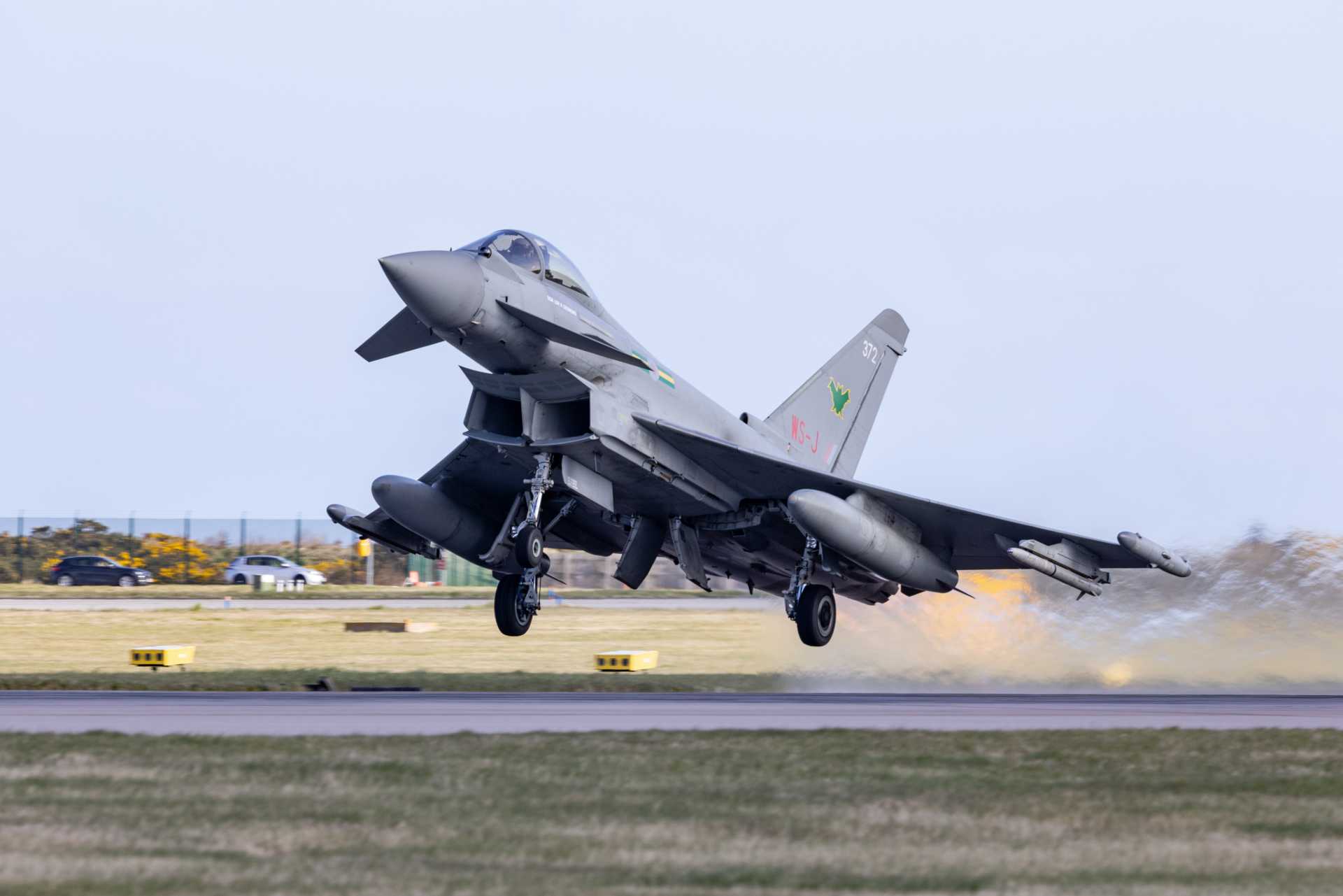
The United Kingdom launched a Quick Reaction Alert sortie on April 14, 2026, after detecting a radar track assessed as a possible Russian long range bomber approaching the northern area of interest near Shetland. (Picture source: UK MoD)
On April 14, 2026, The Telegraph announced that the UK activated a Quick Reaction Alert (QRA) sortie after a radar contact assessed as a possible Russian long-range bomber was detected approaching the northern UK area of interest, prompting an immediate response. Two Eurofighter Typhoon fighter jets were scrambled from RAF Lossiemouth, the designated QRA North base covering Scotland and the North Sea approaches, with a Voyager KC2 or KC3 tanker departing RAF Brize Norton to provide aerial refueling if required. The Russian contact moved on a track oriented toward the Shetland sector, remaining outside the 12 nautical mile limit that defines UK sovereign airspace, and no visual identification phase was initiated before the mission was terminated.
The Russian aircraft was tracked within a NATO-recognized air defense area, meaning that multiple allied command centers had access to the same radar data and trajectory analysis. The sortie concluded once it was assessed that the track would not enter the UK Air Defence Identification Zone (ADIZ) in a manner requiring escalation. The initial detection likely relied on the UK Air Surveillance and Control System network, which includes long-range radar coverage from northern sites such as Saxa Vord in Shetland, possibly combined with data feeds from NATO partners and civilian air traffic systems. The contact would have been classified as an unknown track when no matching flight plan, transponder code, or recognized identification profile could be associated with it.
This classification typically triggers a sequence of actions beginning with continuous tracking, correlation with intelligence databases, and evaluation of trajectory, altitude, and speed. The key factor in this case was the aircraft’s projected path toward the northern approaches of the UK, which lies within the broader Air Defence Identification Zone (ADIZ) but outside sovereign airspace. Under standard procedures, the decision to scramble is based on projected proximity and uncertainty rather than confirmed hostile intent. A potential coordination with NATO might have ensured that the Russian aircraft’s movement was monitored across a wider operational area, including Norwegian and North Atlantic sectors, reducing the likelihood of misidentification.
The force package deployed consisted of two Typhoon jets, which is the standard QRA response unit, supported by a single Voyager tanker configured for air-to-air refueling operations. RAF Lossiemouth maintains continuous QRA readiness with aircraft positioned on operational readiness platforms, allowing takeoff within a timeframe generally below fifteen minutes from scramble order. The Typhoon, under the British FGR4 standard, has a typical combat radius of less than 1,400 kilometers without refueling, which limits endurance over extended northern patrol areas, particularly when operating at high speeds or altitudes. The Voyager tanker extends this endurance by allowing multiple refueling cycles, effectively increasing loiter time and enabling sustained presence over areas such as the North Sea.
The decision to include a tanker indicates that British planners considered the possibility of a longer-duration mission, either due to uncertainty in the track’s behavior or the potential need to maintain continuous coverage. No airborne early warning aircraft or maritime patrol aircraft were reported in direct association with the sortie, suggesting that ground-based radar and allied inputs provided sufficient coverage. The Typhoon jets did not transition into intercept geometry, which would normally involve closing to within visual range, typically between one and five kilometers, followed by positioning alongside or slightly ahead of the target aircraft.
No ICAO intercept procedures were executed, including visual signals such as wing rocking or attempts to guide the aircraft’s direction, and no radio communication was attempted on emergency frequencies. This indicates that the distance between the RAF aircraft and the track remained beyond the threshold required for visual identification, or that the trajectory of the contact did not justify such a maneuver. In standard intercept scenarios, fighters would approach from behind and slightly offset to minimize collision risk while enabling visual confirmation of aircraft type and markings. The absence of these steps confirms that the operation remained in a surveillance phase rather than progressing into an enforcement or identification phase.
The mission, therefore, focused on maintaining readiness while collecting radar-based data on the Russian aircraft’s movement. The behavior of the unidentified aircraft is consistent with established patterns of Russian long-range aviation missions, which frequently operate in international airspace along NATO peripheries without entering sovereign airspace. These flights often occur without active transponder signals or coordination with civilian air traffic control, creating ambiguity that necessitates monitoring by NATO air defense systems. By maintaining a distance beyond 12 nautical miles, the Russian aircraft avoids triggering legal thresholds that would permit interception or coercive measures under international aviation law.
The trajectory toward the Shetland sector suggests a route commonly used for probing air defense responses in the North Atlantic region, where airspace boundaries are closely monitored. Such missions allow the originating state, in this case Russia, to assess reaction times, radar coverage, and coordination between allied air defense networks. In this case, the RAF response remained limited to tracking and readiness, indicating that the Russian bomber did not alter its behavior in a way that required escalation. However, the deployment of the Voyager tanker reflects a planning assumption that the situation could evolve into a longer-duration monitoring mission, particularly if the aircraft maintained a parallel course along the UK’s northern approaches.
Aerial refueling allows Typhoon jets to remain airborne for extended periods, compensating for fuel consumption during high-speed interception profiles and maintaining continuous coverage without rotation. This is particularly relevant in northern sectors, where distances from base to patrol area can exceed several hundred nautical miles, reducing on-station time without refueling support. The presence of the tanker also allows for flexibility in repositioning, enabling fighters to adjust their patrol area without returning to base. In this case, the mission concluded before extended refueling cycles were required, indicating that the track either changed course or was assessed as no longer relevant.
The tanker’s role, therefore, remained precautionary rather than operationally decisive. The event occurred within a broader pattern of Russian military activity near the UK, including naval movements and submarine operations in adjacent maritime areas. Recent activity has included the transit of Russian naval vessels through the English Channel and the monitoring of an Akula-class submarine and associated deep-sea assets near critical infrastructure in the North Sea. These activities have been associated with strategic signaling linked to Vladimir Putin, reflecting a pattern of multi-domain operations designed to test detection and response mechanisms.
The air sortie on April 14 fits within this pattern, representing an aerial component of a wider set of activities across maritime and subsea domains. The overlap of these activities increases the operational workload for UK and allied forces, requiring simultaneous monitoring across multiple domains. The consistency of these patterns suggests a deliberate approach rather than isolated incidents. Compared to previous intercept events, the April 14 sortie remained limited in both scale and outcome, reflecting a lower assessed level of risk. In 2020, a response to a Russian Tu-142 bomber involved the launch of six Typhoon fighters and progressed to visual identification and escort phases, indicating a closer approach to UK airspace.
In contrast, the April 2026 event did not progress beyond radar tracking, suggesting that the aircraft’s trajectory did not bring it within a range requiring visual confirmation. The use of a two-aircraft formation supported by a tanker represents a calibrated response aligned with uncertainty rather than a confirmed threat. This difference highlights the role of proximity, trajectory, and behavior in determining the scale of QRA responses. The absence of close-proximity interaction or escort maneuvers indicates that the situation remained within controlled parameters throughout the operation.
Written by Jérôme Brahy
Jérôme Brahy is a defense analyst and documentalist at Army Recognition. He specializes in naval modernization, aviation, drones, armored vehicles, and artillery, with a focus on strategic developments in the United States, China, Ukraine, Russia, Türkiye, and Belgium. His analyses go beyond the facts, providing context, identifying key actors, and explaining why defense news matters on a global scale.