Belgium deploys two MQ-9B SkyGuardian drones to US base in Italy for first NATO mission
{loadposition bannertop}
{loadposition sidebarpub}
Belgium has deployed two MQ-9B SkyGuardian drones to Naval Air Station Sigonella in Sicily for NATO maritime surveillance missions under Operation Silent Spear, marking the first overseas operational deployment of the country’s MALE drone fleet since entering service in September 2025. Announced on May 18, 2026, the deployment moves Belgium from national qualification flights into active NATO ISR operations and strengthens allied surveillance coverage over increasingly contested Mediterranean sea lanes used for smuggling, irregular migration, and illicit maritime activity.
The Belgian MQ-9Bs will conduct persistent ISR sorties over the central Mediterranean while remaining remotely piloted from Florennes Air Base through SATCOM links, validating Belgium’s distributed long-range drone operating concept with a minimal forward footprint. Equipped with maritime surveillance radar, electro-optical sensors, and future pathways toward armed ISR capability, the SkyGuardian deployment also reflects NATO’s growing reliance on persistent unmanned surveillance networks centered around Sigonella’s multinational ISR hub.
Related topic: Belgium Moves Toward Armed MQ-9B with U.S. Hellfire and UK Brimstone Missiles for NATO Strike Missions
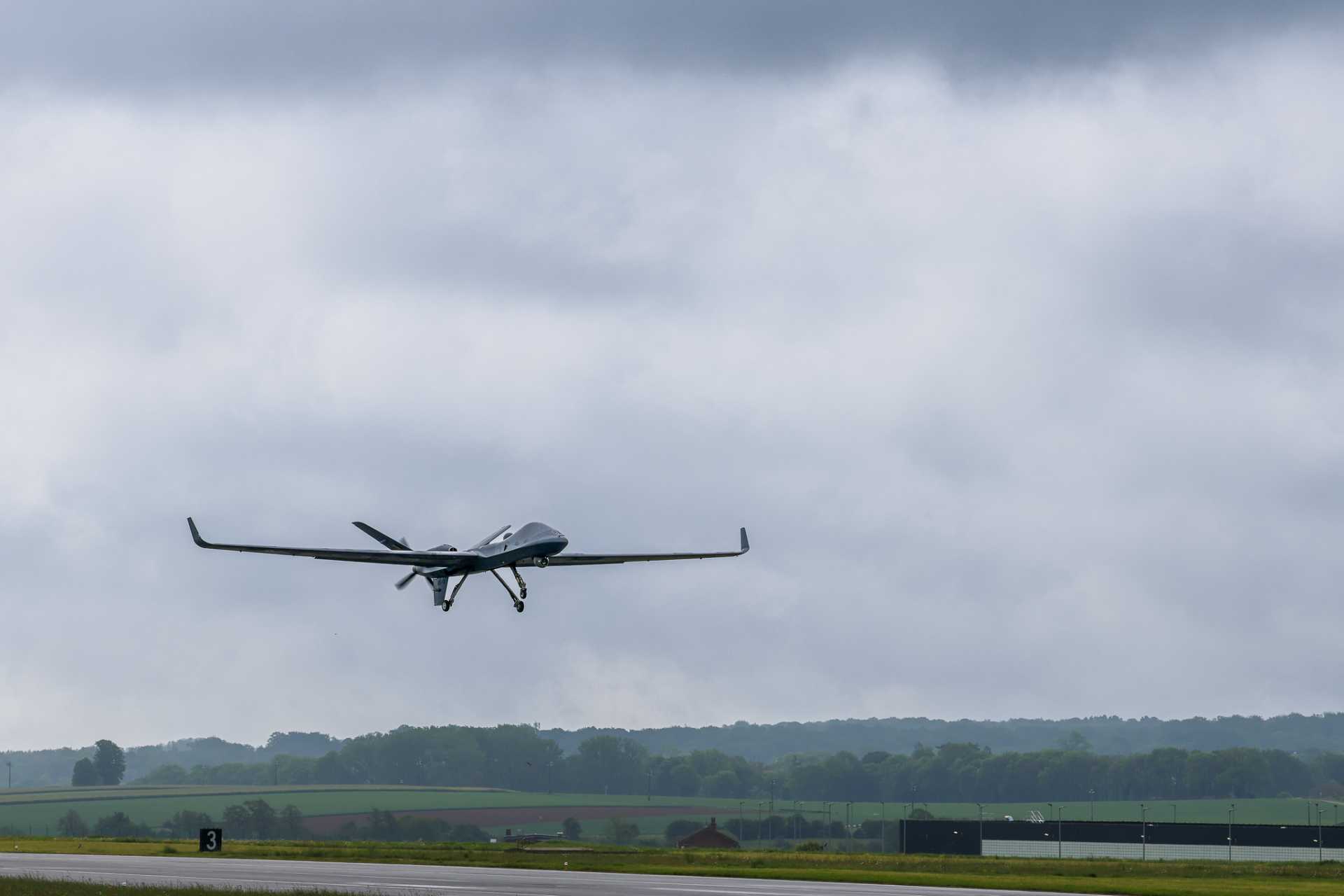
Belgian MQ-9B sorties under Operation Silent Spear are dedicated to maritime operations over the central Mediterranean, including vessel tracking, maritime domain awareness, reconnaissance missions, and identification of anomalous maritime activity patterns. (Picture source: Belgian MoD)
On May 18, 2026, the Belgian Defence announced the deployment of a second MQ-9B SkyGuardian drone from Florennes Air Base to Naval Air Station Sigonella in Sicily under Operation Silent Spear in support of NATO’s Operation Sea Guardian. The first MQ-9B had been transferred on April 27 aboard a Belgian Airbus A400M after partial disassembly, while the second SkyGuardian conducted a direct transit flight from Belgium to Italy. Two MQ-9Bs are now assigned to ISR sorties during May and June 2026, marking the first overseas operational deployment of the Belgian MQ-9B fleet since its entry into service on September 23, 2025.
Although physically based at Sigonella, both MQ-9B SkyGuardians remain piloted and controlled from Florennes through SATCOM and beyond-line-of-sight datalinks. Operationally, Silent Spear constitutes the first transition of the Belgian MQ-9B force from national qualification flights toward active NATO operational tasking within a multinational Intelligence, Surveillance, and Reconnaissance (ISR) architecture focused on Mediterranean maritime surveillance. Belgian MQ-9B sorties will focus on maritime surveillance over the central Mediterranean, including vessel tracking, reconnaissance, maritime traffic analysis, and identification of anomalous activity along sea lanes between North Africa and southern Europe.
The deployment coincides with increased NATO and EU monitoring of irregular migration routes, smuggling corridors, and illicit maritime logistics networks operating between Libya, Tunisia, and European coastlines. For instance, NATO’s Operation Sea Guardian concentrates on maritime situational awareness, protection of maritime lines of communication, and surveillance support to counter-terrorism. Unlike earlier MQ-9 operational models centered on counterinsurgency strike operations in Afghanistan, Iraq, or Syria, the Belgian mission remains oriented on surveillance rather than offensive missions.
Belgian authorities connected the deployment to accelerated detection of potential maritime threats and to the creation of a more persistent surveillance picture over areas characterized by dense civilian maritime traffic combined with irregular non-commercial movement, which probably points to future missions along the Belgian coastline. Belgium currently operates three delivered MQ-9Bs and plans to expand the fleet to six SkyGuardian drones by 2028, with two of the three available systems assigned to the Sicilian deployment. The first MQ-9B was transported aboard a Belgian A400M transport aircraft after disassembly, while the second departed directly from Florennes on May 18.
Mission control, sensor management, and ISR exploitation remain conducted from Belgium rather than through forward-deployed crews in Italy, reducing the manpower footprint associated with overseas operations. Belgium also received a second ground control station in February 2026, together with the second and third MQ-9Bs, all delivered aboard an Antonov An-124 cargo aircraft, increasing simultaneous mission management capacity. The deployment, therefore, will validate the resilience of Belgium’s remote-operating concept based on SATCOM connectivity, secure data transmission, distributed ISR exploitation, and long-distance command architecture.
The MQ-9B SkyGuardian operated by Belgium is the NATO-certifiable evolution of the MQ-9 Reaper, produced by the U.S. company General Atomics Aeronautical Systems for medium-altitude long-endurance ISR operations. The drone has a 24 m wingspan, a 5,670 kg maximum takeoff weight, an endurance exceeding 40 hours, an operational altitude reaching 40,000 ft, and a mission range exceeding 6,000 nautical miles under certain profiles. Propulsion is provided by a Honeywell TPE331-10 turboprop producing close to 900 shp, and Belgian drones integrate electro-optical and infrared payloads alongside Lynx multi-mode synthetic aperture radar optimized for maritime surface mapping and vessel identification.
The MQ-9B architecture also supports AIS receivers, SIGINT payloads, communications relay systems, tactical datalinks, and SeaGuardian maritime mission kits, while compliance with STANAG 4671 requirements permits integration into civilian-controlled airspace. The destination of the two Belgian MQ-9Bs, Naval Air Station Sigonella, represents one of NATO’s principal ISR and maritime aviation hubs in the Mediterranean and hosts NATO Alliance Ground Surveillance operations using RQ-4D Phoenix drones alongside U.S Navy P-8A Poseidon and U.S. Air Force RQ-4 Global Hawk detachments.
Its location in Sicily provides a direct operational access to the central Mediterranean, North African littoral, Levant maritime approaches, and eastern Mediterranean shipping corridors. The Italian base also supports EU Operation Irini, U.S Sixth Fleet operations, and multiple NATO surveillance activities. Belgium, therefore, deployed its MQ-9B detachment into an existing multinational ISR ecosystem, which increases the country’s exposure to NATO ISR command-and-control procedures, maritime surveillance coordination, and allied intelligence-sharing frameworks already centered at Sigonella.
Belgium ordered its MQ-9B drones in August 2020 within a broader ISR modernization effort centered on Florennes Air Base. The first MQ-9B entered service on September 23, 2025, while two additional MQ-9Bs and a second ground control station arrived in February 2026 aboard an Antonov An-124. Belgian crews conducted initial night-flight operations during late 2025 ahead of operational deployment and NATO integration. Program infrastructure includes dedicated SATCOM architecture, simulators, maintenance installations, mission support facilities, and remote piloting infrastructure for future medium-altitude long-endurance (MALE) drone operations.
Belgian planning also linked this capability expansion to infrastructure readiness, personnel availability, and operational certification milestones. The Mediterranean deployment now serves as the first operational validation phase of Belgium’s MALE drone force within NATO ISR operations. The Belgian MQ-9Bs deployed during Operation Silent Spear currently operate exclusively in ISR configuration, but Belgian procurement planning already includes future armed integration pathways.
Brussels is acquiring AGM-114 Hellfire missiles from Lockheed Martin and Brimstone missiles from MBDA for future MQ-9B integration, with procurement values reaching close to $30 million for Hellfire-related acquisitions and close to €10 million for Brimstone purchases. Belgian planning also includes compatibility with GBU-54 Laser JDAM precision-guided munitions, moving the fleet toward armed ISR and precision-strike capability comparable to MQ-9 operational models used by the U.S., UK, France, and Italy. Political authorities nevertheless continue to place future weaponization under parliamentary oversight and restrictive legal authorization procedures.
Written by Jérôme Brahy
Jérôme Brahy is a defense analyst and documentalist at Army Recognition. He specializes in naval modernization, aviation, drones, armored vehicles, and artillery, with a focus on strategic developments in the United States, China, Ukraine, Russia, Türkiye, and Belgium. His analyses go beyond the facts, providing context, identifying key actors, and explaining why defense news matters on a global scale.
{loadposition bannertop}
{loadposition sidebarpub}
Belgium has deployed two MQ-9B SkyGuardian drones to Naval Air Station Sigonella in Sicily for NATO maritime surveillance missions under Operation Silent Spear, marking the first overseas operational deployment of the country’s MALE drone fleet since entering service in September 2025. Announced on May 18, 2026, the deployment moves Belgium from national qualification flights into active NATO ISR operations and strengthens allied surveillance coverage over increasingly contested Mediterranean sea lanes used for smuggling, irregular migration, and illicit maritime activity.
The Belgian MQ-9Bs will conduct persistent ISR sorties over the central Mediterranean while remaining remotely piloted from Florennes Air Base through SATCOM links, validating Belgium’s distributed long-range drone operating concept with a minimal forward footprint. Equipped with maritime surveillance radar, electro-optical sensors, and future pathways toward armed ISR capability, the SkyGuardian deployment also reflects NATO’s growing reliance on persistent unmanned surveillance networks centered around Sigonella’s multinational ISR hub.
Related topic: Belgium Moves Toward Armed MQ-9B with U.S. Hellfire and UK Brimstone Missiles for NATO Strike Missions
Belgian MQ-9B sorties under Operation Silent Spear are dedicated to maritime operations over the central Mediterranean, including vessel tracking, maritime domain awareness, reconnaissance missions, and identification of anomalous maritime activity patterns. (Picture source: Belgian MoD)
On May 18, 2026, the Belgian Defence announced the deployment of a second MQ-9B SkyGuardian drone from Florennes Air Base to Naval Air Station Sigonella in Sicily under Operation Silent Spear in support of NATO’s Operation Sea Guardian. The first MQ-9B had been transferred on April 27 aboard a Belgian Airbus A400M after partial disassembly, while the second SkyGuardian conducted a direct transit flight from Belgium to Italy. Two MQ-9Bs are now assigned to ISR sorties during May and June 2026, marking the first overseas operational deployment of the Belgian MQ-9B fleet since its entry into service on September 23, 2025.
Although physically based at Sigonella, both MQ-9B SkyGuardians remain piloted and controlled from Florennes through SATCOM and beyond-line-of-sight datalinks. Operationally, Silent Spear constitutes the first transition of the Belgian MQ-9B force from national qualification flights toward active NATO operational tasking within a multinational Intelligence, Surveillance, and Reconnaissance (ISR) architecture focused on Mediterranean maritime surveillance. Belgian MQ-9B sorties will focus on maritime surveillance over the central Mediterranean, including vessel tracking, reconnaissance, maritime traffic analysis, and identification of anomalous activity along sea lanes between North Africa and southern Europe.
The deployment coincides with increased NATO and EU monitoring of irregular migration routes, smuggling corridors, and illicit maritime logistics networks operating between Libya, Tunisia, and European coastlines. For instance, NATO’s Operation Sea Guardian concentrates on maritime situational awareness, protection of maritime lines of communication, and surveillance support to counter-terrorism. Unlike earlier MQ-9 operational models centered on counterinsurgency strike operations in Afghanistan, Iraq, or Syria, the Belgian mission remains oriented on surveillance rather than offensive missions.
Belgian authorities connected the deployment to accelerated detection of potential maritime threats and to the creation of a more persistent surveillance picture over areas characterized by dense civilian maritime traffic combined with irregular non-commercial movement, which probably points to future missions along the Belgian coastline. Belgium currently operates three delivered MQ-9Bs and plans to expand the fleet to six SkyGuardian drones by 2028, with two of the three available systems assigned to the Sicilian deployment. The first MQ-9B was transported aboard a Belgian A400M transport aircraft after disassembly, while the second departed directly from Florennes on May 18.
Mission control, sensor management, and ISR exploitation remain conducted from Belgium rather than through forward-deployed crews in Italy, reducing the manpower footprint associated with overseas operations. Belgium also received a second ground control station in February 2026, together with the second and third MQ-9Bs, all delivered aboard an Antonov An-124 cargo aircraft, increasing simultaneous mission management capacity. The deployment, therefore, will validate the resilience of Belgium’s remote-operating concept based on SATCOM connectivity, secure data transmission, distributed ISR exploitation, and long-distance command architecture.
The MQ-9B SkyGuardian operated by Belgium is the NATO-certifiable evolution of the MQ-9 Reaper, produced by the U.S. company General Atomics Aeronautical Systems for medium-altitude long-endurance ISR operations. The drone has a 24 m wingspan, a 5,670 kg maximum takeoff weight, an endurance exceeding 40 hours, an operational altitude reaching 40,000 ft, and a mission range exceeding 6,000 nautical miles under certain profiles. Propulsion is provided by a Honeywell TPE331-10 turboprop producing close to 900 shp, and Belgian drones integrate electro-optical and infrared payloads alongside Lynx multi-mode synthetic aperture radar optimized for maritime surface mapping and vessel identification.
The MQ-9B architecture also supports AIS receivers, SIGINT payloads, communications relay systems, tactical datalinks, and SeaGuardian maritime mission kits, while compliance with STANAG 4671 requirements permits integration into civilian-controlled airspace. The destination of the two Belgian MQ-9Bs, Naval Air Station Sigonella, represents one of NATO’s principal ISR and maritime aviation hubs in the Mediterranean and hosts NATO Alliance Ground Surveillance operations using RQ-4D Phoenix drones alongside U.S Navy P-8A Poseidon and U.S. Air Force RQ-4 Global Hawk detachments.
Its location in Sicily provides a direct operational access to the central Mediterranean, North African littoral, Levant maritime approaches, and eastern Mediterranean shipping corridors. The Italian base also supports EU Operation Irini, U.S Sixth Fleet operations, and multiple NATO surveillance activities. Belgium, therefore, deployed its MQ-9B detachment into an existing multinational ISR ecosystem, which increases the country’s exposure to NATO ISR command-and-control procedures, maritime surveillance coordination, and allied intelligence-sharing frameworks already centered at Sigonella.
Belgium ordered its MQ-9B drones in August 2020 within a broader ISR modernization effort centered on Florennes Air Base. The first MQ-9B entered service on September 23, 2025, while two additional MQ-9Bs and a second ground control station arrived in February 2026 aboard an Antonov An-124. Belgian crews conducted initial night-flight operations during late 2025 ahead of operational deployment and NATO integration. Program infrastructure includes dedicated SATCOM architecture, simulators, maintenance installations, mission support facilities, and remote piloting infrastructure for future medium-altitude long-endurance (MALE) drone operations.
Belgian planning also linked this capability expansion to infrastructure readiness, personnel availability, and operational certification milestones. The Mediterranean deployment now serves as the first operational validation phase of Belgium’s MALE drone force within NATO ISR operations. The Belgian MQ-9Bs deployed during Operation Silent Spear currently operate exclusively in ISR configuration, but Belgian procurement planning already includes future armed integration pathways.
Brussels is acquiring AGM-114 Hellfire missiles from Lockheed Martin and Brimstone missiles from MBDA for future MQ-9B integration, with procurement values reaching close to $30 million for Hellfire-related acquisitions and close to €10 million for Brimstone purchases. Belgian planning also includes compatibility with GBU-54 Laser JDAM precision-guided munitions, moving the fleet toward armed ISR and precision-strike capability comparable to MQ-9 operational models used by the U.S., UK, France, and Italy. Political authorities nevertheless continue to place future weaponization under parliamentary oversight and restrictive legal authorization procedures.
Written by Jérôme Brahy
Jérôme Brahy is a defense analyst and documentalist at Army Recognition. He specializes in naval modernization, aviation, drones, armored vehicles, and artillery, with a focus on strategic developments in the United States, China, Ukraine, Russia, Türkiye, and Belgium. His analyses go beyond the facts, providing context, identifying key actors, and explaining why defense news matters on a global scale.